


The British economy staged a dramatic and unexpected comeback in February 2026, recording its most significant monthly expansion in over a year. New data from the Office for National Statistics (ONS) reveals a “thumping” performance that caught the City by surprise, providing a rare moment of optimism for the Treasury.
However, this momentum is already being overshadowed by the outbreak of the Iran-Israel conflict, which has sent shockwaves through global energy markets and forced the IMF to slash Britain’s growth outlook, labelling the UK as the most vulnerable G7 nation in the current crisis.
What Drove the UK’s 0.5% Growth Spike in February?
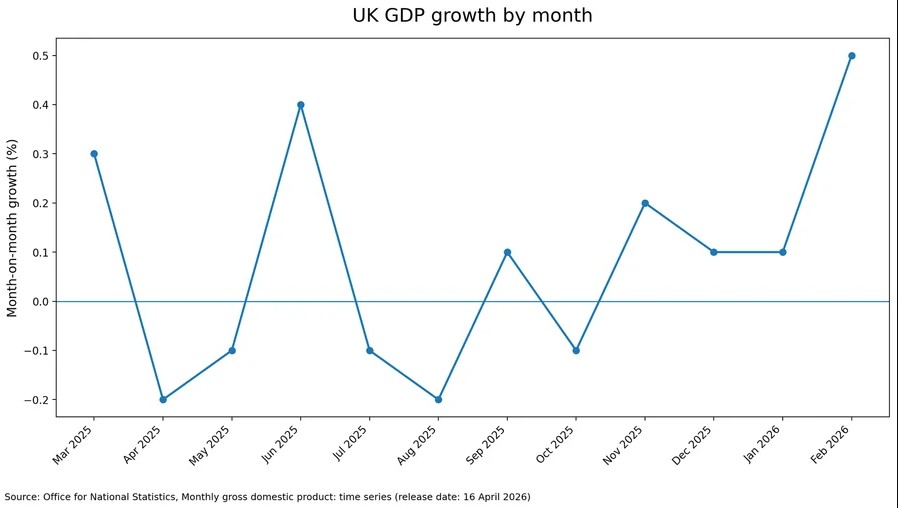
Official figures released on Thursday, 16 April 2026, show that UK Gross Domestic Product (GDP) grew by 0.5% in February, far exceeding the 0.1% expansion predicted by most economists. This follows a revised upward figure of 0.1% growth in January, suggesting that the UK entered the spring on much firmer footing than previously thought.
The growth was broad-based, fueled by:
- Services Output: Increased by 0.5%, with significant contributions from wholesale, retail trade, and the information and communication sectors.
- Production & Manufacturing: Rose by 0.5% overall, with manufacturing and energy supply showing resilience.
- Construction Rebound: After a period of decline, the sector saw a 1.0% increase in February alone.
Despite these figures, analysts at MHA have described the data as “the calm before the storm,” noting that the economic momentum gained in February has likely been extinguished by the geopolitical events of March and April.
Why is the IMF Slashing the UK Growth Forecast to 0.8%?
While the Chancellor welcomed the February data as proof that the government’s stability plan is working, the International Monetary Fund (IMF) delivered a sobering assessment during its spring meetings in Washington.
The body has slashed its 2026 UK growth forecast from 1.3% down to just 0.8%, making Britain the worst-performing economy in the G7.
The downgrade stems from the UK’s high dependency on imported energy and the likelihood that the Bank of England will delay interest rate cuts to combat war-induced inflation.
During these high-stakes meetings, the Chancellor slammed foreign policy decisions regarding the Middle East, arguing that global instability is the primary hurdle to sustained domestic prosperity.
How Will Middle East Supply Chain Chaos Affect UK Regions?
The escalating conflict involving Iran is creating localised economic pressure points across the United Kingdom, threatening to reverse the gains made in February:
- The South East & London Logistics: The disruption of maritime trade through the Red Sea and the Strait of Hormuz is hitting ports like Felixstowe and Southampton, causing delays in electronics and clothing shipments.
- The “Black Country” & Industrial Midlands: High-energy manufacturing hubs in Birmingham and Wolverhampton face rising industrial gas prices.
- Rural Communities: The National Farmers’ Union (NFU) warned that food prices are likely to rise as fertiliser costs—heavily dependent on natural gas—spike due to Middle East instability.
Will the 0.5% Growth Be Enough to Prevent Stagflation?
The term “stagflation”, a toxic mix of stagnant growth and high inflation, is once again haunting Whitehall. Suren Thiru, chief economist at the ICAEW, suggests that February’s success was a “false dawn” before the storm.
With inflation now forecast to climb back toward 4% due to energy pressures, the country faces a deepening stagflation crisis where surging costs trigger significant declines in both business investment and consumer spending.
Experts warn that the stronger-than-expected February performance does little to calm fears that the UK is entering a prolonged period of economic paralysis.
How Does the Iran Conflict Impact Your Household Budget?
The technical 0.5% growth in February offers little comfort to households currently facing a “triple threat” of economic pressures:
- Petrol and Diesel: Prices at UK forecourts rose significantly between late February and mid-April 2026 as crude oil prices surged.
- The Mortgage Squeeze: Kevin Brown, savings expert at Scottish Friendly, warned that rising borrowing costs are hitting households. Any hope of an early Spring interest rate cut has largely evaporated.
- Business Bills: The Treasury is attempting to mitigate the damage by cutting bills by up to 25% for 10,000 British businesses, but thousands of others remain exposed to volatile wholesale markets.
What Happens Next for the British Economy?
- Bank of England Strategy: The Monetary Policy Committee (MPC) is expected to maintain a “sustained pause” on interest rates rather than delivering the cuts the market had hoped for earlier this year.
- Defence Spending Pressures: With global tensions rising, the Government faces an uncomfortable trade-off: increase military spending to meet NATO obligations or protect households struggling with energy costs.
- Supply Chain Investigations: The Department for Business and Trade is expected to launch a review into UK supply chain resilience to ensure that future energy shocks do not completely derail GDP growth.