


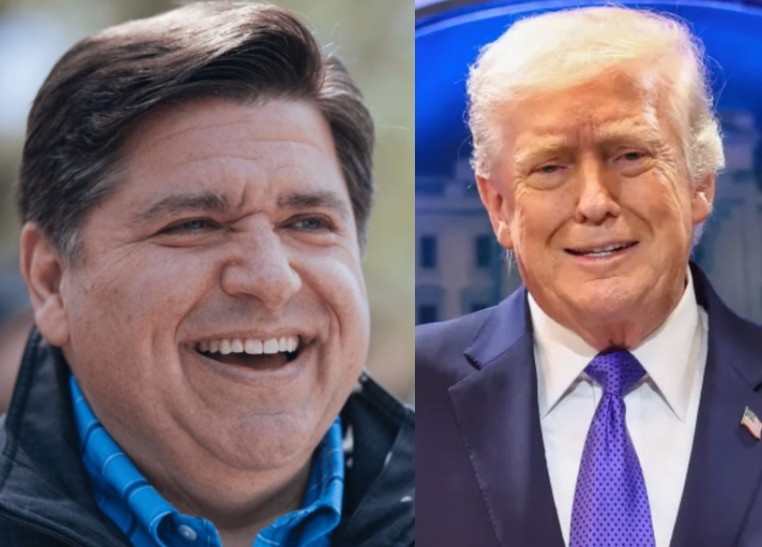
The Trump tariff ruling has ignited a fierce political clash in the United States after the US Supreme Court struck down key elements of Donald Trump’s global tariff policy.
Within hours of the decision, Illinois Governor JB Pritzker sent the former president an $8.6 billion (£6.8bn) “invoice”, claiming families in his state deserve refunds.
A senior Trump adviser then responded with a foul-mouthed personal attack, escalating tensions further.
The row matters beyond US borders. If Trump successfully reintroduces tariffs under a different legal route, UK exporters could face renewed trade uncertainty with America, Britain’s single largest trading partner.
What did the Supreme Court rule on Trump’s tariffs?
The US Supreme Court ruled 6–3 that Trump exceeded his authority when imposing sweeping global tariffs under emergency trade powers.
Trump had relied on Section 122 of the Trade Act of 1974, which allows a president to impose temporary tariffs for up to 150 days without congressional approval during economic crises.
The court found that the way the policy was structured went beyond those limits, effectively confirming the Supreme Court ruling that scrapped Trump’s US tariffs after constitutional concerns were raised.
Two justices appointed by Trump, Neil Gorsuch and Amy Coney Barrett, joined Chief Justice John Roberts and three liberal justices in the majority. Justice Brett Kavanaugh dissented alongside Samuel Alito and Clarence Thomas.
In response, Trump said: “The Supreme Court’s ruling on tariffs is deeply disappointing, and I’m ashamed of certain members of the Court.”
He later claimed the decision had clarified his authority and announced plans to reintroduce a 10% global tariff using alternative legal grounds.
The White House confirmed that a revised temporary import duty would take effect on 24 February at 12.01am EST.
Why did JB Pritzker send an $8.6bn invoice?
JB Pritzker framed his response as financial accountability. In a formal letter, he demanded that Trump refund Illinois families for higher costs linked to the tariffs.
Pritzker estimated that each household had effectively paid around $1,700 due to price increases on imported goods.
🚨 BREAKING: Illinois Governor JB Pritzker sends $8.6 billion invoice to President Trump, demanding refunds following a Supreme Court tariff ruling. 🇺🇸💰 pic.twitter.com/XZdRBeNTQ6
— Whale News (@WhaleNewsGlobal) February 20, 2026
With more than five million households in Illinois, he calculated the total at $8,679,261,600.
In the letter, he wrote: “Your tariff taxes wreaked havoc on farmers, enraged our allies, and sent grocery prices through the roof.”
He labelled the attached invoice “Past Due – Delinquent” and warned of “further action” if payment was not made.
The move was largely symbolic, but it signalled how Democratic governors may use the court’s ruling to challenge Trump’s economic record.
How did Trump’s adviser respond?
Trump adviser Alex Bruesewitz responded on social media after political reporter Natasha Korecki shared details of the invoice.
Bruesewitz used abusive language and launched a personal attack referencing Pritzker’s family connections to Hyatt Hotels. The remarks shifted the focus from constitutional law to personal politics, drawing criticism from commentators online.
The White House has not formally distanced itself from the comments.
What goods are exempt under the new tariff plan?
According to White House statements, the revised 10% tariff does not apply to:
- Energy products
- Natural resources
- Fertilisers
- Pharmaceuticals
- Certain electronics
- Some vehicles
- Aerospace products
- Food items such as beef and tomatoes
Canada and Mexico remain largely exempt under the United States–Mexico–Canada Agreement (USMCA), although steel, aluminium and non-compliant goods may still face duties.
Why does the Trump tariff ruling matter to the UK?
The United States remains the UK’s largest single-country export market. In 2023, Britain exported more than £60 billion worth of goods to the US, including aerospace components, cars, pharmaceuticals and machinery.
A blanket 10% US tariff could:
- Raise costs for British exporters
- Squeeze profit margins for UK manufacturers
- Increase prices for American consumers buying British goods
- Create exchange rate volatility affecting UK import prices
For example, UK aerospace firms supplying parts to US manufacturers often operate on long-term contracts. Sudden tariff shifts can disrupt pricing structures agreed months in advance.
Trade analysts say repeated legal battles over tariffs increase uncertainty. Markets dislike unpredictability, and currency movements can quickly feed into inflation pressures, something UK households already feel through higher food and energy bills.
What happens next?
Trump insists he will press ahead with tariffs using alternative legal authority. Section 122 allows temporary measures, but any long-term framework would require congressional approval.
Legal experts expect further court challenges if the administration attempts to expand the policy again.
Meanwhile, Democratic governors and political opponents appear ready to use the ruling as evidence that the original tariff strategy overstepped constitutional boundaries.