

The Iran-US war escalated dramatically on Saturday after Israeli forces bombed Tehran’s Mehrabad Airport while US officials warned that the largest bombing campaign of the conflict could begin within hours.
The strike came amid growing regional tension, with Iran launching a fresh wave of missiles and drones and civilians across the Gulf region rushing to shelters.
The developments involve Israel, Iran, and the United States, with events unfolding overnight in Tehran and across the wider Middle East.
The escalation matters globally because it threatens to widen the war across multiple countries, potentially affecting oil markets, international air travel, and geopolitical stability.
What happened at Tehran’s Mehrabad Airport?
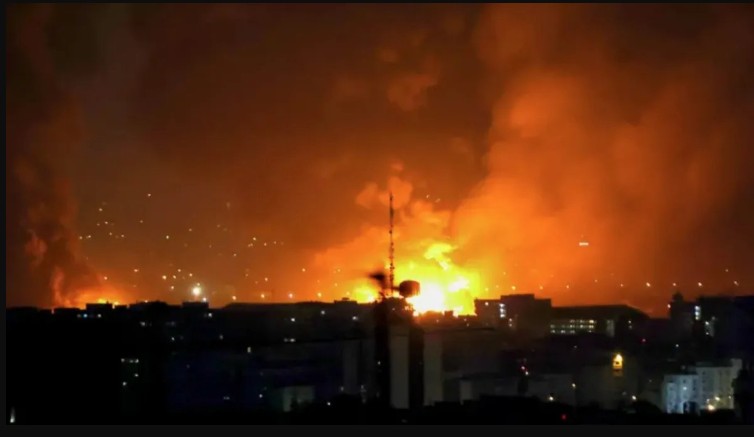
Israeli forces carried out air strikes early Saturday on Mehrabad Airport in Tehran, Iran’s main domestic aviation hub and a facility that also serves the country’s air force.
Videos circulating on social media showed a plane burning on the runway and thick smoke rising above the airport complex following the explosions. Satellite imagery taken hours earlier reportedly showed multiple aircraft positioned on the airfield.
Mehrabad plays a crucial role in Iran’s aviation network. While it handles most domestic flights, parts of the airport also support military logistics and operations, making it a strategic target in the ongoing conflict.
US and Israel have just targeted Mehrabad International Airport in Tehran setting one more plane on firehttps://t.co/JWRpjoQpAw
— Box of Chocolates (@BoxOfChocol8s) March 6, 2026
The strike formed part of a broader intensification of attacks by Israel and the United States against Iranian military infrastructure.
Why is the United States warning of a major bombing campaign?
US officials say the next phase of the military operation will focus on Iran’s missile systems and weapons production facilities.
US Treasury Secretary Scott Bessent warned that a large-scale bombing campaign was imminent and would target key elements of Iran’s missile capability.
“Tonight will be our biggest bombing campaign. We’ll do the most damage to the Iranian missile launchers, the factories that build the missiles, and we are substantially degrading them.”
Military planners believe destroying launch sites and manufacturing facilities could significantly reduce Iran’s ability to strike regional targets, including US bases and allied infrastructure.
The announcement signals that Washington is prepared to escalate the Iran-US war beyond previous levels of air strikes.
How has Iran responded to the latest attacks?
Iran responded within hours by launching a new wave of ballistic missiles and drones across the region.
Officials in Gulf countries reported several attempted strikes and interceptions overnight:
- Saudi Arabia said its air defence systems intercepted four drones targeting the Shaybah oil field.
- Regional defence forces reported additional missile interceptions in Gulf airspace.
- Explosions heard in several locations were linked to defensive systems destroying incoming threats.
The attempted attack on the Shaybah facility marks the second strike against the oil field within a matter of hours, raising fears that energy infrastructure may become a central battlefield in the conflict.
Such attacks carry global economic implications because the Gulf region remains one of the world’s most critical energy supply hubs.
Why were civilians sheltering at Dubai International Airport?
Passengers at Dubai International Airport, the world’s busiest airport for international travel, were directed to take shelter after authorities issued mobile alerts warning of potential missile threats.
Travellers were moved into underground train tunnels beneath the airport complex, which serve as protected areas during emergency situations.
Officials in the United Arab Emirates later confirmed that a minor incident occurred when debris from an intercepted missile fell near the city, though authorities reported no injuries.
Flight tracking data showed multiple aircraft placed in holding patterns before landing, causing delays for flights arriving in Dubai.
How many people have been killed in the Iran-US war so far?
Casualty figures continue to rise as the conflict spreads across several countries in the region.
According to official and regional estimates:
- More than 1,300 people have been killed in Iran since strikes began late last month.
- Over 200 deaths have been reported in Lebanon following Israeli operations.
- Around a dozen people have died in Israel during retaliatory attacks.
- At least six US troops have been killed during the conflict.
One of the deadliest incidents occurred after a strike on a girls’ school in Iran, which US military officials say American forces were likely responsible for. The attack reportedly killed around 150 people, including many pupils, triggering widespread international criticism.
Is the US considering sending ground troops to Iran?
Reports in American media suggest President Donald Trump has discussed the possibility of deploying a limited US ground force to Iran.
Officials familiar with the discussions say the proposed deployment would involve a small contingent of specialised troops, rather than a full-scale invasion. The White House has strongly denied that any final decision has been made.
White House Press Secretary Karoline Leavitt said, “This story is based on assumptions from anonymous sources who are not part of the President’s national security team.”
She added that the president keeps all military options open, but suggested media reports had overstated the likelihood of ground deployment.
Could other global powers become involved in the war?
US defence officials are also examining intelligence suggesting Russia may be assisting Iran with military information.
According to reports, Russian intelligence could help Iranian forces target American warships, aircraft, and military bases in the region.
US Defence Secretary Pete Hegseth said the situation is being closely monitored.“The American people can rest assured their commander in chief is well aware of who’s talking to whom.”
If confirmed, such cooperation could broaden the geopolitical scope of the conflict, raising concerns that the war may draw in additional global powers.