
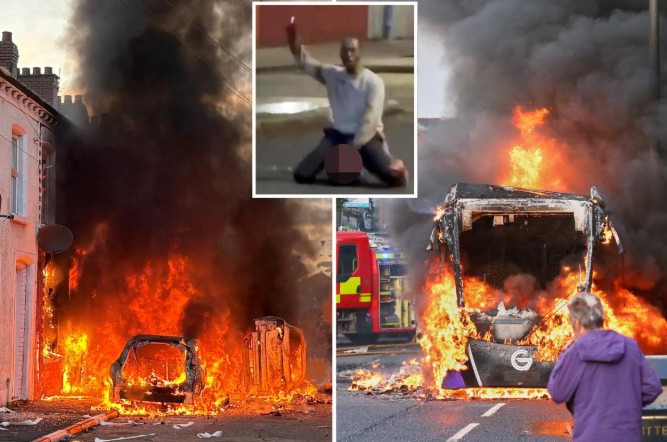
A brutal Belfast knife attack on Monday night has triggered severe civil unrest across Northern Ireland. A 30-year-old Sudanese national has been charged with attempted murder after a man was critically stabbed in North Belfast. Subsequent anti-immigration riots led to widespread arson, hijacked public transport, and attacks on homes.
What Happened on Kinnaird Avenue?
The Police Service of Northern Ireland (PSNI) declared a critical incident following a violent assault around 10:30 pm on Monday in the Kinnaird Avenue area of North Belfast. The victim, a local resident in his 40s unofficially identified by neighbours as Stephen Ogilvie, was repeatedly stabbed in the head and neck.
Sustained intervention by passing citizens, one of whom wielded a hurling stick, successfully fended off the assailant until emergency services arrived. The weapon, later identified by detectives as a kitchen knife, was recovered at the scene.
🚨WATCH: GRAPHIC FOOTAGE shows An African migrant attempting to BEHEAD somebody in North Belfast 🇮🇪
The attack was carried out with a Stanley blade and happened at around 10:30pm last night (Monday 8th June) on Kinnaird Avenue.
Every single one must leave, ALL OF THEM 🚫…
— BRITAIN IS BROKEN 🇬🇧 (@BROKENBRITAIN0) June 9, 2026
The suspect was arrested immediately. Under the Criminal Justice (Northern Ireland) Order 2008, the 30-year-old Sudanese national faces formal charges of:
- Attempted murder.
- Possession of an article with a blade or point in a public place.
- Making threats to kill.
Why Did Riots Break Out Across Belfast?
Graphic video footage of the stabbing circulated rapidly across social media platforms, acting as a direct trigger event for far-right mobilisations. Anti-immigration organisers used the digital footage to orchestrate rapid street demonstrations.
By Tuesday evening, the assembly deteriorated into localised rioting. Masked groups of men and teenagers blocked arterial transport routes and launched firebombs across East Belfast, North Belfast, and Newtownabbey.
Targeted Attacks and Looting
The violence transitioned from street blockades to targeted property damage. On the Shankill Road, rioters stormed local businesses, looting two mobile phone shops and setting fire to an African-owned retail outlet.
In East Belfast, a crowd of approximately 100 individuals marched down residential areas including Lendrick Street, smashing windows, breaking doors, and setting fire to domestic refuse bins that subsequently spread to homes occupied by ethnic minority families.
What Are the Regional Infrastructure and Financial Impacts?
The sudden breakdown of public order has caused acute administrative and financial friction for regional authorities and transport infrastructure.
| Affected Sector | Documented / Estimated Impact |
|
Frontline Policing Costs (Northern Ireland Policing Board) |
£1.5M – £2.0M per night (Emergency deployment & overtime) |
|
Public Transport Infrastructure (Translink Capital Deficit) |
£450,000 capital asset loss (Destroyed East Belfast Glider) |
|
Local Social Housing Pressure (NI Housing Executive Dispersal) |
14% emergency budget inflation (Displaced immigrant families) |
Strategic Transport Disruption
The hijacking and subsequent destruction of a multi-million-pound Translink Glider rapid transit bus on the Newtownards Road completely halted transit links between East Belfast and the city centre. The Department for Infrastructure faces immediate logistical backlogs because replacing these specialised low-emission commuter vehicles requires lengthy procurement processes.
Asylum Dispersal Demographics
During a briefing at Stormont, PSNI Chief Constable Jon Boutcher detailed the suspect’s travel itinerary into the UK. The individual travelled from Sudan to Paris, flew into Dublin, and subsequently entered Northern Ireland via a cross-border commercial bus route in February 2023.
The suspect was granted refugee status by the Home Office on September 28, 2023, with official leave to remain active until 2028. According to recent data from the Office for National Statistics (ONS), regional dispersal models have increased the demand for social housing packages, straining local executive budgets amid shifting community demographics.
How Have Political Leaders Responded?
Prime Minister Sir Keir Starmer: “The horrific attack in Belfast is sickening. I have absolutely no tolerance for abhorrent scenes of violence like this on our streets. My thoughts are first and foremost with the victim.”
🇬🇧 Riots erupt in Belfast after Sudanese man arrested over attempted beheading.
British Prime Minister Keir Starmer described the attack as “horrific” and “sickening,” appealing for calm. pic.twitter.com/saHTfKIMSC
— Eli Afriat 🇮🇱 (@EliAfriatISR) June 9, 2026
Northern Ireland First Minister Michelle O’Neill: “Groups of masked men burning families out of their homes is nothing less than disgusting cowardice. This has nothing to do with community; this is outright thuggery.”
Justice Minister Naomi Long: “Those intent on wreaking destruction are harming the very communities they claim they are trying to protect. While I recognise the community’s profound shock, hate cannot be allowed to win.”
What Happens Next?
The suspect is scheduled for a formal arraignment before the Belfast Magistrates’ Court. The legal proceedings will be managed under Northern Ireland’s specific judicial codes, in which the names of the accused are strictly withheld from official public court listings until their initial physical appearance before a magistrate.
Politically, the incident has renewed debate regarding the Immigration Act 2014 and the enforcement loopholes within the Common Travel Area (CTA) agreement between the UK and the Republic of Ireland. Lawmakers are demanding stricter security audits on cross-border bus and rail routes arriving from Dublin to prevent unregistered international travel within domestic borders.
The PSNI has maintained an elevated threat posture, deploying tactical support groups to secure flashpoint areas across North and East Belfast.