


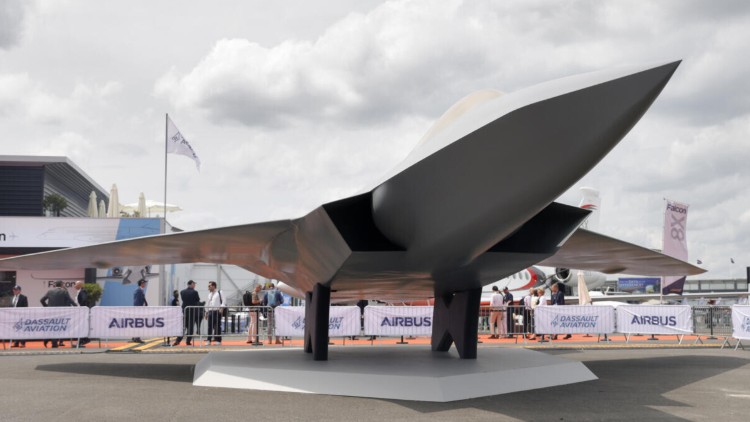
While the political fallout of this decision reverberates through the government offices of Paris, Berlin, and Madrid, the practical, industrial fallout is immediately shifting across the English Channel.
The collapse of the strategic france germany fighter jet partnership directly impacts high-tech manufacturing corridors, military airfields, and corporate boardrooms across the United Kingdom.
The termination of the core combat aircraft element of the Future Combat Air System (FCAS), plagued by years of industrial infighting between France’s Dassault Aviation and Germany’s Airbus, fundamentally alters the geopolitical and industrial landscape of European air power.
For the United Kingdom, this structural breakdown in mainland Europe is not merely a foreign policy update event. It is an industrial watershed. As Berlin and Paris acknowledge their irreconcilable differences, the spotlight shifts decisively to the UK’s competing next-generation aircraft programme: the Global Combat Air Programme (GCAP), commonly known as Tempest.
Spearheaded by BAE Systems in Lancashire alongside partners Italy and Japan, GCAP now stands as the most stable, advanced, and viable sixth-generation fighter programme on the continent, positioning the UK to potentially absorb displaced European defence spending and rewrite the rules of Western aerial dominance.
Why Did the Flagship Franco-German Alliance Implode?
The historic decision to axe the collaborative manned fighter aircraft came directly from the highest political levels in Berlin and Paris. Following intense deliberations held on the sidelines of the EU-Western Balkans summit in Montenegro, German Chancellor Friedrich Merz advised French President Emmanuel Macron that continuing the joint fighter jet build was no longer viable.
The industrial partners, quite simply, reached a state of terminal gridlock.
Launched with immense fanfare in 2017 by President Macron and former German Chancellor Angela Merkel, the FCAS programme was designed to engineer a replacement for France’s Rafale and the multi-nation Eurofighter Typhoon by 2040.
It was intended to be the ultimate statement of European strategic autonomy, a united military-industrial front capable of deterring a hostile Russia while reducing reliance on the United States defence apparatus, particularly amid ongoing European anxieties regarding Washington’s long-term NATO commitments.
🇩🇪 Germany’s Defense Minister Pistorius: ‘FCAS collapse hurts me deeply.’ The Franco-German next-gen fighter project is on the verge of collapse, dealing a severe blow to EU defense cooperation and military autonomy ambitions. pic.twitter.com/SjQwTfznNk
— Dino breaking news (@DinoLeadingNews) June 9, 2026
However, the programme was structurally flawed from its inception, crippled by deep-seated corporate friction and divergent military doctrines:
- The Control Dispute: Dassault Aviation, the primary contractor for the French state, consistently fiercely guarded its intellectual property and demanded sole operational leadership. Its Chief Executive regularly insisted that the company would rather go it alone than submit to a co-managed compromise. Conversely, Airbus, representing German and Spanish industrial interests, pushed for an equal partnership, demanding comprehensive technology transfers that Paris viewed as a threat to its domestic sovereign capabilities.
- Divergent Strategic Needs: The French Air Force and Navy required a highly specific aircraft: a single platform capable of carrying nuclear payloads and surviving the high-stress catapult launches and arrests of carrier-deck operations. Germany had no carrier requirements and no desire to fund the heavy structural engineering necessary for naval deployment. Instead, Berlin required a long-range, high-endurance conventional bomber.
- The System of Systems Survival: While the central crewed fighter jet platform has been permanently shelved, officials from both the Élysée and the German Federal Chancellery confirmed that other ancillary elements of FCAS will theoretically continue. Both nations intend to cooperate on the wider combat cloud software network and autonomous wingman drones. However, without a shared central aircraft, experts view this as a diplomatic face-saving exercise to prevent a total collapse of bilateral defence ties.
How Does the European Air Power Shakeup Impact the UK Aerospace Industry?
While the political fallout of this decision reverberates through the government offices of Paris, Berlin, and Madrid, the practical, industrial fallout is immediately shifting across the English Channel.
The collapse of the France-Germany fighter jet partnership directly impacts high-tech manufacturing corridors, military airfields, and corporate boardrooms across the United Kingdom.
The absolute epicentre of the UK’s response is the North West of England aerospace cluster. BAE Systems’ advanced manufacturing and assembly facilities at Warton and Samlesbury in Lancashire are the engine rooms of the British GCAP Tempest effort.
The termination of the mainland European project injects immense commercial momentum into these sites.
Engineering teams in Lancashire, who are already developing digital twins and advanced aerodynamics for the UK-led fighter, now find themselves leading Europe’s sole active sixth-generation development pipeline.
Furthermore, the military realities of this collapse will be felt at major Royal Air Force hubs. RAF Coningsby in Lincolnshire, home to the UK’s frontline Eurofighter Typhoon squadrons, and RAF Marham in Norfolk, which hosts the fifth-generation F-35 Lightning II fleet, will monitor how the collapse alters international operational standards.
With Germany and France now facing a massive development delay as they scramble to design separate, sovereign aircraft, the RAF’s future operational timelines look significantly more secure than those of their continental neighbours.
What Do British Defence Experts and European Leaders Say About the Split?
The reaction across European defence circles has been a mix of sobering realism and strategic recalculation. While Paris and Berlin express formal regret, independent defence analysts and European parliamentarians are already looking toward London.
A German government official, speaking on condition of anonymity to detail the discussions between Chancellor Merz and President Macron, stated: “We have reached the shared assessment that our industrial partners will not be able to come together on building a joint combat aircraft. We must acknowledge this reality.
Our defence ministries will now pivot to draw up a plan focused strictly on a few realistic and relevant alternative projects.”
From Brussels, Marie-Agnes Strack-Zimmermann, the influential German chair of the Security and Defence (SEDE) committee in the European Parliament, was far more direct.
Writing publicly on social media, she openly blamed the protectionist stance of France’s aerospace sector for the failure, while explicitly pointing to the UK-led alternative as the future anchor of continental security: “The announcement does not come as a surprise. Dassault’s insistence on unilateral control blocked progress.
The good news is that our research money is not lost, but we must now look at viable alternatives. The global partnership involving the United Kingdom, Sweden, and Italy offers a proven, structured alternative. We must finally put an end to national fragmentation.”
Downing Street and Whitehall sources indicate that the Ministry of Defence (MoD) and the Foreign, Commonwealth & Development Office (FCDO) are viewing the development with cautious optimism. While the UK government maintains a formal stance of supporting overall European security cohesion, defence procurement officials recognize that the FCAS collapse presents a historic market opportunity.
Senior analysts at the Royal United Services Institute (RUSI) in London note that the UK is now in an incredibly strong position to offer export options or industrial data-sharing agreements to European nations that find themselves entirely left behind by the Franco-German split.
How Will the End of the Franco-German Jet Affect British Workers and Taxpayers?
The end of the France Germany Fighter Jet Partnership will have tangible flow-on effects for the British public, particularly regarding regional economic prosperity and long-term national security funding.
High-Value Engineering Jobs and Regional Growth
The UK aerospace sector is heavily reliant on long-term, multi-decade military contracts. The GCAP Tempest programme already supports over 3,500 highly skilled jobs across the UK, with a heavy concentration in the North West, Scotland, and the Midlands.
The collapse of Europe’s competing project increases the likelihood of international export wins for the BAE Systems-led consortium.
For communities in Lancashire and surrounding regions, this translates into decades of employment stability, expanded engineering apprenticeship intakes, and sustained private-sector investment in local supply chains.
Protection of the UK Taxpayer
Defence procurement is notoriously expensive, often plagued by budget overruns. By successfully building a stable international coalition with Italy and Japan, the UK has effectively spread the multi-billion-pound financial burden of developing next-generation radar, stealth, and engine technologies.
Because the UK avoided the industrial infighting that doomed the €100bn FCAS project, British taxpayers are insulated from the severe financial waste currently being endured by French and German citizens, whose governments spent nearly a decade funding preliminary research on a joint jet that will now never take off.
Sovereign Security and Air Dominance
At a macro level, the collapse of European military cohesion comes at a highly unstable geopolitical moment, with Russia’s war in Ukraine in its fifth year and shifting political priorities in Washington. British citizens rely on the RAF to maintain absolute air sovereignty over UK airspace and maritime approaches.
The stability of the UK’s GCAP development ensures that Britain will not suffer a capability gap in the 2030s and 2040s, maintaining a credible, cutting-edge deterrent against evolving global threats.
What Next for the Global Balance of Sixth-Generation Air Power?
The cancellation of the joint fighter jet triggers an immediate, aggressive race for industrial survival across Europe. Over the coming months, a series of critical strategic realignments are expected to take place.
1. The Battle for the Displaced Partners: Spain and Sweden
Spain, which was initially integrated into the trilateral FCAS structure alongside Germany and France, is now in a precarious position. Madrid has explicitly ruled out purchasing the American F-35 for its primary fleet, preferring to invest in European technology.
With the FCAS jet dead, Spain may look to pivot its industrial weight toward the UK-led GCAP.
Similarly, Sweden, a nation with an exceptionally rich history of independent fighter development via Saab, will have to evaluate which bloc offers the most reliable long-term security architecture.
2. Germany’s Pivot to Off-the-Shelf US Technology
With its future domestic fighter delayed by at least a decade due to this hard reset, Germany will almost certainly have to expand its reliance on off-the-shelf American technology.
Berlin has already procured an initial batch of Lockheed Martin F-35 Lightning II stealth fighters to fulfill its NATO nuclear-sharing obligations.
Chancellor Merz’s government will likely face intense domestic pressure to place additional orders for American hardware to prevent a dangerous drop in Luftwaffe operational capabilities as its older Eurofighters age out of service.
3. France Embraces Total Industrial Isolation
True to its historical military doctrine of absolute self-reliance, France is expected to push Dassault Aviation into creating a completely sovereign, independent sixth-generation successor to the Rafale.
However, the sheer financial reality of developing modern stealth technology, advanced AI-driven sensory suites, and next-generation engines completely alone is staggering.
The French parliament will be forced to approve massive increases in domestic defence spending, a move that could trigger significant political friction within the National Assembly.
Why Did GCAP Succeed Where FCAS Disintegrated?
The divergent fates of Europe’s two premier next-generation combat projects offer a stark masterclass in international corporate governance.
While both projects set out with nearly identical mission briefs, to field an operational sixth-generation fighter by roughly 2035–2040, the framework under which they operated was night and day.
| Operational Aspect | GCAP (UK, Italy, Japan) | FCAS (France, Germany, Spain) |
| Industrial Leadership | Clear, pre-negotiated division of work share with BAE Systems, Leonardo, and Mitsubishi Heavy Industries. | Paralyzing corporate gridlock; Dassault demanded unilateral authority while Airbus pushed for a 50/50 split. |
| Requirement Harmony | All three partners aligned on a long-range, twin-engine stealth platform focused on the Indo-Pacific and European threat vectors. | Core operational clash; France required carrier-capable nuclear delivery, while Germany flatly rejected both. |
| Political Continuity | Insulated from domestic political swings via formal treaty frameworks signed at the ministerial level. | Highly volatile; subjected to constant public spats between Berlin and Paris chancelleries. |
The fundamental triumph of the UK’s GCAP strategy was its early implementation of an equal but non-overlapping technology split.
Rather than arguing over who gets to press the buttons on the assembly line, the partners divided the jet by subsystem domains: Rolls-Royce and Japan’s IHI Corporation co-develop the cutting-edge power plants, Italy’s Leonardo handles advanced electronics alongside the UK’s domestic facilities, and BAE Systems oversees overall airframe integration.
FCAS attempted to force two fiercely nationalistic aviation champions to share a single drawing board, a decision that defence insiders now universally view as an engineering impossibility from day one.