


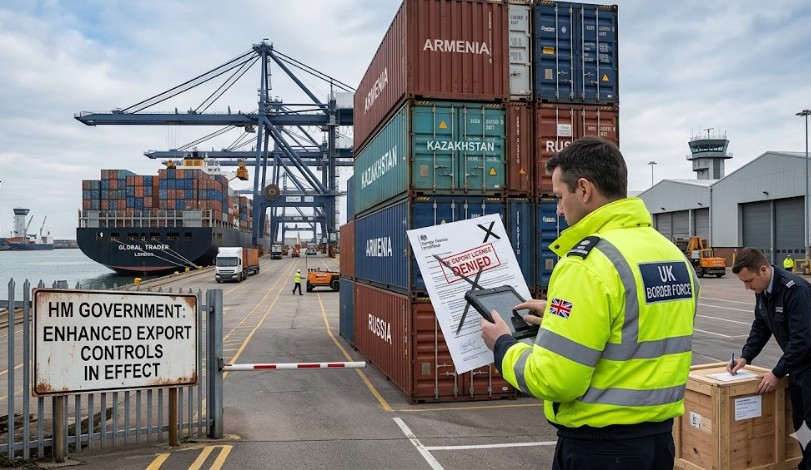
British manufacturers are entering a new era of regulatory scrutiny as the UK government moves to close “diversion” loopholes that have allowed high-tech goods to reach Russia via third-party nations.
Following a series of high-profile investigations into British engineering exports, a major policy overhaul is set to transform how a UK export licence is granted and enforced.
The crackdown, led by the Department for Business and Trade (DBT), targets the flow of “dual-use” technology, goods that have both civilian and military applications, to countries suspected of acting as staging posts for Vladimir Putin’s war machine.
Why is the UK Government Overhauling Export Controls Now?
The shift in policy follows a damning investigation into Cygnet Texkimp, a Cheshire-based firm. The company was reportedly in the final stages of exporting £4 million worth of carbon fibre machinery to Rydena LLC, a newly formed firm in Armenia.
Investigations by The Guardian revealed that Rydena was established by former senior executives of Umatex, a subsidiary of the sanctioned Russian state nuclear giant Rosatom. Umatex is a primary supplier for Russian military hardware, including drones and missiles.
Under the previous framework, the UK government could flag concerns but lacked the legal authority to block exports if the destination country, such as Armenia, was not under an active embargo.
The new statutory instrument, laid in Parliament this Wednesday, April 22, 2026, provides ministers with the power to demand a UK export licence for any shipment suspected of being diverted to Russia, regardless of its immediate destination.
Which UK Locations and Industries are Most Affected?
The impact of these “much tougher” controls is concentrated in Britain’s industrial heartlands and its logistical gateways:
- North West England (Cheshire): As the base for Cygnet Texkimp and several high-end composite material manufacturers, Northwich and the surrounding areas are at the center of the new compliance storm.
- The Midlands: Often referred to as the UK’s “Engine Room,” firms producing sensors, microchips, and aerospace components will face increased scrutiny from the Export Control Joint Unit (ECJU).
- UK Port Hubs: Felixstowe, Southampton, and Dover will see intensified Border Force activity. This heightened security follows recent incidents across British waters, such as the DFDS Caesarea Trader fire, which highlighted the critical importance of maritime safety and oversight in our busy shipping lanes.
- The “Golden Triangle” (London, Oxford, Cambridge): Tech startups and laboratories developing “dual-use” software must now navigate a more complex licensing landscape.
What are the New Powers of the Office for Trade Sanctions Implementation (OTSI)?
The government is centralizing its enforcement through the Office for Trade Sanctions Implementation (OTSI). From April 27, 2026, OTSI will take over the primary responsibility for licensing the export of sanctioned goods.
Key changes include:
- Mandatory Licensing for “Staging Posts”: If a destination (e.g., Kyrgyzstan, Kazakhstan, or Armenia) is identified as a risk for diversion, a UK export licence becomes mandatory even for previously unrestricted items.
- Civil Penalties: OTSI now has the authority to issue significant monetary fines for “unwitting” breaches if a firm failed to perform “enhanced due diligence.”
- Real-Time Data Sharing: OTSI’s systems are now integrated with HMRC and Border Force, ensuring that when a licence is flagged for review, the physical goods are automatically stopped at the border.
How Do Strategic Exports Relate to Britain’s Resource Security?
The regulation of high-tech exports is part of a broader strategy to protect the UK’s economic and energy sovereignty. For decades, the UK has balanced trade with the protection of vital assets, a history detailed in the 1984 UK North Sea oil atlas, which traces the origins of Britain’s modern energy independence.
Just as the government secured North Sea resources in the 20th century, it is now moving to secure the UK’s technological “empire” by ensuring advanced engineering does not benefit hostile states.
Government and Parliamentary Response
Sir Chris Bryant, Business Minister, told the Business and Trade Committee: “We are motivated by concern that our sanctions regime is being undermined by diversion.
We’re trying to be ahead of the curve because Putin has been successful at getting what he needs to prosper financially. If firms are making money out of the war in Ukraine, that is on them.”
Liam Byrne MP, Chair of the Business and Trade Committee, has been a driving force behind the changes. He stated that the case in Cheshire showed “red flags” that the previous system was unable to address.
Byrne argued that the transfer of “technical know-how,” including manuals translated into Russian for Armenian firms, is a critical vulnerability that the new laws must plug.
How Does This Impact UK Businesses and the Public?
For the average UK resident, these measures are intended to stabilize long-term security and economic interests by shortening the conflict in Ukraine. However, the immediate impact on the UK economy is more direct:
- Increased Compliance Costs: Manufacturers must now hire specialized “Sanctions Compliance Officers” to vet every international client.
- Slower Trade Routes: The “at-pace” review promised by the government still adds weeks to delivery schedules for high-tech exports.
- Legal Risks: Company directors now face personal liability and potential prison sentences for attempting to bypass licensing controls, as seen in recent successful HMRC prosecutions.
What Happens Next?
As the statutory instrument takes effect, several key developments are expected:
- Late April 2026: OTSI will publish updated “Red Flag” guidance for exporters, detailing specific corporate structures (like the use of Cypriot holding companies) that will trigger an automatic licence refusal.
- Strategic Export Review: The Export Control Joint Unit (ECJU) will begin a “look-back” exercise to review all licences granted to the Caucasus region over the last 12 months.
- Enhanced Monitoring: The UK will deploy “Sanctions Envoys” to third countries to pressure local governments to stop acting as conduits for Russian procurement.