


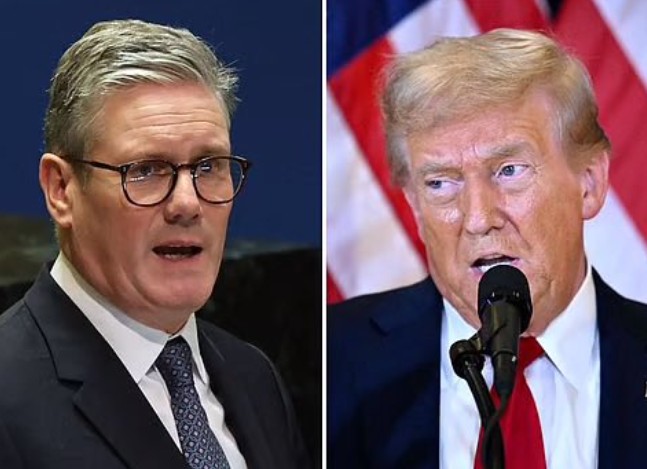
The Starmer vs Trump disagreement has become the most serious rift yet between the UK Prime Minister and President Donald Trump, after Sir Keir Starmer openly criticised US and Israeli strikes on Iran.
Speaking in the House of Commons on Wednesday, Sir Keir said the UK government “does not believe in regime change from the skies”, distancing Britain from Washington’s approach while still allowing US forces to use UK airbases for defensive purposes.
The row matters because it touches on three core issues for Britain: the legality of military action, the UK’s relationship with its closest ally, and the potential economic fallout from rising tensions in the Middle East.
Why did Starmer publicly disagree with Trump?
For nearly two days, senior ministers struggled to clearly explain the government’s position on the US and Israeli attacks targeting Iranian missile infrastructure.
The Defence Secretary and Foreign Secretary both faced questions over whether Britain supported the strikes outright.
Sir Keir ended that uncertainty during a lengthy Commons session, where he set out a more defined position. He told MPs: “We do not believe in regime change from the skies.”
🚨 SHOCKER: UK breaks ranks with Trump and #Netanyahu over Iran.
Keir Starmer refuses to join US-Israel strikes. British bases only for defense.
Not every ally signs up for war. Finally, a leader showing spine.#IranIsraelWar
pic.twitter.com/oXFov3IapZ— Adv. Vijay Singh (@VijaySingh_law) March 2, 2026
That sentence marked a clear political line between London and Washington. While the Prime Minister stopped short of directly condemning President Trump, he made it plain that the UK does not support military action aimed at forcing political change through air strikes alone.
At the same time, he confirmed that Britain authorised the US to use RAF Akrotiri in Cyprus to strike Iranian missile launch sites threatening British allies in the Gulf. He argued that protecting allies from imminent attack is lawful and defensible.
This distinction, rejecting regime change while supporting defensive protection, sits at the heart of the disagreement.
Is the dispute really about international law?
Much of the Commons debate focused on legality. Sir Keir, a former Director of Public Prosecutions, made clear that his judgment rests heavily on international law.
He implied that wider offensive action without clear legal grounds risks breaching established norms.
The legal argument centres on whether the strikes qualify as self-defence under international law and whether there was an immediate threat that justified action without broader international backing.
Conservative shadow attorney general Lord Wolfson has argued that UK involvement could fall within the doctrine of collective self-defence. However, the Prime Minister signalled he does not accept that broader interpretation in this case.
The Iraq War loomed heavily over the debate. Although Sir Keir was not an MP at the time, he acknowledged that the conflict continues to shape public trust in government decisions on military action.
Many MPs warned against repeating what they see as past mistakes made without transparent legal justification.
How divided is British politics over the US action?
The disagreement has exposed sharp political lines in Westminster.
Conservatives and Reform UK argue that Britain should offer clearer and stronger support to the United States and Israel. They say standing firmly with allies strengthens deterrence and global stability.
Meanwhile, the Liberal Democrats, the Green Party and the Scottish National Party have taken a more critical stance towards President Trump’s approach. Some have questioned whether the UK should have allowed US forces to operate from British territory at all.
Within Labour, most MPs appear broadly comfortable with the Prime Minister’s careful balance. He faces criticism from both sides, yet his emphasis on legality has so far kept his party largely united.
What does public opinion suggest?
Polling by YouGov indicates that more people in Britain oppose the US strikes than support them. A similar pattern appears in attitudes towards allowing US forces to use UK airbases.
Public caution is not surprising. The wars in Iraq and Afghanistan remain within living memory for many voters. Military intervention without a clear defensive necessity often triggers scepticism rather than enthusiasm.
Could this disagreement affect the UK economy?
The diplomatic tension comes at a sensitive moment. Chancellor Rachel Reeves is delivering her Spring Statement, which her team insists is not a major fiscal event.
No new tax rises or spending cuts are expected. Instead, the focus remains on economic stability, reducing borrowing and easing the cost-of-living burden.
However, international shocks can quickly ripple through the UK economy. Middle East instability often affects oil prices, which in turn influence fuel costs, inflation and household bills. Markets are also watching for any wider escalation that could impact trade or defence spending.
While some recent economic indicators have shown modest improvement, renewed global uncertainty complicates the government’s growth narrative.
What happens next in the Starmer vs Trump disagreement?
The Prime Minister’s remarks mark a significant moment in UK–US relations. Britain remains closely aligned with Washington on security matters, but Sir Keir has signalled that legal principle will guide decisions even when that creates friction with the White House.
Much now depends on how events unfold in the region. If tensions escalate, pressure on the UK government will intensify. Parliament may also demand greater transparency over the legal advice underpinning military cooperation.
For now, Sir Keir appears determined to walk a narrow path: defend allies where necessary, avoid endorsing regime change, and anchor decisions firmly in international law.