


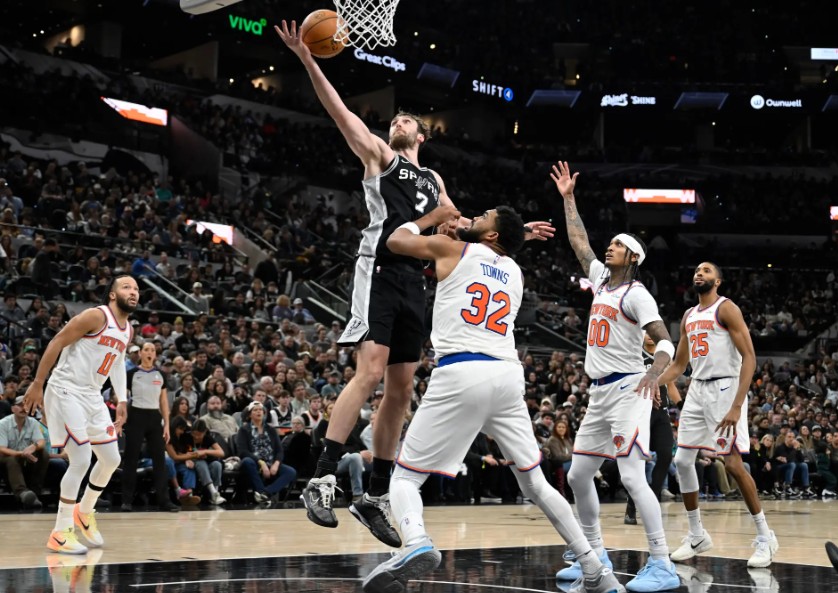
The Knicks vs Spurs clash on Wednesday night offered late drama and big scoring, but it also revealed a worrying truth for New York.
In a 134–132 loss in San Antonio, the Knicks were undone not by shooting or tactics, but by the sudden disappearance of one of their biggest strengths: rebounding.
Missing Mitchell Robinson through load management and Josh Hart with an ankle injury, the Knicks struggled to control the glass, allowing the Spurs to stay alive on possessions that should have ended defensively.
After this setback, New York showed they could recover quickly in games like their late surge to win the NBA Cup, proving the team can bounce back when fully firing.
How did rebounding decide the Knicks vs Spurs game?
The numbers tell a clear story. San Antonio consistently outworked New York around the basket, extending plays and punishing slow reactions.
Those extra efforts translated directly into points, swinging momentum in a game decided by just two.
Key rebounding and second-chance stats
| Category | Spurs | Knicks |
|---|---|---|
| Offensive rebounds | 11 | Fewer |
| Second-chance points | 23 | 7 |
| Total points scored | 134 | 132 |
Those 16 extra second-chance points proved decisive. Time and again, the Spurs recovered missed shots while Knicks defenders stood flat-footed, unable to recover after the initial contest.
Why is this performance so out of character for New York?
For most of the season, the Knicks have been among the NBA’s most physical and disciplined rebounding teams.
Across the 2024–25 season to date, New York averages 17.3 offensive rebounds per game, the fourth-highest figure in the league.
Defensively, they concede just 14.8 second-chance points per game, ranking inside the top ten.
Knicks defense was soft vs Spurs (min. 9 defensive possessions)
FGs/3s Made/Attempts vs Players:
Mikal Bridges — 9/16 FG | 1 3PT
(Fox went 6/8 when guarded by Mikal)
Deuce McBride — 6/12 FG | 0 3PT
Jalen Brunson — 6/12 FG | 4 3PT
KAT — 5/9 FG | 1 3PT… pic.twitter.com/xl4ZcE2QEn— State (@SNYKPodHarlem) January 1, 2026
Yet over the last two games, defeats against the Hawks and Spurs, those standards collapsed. Without Robinson and Hart, the Knicks conceded 41 second-chance points, tied for the second-most allowed by any team over a two-game span this season.
In the same period, they generated only 20 second-chance points themselves.
The contrast highlights how dependent New York is on their core rebounders to maintain intensity.
What did the Knicks say after the Spurs’ loss?
The post-game mood was one of frustration rather than confusion.
Guard Miles McBride openly admitted the issue was effort-based: “They killed us on the offensive glass. That’s an effort thing, and we gotta fix that.”
From the coaching staff, the message echoed the same theme. There was concern not just about giving up offensive rebounds, but about what followed: a lack of urgency, missed rotations, and slow reactions that allowed San Antonio to reset their offense with ease.
Why are Robinson and Hart so crucial to the Knicks’ identity?
Mitchell Robinson and Josh Hart are central to how the Knicks impose themselves physically.
Robinson anchors the paint, protects the rim, and creates extra possessions with tip-ins and contested rebounds.
Hart, despite not being a traditional big man, consistently outworks opponents, often leading guards and forwards in rebounding through sheer effort.
When Robinson sits, something expected to continue periodically due to load management, Hart’s presence becomes even more important. Without both players, the Knicks lose the edge that usually defines them.
When will the Knicks get their rebounders back?
There is some encouragement for New York fans.
Robinson is expected to return for one game of the upcoming Madison Square Garden back-to-back on Friday and Saturday, though his minutes will remain carefully managed.
Hart is also expected back soon, with his ankle issue not considered long-term.
However, Robinson’s workload will be monitored throughout the season, meaning the Knicks must adapt and find rebounding contributions elsewhere when either player is unavailable.
Why does this matter for the rest of the season?
This loss was more than a narrow defeat on the road. It exposed how quickly the Knicks’ foundation can crack when their core strengths are missing.
New York knick’s success has been built on effort, physicality, and winning the small battles. When those disappear, even against teams lower down the standings, close games can easily slip away.
With tougher opposition ahead, the Knicks’ ability to protect the glass without relying solely on Robinson and Hart could define their season.