


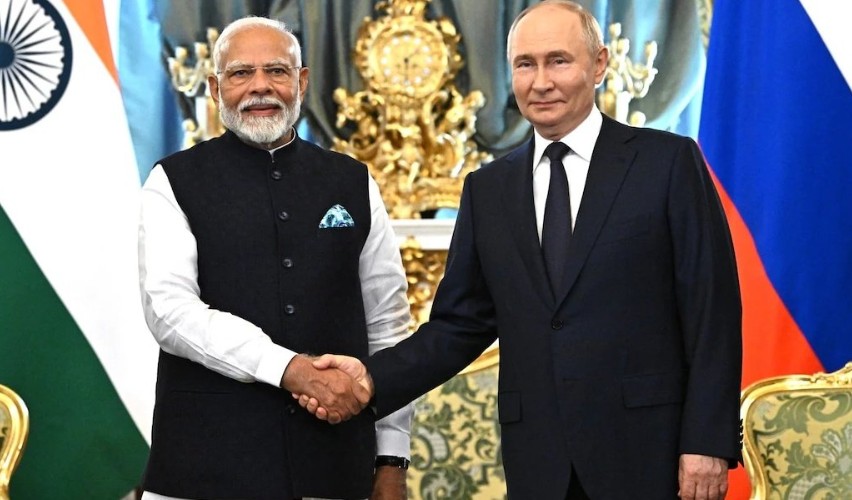
Russian President Vladimir Putin arrives in New Delhi on Thursday for a two-day diplomatic visit, since this was his first visit to India after the outbreak of the Russia–Ukraine war.
Prime Minister Narendra Modi hosted a private dinner for the Russian leader shortly after his appearance, ahead of the 23rd India–Russia Annual Summit, signalling the significance of strengthening bilateral ties between the two nations.
Strengthening India–Russia Strategic Partnership
The visit is set to consolidate strategic cooperation between India and Russia, with crucial addresses covering defence, trade, and energy collaboration.
Kremlin officers have stressed plans to bandy “promising projects” across sectors such as artificial development, advanced technologies, transportation, peaceful space programmes, mining, healthcare, and labour migration.
President Putin is also scheduled to meet President Droupadi Murmu, buttressing high-level political engagement.
Yury Ushakov, an assistant to Putin, stressed that political dialogue between New Delhi and Moscow remains “regular and confidential,” emphasizing the ongoing strategic applicability of the cooperation.
Defence and Business Talks Take Centre Stage
One of the crucial highlights of the visit is the implicit discussion on supplying Su-57 fifth-generation fighter jets to the Indian Air Force, as part of India’s long-term defence modernization plan.
Kremlin spokesman Dmitry Peskov verified that military collaboration could form a major docket point.
On the business side, Putin will attend the Russia–India Business Forum, which aims to boost marketable engagement and expand trade relations.
The visit will also see the launch of the RT television network in India, a move reflecting growing media and artistic cooperation between the two countries.
Energy, Oil Trade, and Economic Priorities
Energy cooperation is anticipated to be another focal point, with conversations around Russian crude oil painting exports to India.
According to reports, India is balancing its need for affordable oil painting with the challenge of US tariffs and warrants, especially after Washington assessed 50 percent duties on named Indian products.
Both nations are keen to increase bilateral trade from$ 68 billion to$ 100 billion by 2030, exploring the use of original currency agreements to cover trade overflows from global profitable pressures.
Agreements on the Horizon
Several agreements are anticipated during the summit, including:
- A framework for the movement of Indian workers to Russia
- Cooperation on small modular nuclear reactors
- Measures to strengthen defence collaboration
- Discussions on India’s proposed Free Trade Agreement (FTA) with the Eurasian Economic Union (EAEU)
Vladimir Putin’s visit highlights the strategic depth of India–Russia relations, showcasing a robust cooperation in defence, trade, energy, and technology at a time of shifting global geopolitics.