


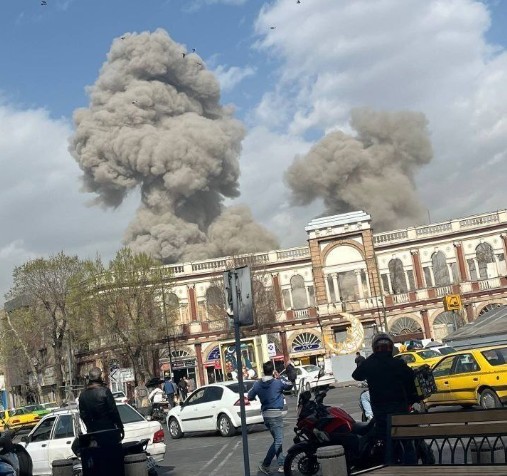
The US, Israel attack on Iran began early Saturday morning after Tehran refused to dismantle its nuclear programme following weeks of stalled negotiations.
According to reports from American officials, US and Israeli forces launched coordinated airstrikes targeting Iranian nuclear facilities.
The escalation comes after President Donald Trump warned Iran it would face “really bad things” if it failed to agree to new nuclear restrictions.
The strikes mark a major turning point in Middle East tensions and could have global economic consequences, including for the UK.
What happened during the US, Israel attack on Iran?
Reports suggest US forces began striking key Iranian nuclear facilities, including Fordow and Natanz, in the early hours of Saturday.
The US Air Force deployed B-2 Spirit stealth bombers armed with so-called “bunker buster” bombs designed to penetrate underground sites.
The US Navy reportedly launched Tomahawk cruise missiles from ships positioned in the region. Two aircraft carriers, the USS Gerald R. Ford and USS Abraham Lincoln, had already been deployed to the Middle East in recent days as part of a wider military build-up.
According to a US official quoted, American strikes were “underway” as tensions peaked.
Breaking: Israel has launched an attack on Iran. 💥
Is this the beginning of a protracted war?
Will Iran retaliate?
Will the US join in? pic.twitter.com/FvOKB3tEQn
— S.L. Kanthan (@Kanthan2030) February 28, 2026
Reuters reported that Iran’s Supreme Leader, Ali Khamenei, had been moved from Tehran to a secure location before the attacks began.
The full scale of the damage remains unclear.
Why did the US and Israel launch strikes now?
The military action follows weeks of indirect nuclear talks held in Geneva. President Donald Trump had reportedly given Tehran a 10 to 15-day deadline on 19 February to agree to new nuclear terms.
Trump has repeatedly stated he would not accept any deal allowing Iran to continue enriching uranium, arguing that enrichment capability could be used to develop nuclear weapons.
Tehran insists its programme is for civilian energy purposes only.
US intelligence officials have long warned that advanced uranium enrichment shortens the time needed to build a nuclear weapon.
According to the International Atomic Energy Agency (IAEA), Iran has previously enriched uranium to levels significantly higher than required for civilian reactors.
The US assault marks the first American-led strike on Iran since “Operation Midnight Hammer” last June, which also targeted major nuclear infrastructure.
How strong was the US military build-up before the attack?
In the weeks leading up to the US, Israel attack on Iran, Washington significantly increased its military presence across the Middle East:
- Two carrier strike groups
- More than 50 additional fighter jets
- At least 12 Navy destroyers
- Three littoral combat ships
Aircraft deployed reportedly included F-16 Falcons, F-22 Raptors and F-35 stealth jets. Defence analysts say stealth aircraft allow deep penetration into heavily defended airspace without early detection.
Iran had warned it would retaliate against US bases in the region if attacked. Last year, Tehran launched missiles at Al Udeid Air Base in Qatar following previous US strikes. No American casualties were reported at that time.
What could this mean for the UK?
The UK has strong diplomatic and security ties with both the US and Israel. Britain also maintains naval assets in the Gulf and has thousands of UK nationals living and working across the Middle East.
There are several potential impacts for the UK:
1. Energy prices
The Middle East supplies a significant share of global oil exports. Any disruption to shipping routes, especially through the Strait of Hormuz, could drive up crude oil prices. Higher oil prices typically lead to rising petrol and energy bills in the UK.
2. Security concerns
The UK Government may increase threat monitoring at home if tensions escalate. British military bases in Cyprus and elsewhere in the region could also face heightened alert levels.
3. Diplomatic pressure
London could face pressure to mediate or publicly support US actions. The Foreign Office is expected to issue updated travel guidance for British nationals in the region.
Could Iran retaliate further?
Iran has previously stated it would respond to any direct US aggression. Analysts warn retaliation could take several forms:
- Missile strikes on US bases
- Proxy militia attacks in Iraq or Syria
- Disruption of shipping routes
- Cyber attacks
If escalation continues, oil markets and global stock exchanges are likely to react sharply.