


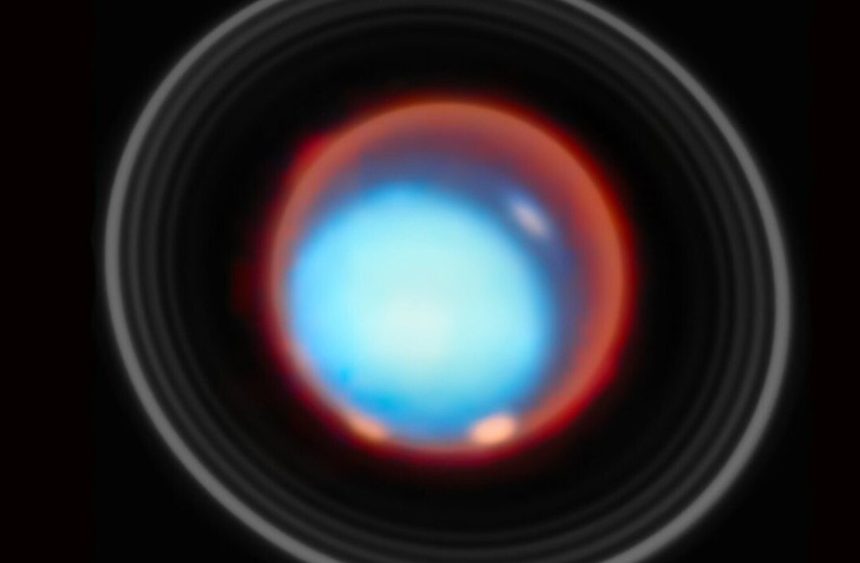
A team of scientists at Northumbria University has produced the first detailed Uranus 3D view, mapping the planet’s upper atmosphere in three dimensions for the first time.
Using data from the James Webb Space Telescope, researchers observed Uranus across nearly a full rotation, revealing how heat and charged particles move high above its cloud tops.
The study, led by Paola Tiranti and published in Geophysical Research Letters, provides the clearest picture yet of where Uranus’s auroras form and why they behave so differently from Earth’s Northern Lights.
The findings matter because Uranus remains one of the least explored planets in our Solar System, despite being more than one billion miles from Earth.
How did scientists build the Uranus 3D view?
Researchers used Webb’s advanced infrared instruments to track subtle changes in light emitted from Uranus’s upper atmosphere, known as the ionosphere. This layer sits roughly 3,100 miles above the cloud tops and contains electrically charged particles.
Scientists using the James Webb telescope have created the first 3D map of Uranus’s upper atmosphere, revealing how its wildly tilted magnetic field drives complex auroras and continued atmospheric cooling. #Uranus #JamesWebb #Auroras pic.twitter.com/VuU0LQDXFV
— NextGen Signals (@nextgen_signals) February 21, 2026
By studying those emissions over time, the team created a vertical and horizontal map of:
- Temperature distribution
- Ion density levels
- Energy flows through the atmosphere
“This is the first time we’ve been able to see Uranus’s upper atmosphere in three dimensions. With Webb’s sensitivity, we can trace how energy moves upward through the planet’s atmosphere and even see the influence of its lopsided magnetic field,” Ms. Tiranti said.
Unlike earlier missions, which captured only limited snapshots, this near-complete rotational coverage allowed scientists to observe how features shift as the planet spins.
What makes Uranus’s auroras so unusual?
The Uranus 3D view revealed two bright auroral bands positioned near the planet’s magnetic poles. However, Uranus does not behave like Earth.
Key differences include:
- A magnetic field tilted by almost 60 degrees
- Magnetic poles are significantly offset from the planet’s centre
- A sideways rotational axis
Because of this unusual geometry, the auroras move in complex patterns rather than forming stable rings near the poles.
Scientists also identified a zone of reduced emission and lower ion density between the two auroral bands.
Researchers believe the planet’s skewed magnetic field channels charged solar particles in a highly uneven way. Similar processes appear on Jupiter, but Uranus’s extreme tilt makes the effect more dramatic.
What do the new temperature readings show?
The data confirms that Uranus’s upper atmosphere continues a cooling trend first detected in the early 1990s.
Measured findings include:
| Atmospheric Feature | Recorded Measurement |
|---|---|
| Average temperature | 426 Kelvin (around 150°C) |
| Temperature peaks | Between 1,864 and 2,485 miles above cloud tops |
| Highest ion density | Around 621 miles high |
Although 150°C sounds intense, scientists expected even higher readings based on older ground-based observations and spacecraft data. The lower average suggests Uranus has cooled further over recent decades.
“By revealing Uranus’s vertical structure in such detail, Webb is helping us understand the energy balance of the ice giants. This is a crucial step towards characterising giant planets beyond our Solar System,” Ms. Tiranti said.
Why does this discovery matter for the UK?
The research highlights the growing contribution of UK universities to global space science. Northumbria University’s involvement strengthens Britain’s role in international projects led by agencies such as the European Space Agency and the Canadian Space Agency.
Understanding how Uranus regulates heat and magnetic energy could influence:
- Future proposals for a dedicated Uranus space mission
- Comparative studies of Neptune, another ice giant
- Research into exoplanets that share a similar size and composition
For UK researchers, the study demonstrates how access to world-class observatories like Webb enables universities outside London and Oxford to lead frontier planetary science.