


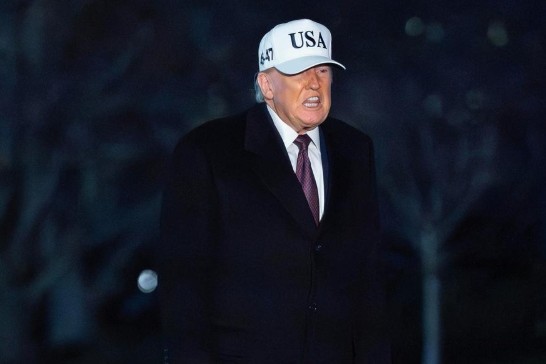
A fresh political storm has erupted after US President Donald Trump publicly declared himself the “Acting President of Venezuela” in a social media post.
The unexpected claim, shared via his Truth Social platform, has sparked confusion, criticism, and global debate, including questions about international law, foreign policy norms, and whether such a declaration carries any real power.
For a UK audience, the story matters because it touches on global stability, energy markets, and Britain’s diplomatic stance on Latin America.
What Has Happened?
On 12 January 2026, Donald Trump shared a digitally altered image on Truth Social, presenting himself as the “Acting President of Venezuela”, describing himself as “incumbent” while remainingthe US president.
The post appeared amid heightened tensions between Washington and Caracas and followed Trump’s own claims that Venezuelan President Nicolás Maduro had been removed from power during a US-led operation.
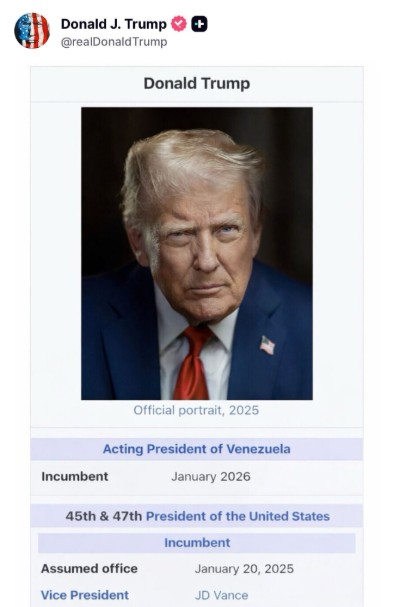
The image was widely circulated online and quickly picked up by international media. Trump did not announce any formal legal process, treaty, or international agreement to support the claim.
Is Trump Really the Acting President of Venezuela?
In short: no. There is no legal, constitutional, or international basis for a US president to hold office in Venezuela.
Key facts:
- Venezuela’s constitution does not allow a foreign leader to assume its presidency.
- No international body, including the United Nations or European Union, recognises Trump as Venezuela’s leader.
- Diplomatic recognition of governments happens through formal channels, not social media posts.
The claim is therefore viewed by legal experts as symbolic, provocative, and politically motivated, rather than legitimate.
Who Is Running Venezuela Right Now?
Following the removal of Nicolás Maduro, Venezuela’s Supreme Court appointed Vice President Delcy Rodríguez as interim president, in line with domestic legal procedures.
While her leadership is contested internationally, she remains the only recognised authority within Venezuela’s own legal system. Trump’s declaration does not alter this reality on the ground.
Why Did Trump Make This Claim?
Several factors may explain the timing:
1. Political Messaging
Trump has a long history of using bold statements and visual posts to dominate headlines and frame global narratives on his own terms.
2. Control of Venezuelan Oil
Trump has also stated that Venezuelan oil revenues would be placed under US control, claiming this would benefit both Venezuelan citizens and American interests.
Venezuela holds some of the world’s largest oil reserves, making control over its resources highly significant.
3. Power Projection
Declaring himself “acting president” sends a strong, though legally meaningless, signal of US dominance in the region.
How Has the World Reacted?
- No country has recognised Trump’s claim.
- European governments have emphasised that leadership changes must adhere to international law and Venezuelan constitutional procedures.
- Legal scholars have described the post as political theatre, not governance.
The Former President of Venezuela is an alleged felon while the Acting President of Venezuela is a convicted felon. Those poor Venezuelan bastards can’t catch a break. pic.twitter.com/PcSRBap47b
— Moe Davis (U.S. Air Force, Retired) (@ColMoeDavis) January 12, 2026
BREAKING: After Donald Trump just tweeted out a trolling post that says he’s the “Acting President of Venezuela,” Venezuelan officials trolled him back by announcing they were indicting him for sex-trafficking and launching impeachment proceedings.
— The Halfway Post (@HalfwayPost) January 12, 2026
The declaration triggered widespread debate online, with critics questioning its legality and supporters framing it as a tough stance on authoritarian regimes.
What Does This Mean for the UK?
- Energy Prices: Venezuela’s oil situation can affect global markets, which in turn influence UK fuel and energy costs.
- Foreign Policy: The UK traditionally supports international law and coordinated diplomatic recognition, not unilateral declarations.
- Global Stability: Actions that blur the rules around sovereignty raise concerns for international order, an issue closely watched in Westminster.
The UK government is expected to maintain its existing position and avoid recognising any leadership claim made outside established legal frameworks.