


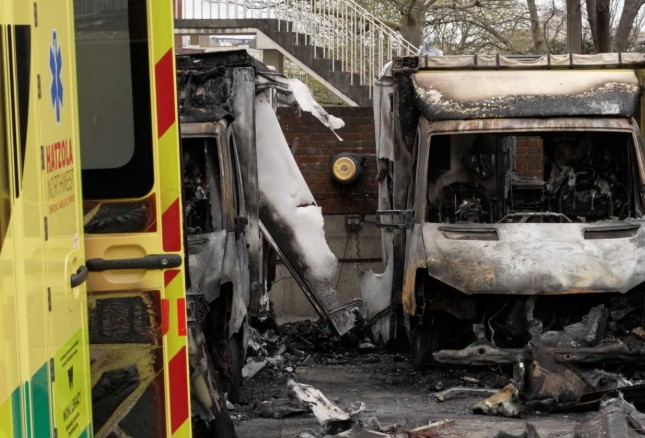
Three young men are due to appear at Westminster Magistrates’ Court today following a high-profile London ambulance fire that targeted the Jewish community’s volunteer emergency service.
The incident, which took place in the early hours of Monday, 23 March 2026, resulted in the destruction of four ambulances belonging to the Hatzola charity in Golders Green.
The investigation, spearheaded by Counter Terrorism Policing (CTP) London, led to the arrest and subsequent charging of three individuals from East London.
North London: Muslims set fire to volunteer-run ambulance service run by the Jewish community (but catering to everyone, Jews and non-Jews alike). 🇬🇧 pic.twitter.com/fd0XBTFrZt
— Peter Lloyd (@Suffragent_) March 23, 2026
While the case is being treated as a suspected antisemitic hate crime rather than a formal act of terrorism, the scale of the blaze and the use of specialist police units have underscored the gravity of the incident.
Who has been charged in the London ambulance fire case?
Following an intensive 12-day investigation, the Metropolitan Police confirmed that three suspects were charged on Friday evening. The individuals named are:
- Hamza Iqbal, 20, a British national residing in Leyton.
- Rehan Khan, 19, a British national also from the Leyton area.
- A 17-year-old male, a dual British and Pakistani national from Walthamstow.
All three face charges of arson, being reckless as to whether life would be endangered. This specific charge reflects the severity of the fire, which occurred in a residential area and involved exploding gas canisters.
Two other men, aged 45 and 47, remain on bail until late April as enquiries continue.
Why was the Golders Green site targeted?
The attack centred on Highfield Road in Golders Green, a major hub for London’s Jewish community. The vehicles were parked in a lot used by Hatzola Northwest, a charity that provides rapid medical response regardless of faith, though it is primarily staffed by Jewish volunteers.
The timing of the attack, shortly before the Passover festival, and the nature of the target have led community leaders and the Community Security Trust (CST) to label it a calculated attempt to intimidate the local population.
Detectives are also examining potential links to the Harakat Ashab al-Yamin group after claims of responsibility surfaced online following the blaze.
How did the emergency services respond to the blaze?
The London Fire Brigade (LFB) received 56 emergency calls starting at 01:40 GMT. Six fire engines and approximately 40 firefighters from stations including Hendon, West Hampstead, and Mill Hill attended the scene.
- The Fire: Four ambulances were fully engulfed.
- Explosions: Oxygen and medical gas cylinders stored inside the vehicles reached critical temperatures, leading to multiple explosions.
- Property Damage: The force of the blasts shattered windows in a nearby block of residential flats.
- Evacuations: Residents were evacuated to a local rest centre while crews worked for nearly two hours to bring the fire under control, finally declaring the site safe at 03:06 GMT.
What is the role of Counter Terrorism Policing in this investigation?
Although the incident has not been declared a terrorist attack, Commander Helen Flanagan, head of CTP London, is leading the probe.
This is due to the “specialist capability” required to investigate crimes targeting specific religious groups and the potential for wider radicalisation links.
Authorities are also reportedly scrutinising an online claim of responsibility from a group calling itself the “Islamic Movement of the People of the Right Hand” (HAYI).
Security analysts are investigating whether this group has any genuine presence or links to foreign state actors.
How has the UK Government and the NHS supported Hatzola?
The loss of four ambulances represents a financial hit of approximately £400,000, excluding the life-saving medical equipment inside.
- Vehicle Loans: The London Ambulance Service (LAS) immediately provided loan vehicles to ensure Hatzola volunteers could continue their shifts.
- Financial Support: Health Secretary Wes Streeting stated in Parliament that the government would fund permanent replacements, ensuring the charity’s vital work is not stalled by “acts of hate.”
- Enhanced Security: A “bespoke policing plan” has been enacted across North West London, featuring highly visible armed patrols to serve as a deterrent during religious holidays.
What is the legal outlook for the accused?
The three suspects appearing at Westminster Magistrates’ Court today will likely face a preliminary hearing before the case is sent to a Crown Court, given the “reckless as to life endangered” element of the charges.
Under UK law, this offence carries a maximum sentence of life imprisonment, though sentencing typically ranges from 4 to 12 years depending on the level of planning and intent.