

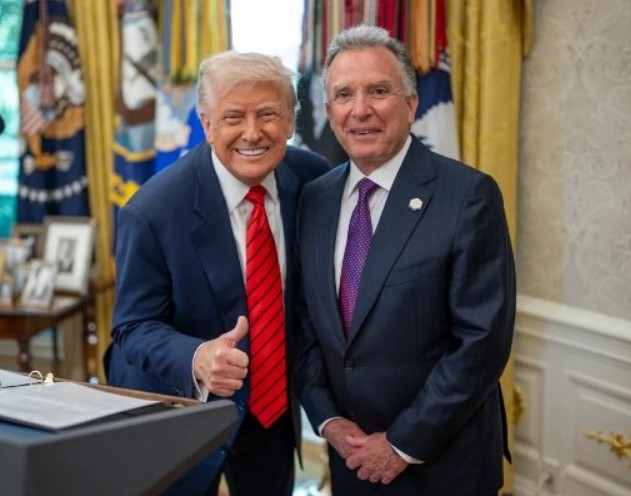
Steve Witkoff, a businessman turned diplomatic envoy for US President Donald Trump, reportedly gave guidance to a senior Kremlin adviser on how Vladimir Putin should approach Washington over a potential Ukraine peace plan.
The revelations put fresh scrutiny on Mr Witkoff’s role in shaping Trump-era foreign policy, especially as the White House pushes a new approach to ending the Russia–Ukraine war.
A transcript published by Bloomberg News suggests Mr Witkoff advised Yuri Ushakov, President Putin’s long-time foreign policy aide, on how the Russian leader could frame an outreach call to President Trump.
According to the transcript, Mr Witkoff encouraged Mr Putin to congratulate Mr Trump on the Gaza ceasefire deal and highlight Russia’s support, saying this would set the tone for a productive conversation.
“From that, it’s going to be a really good call,” Mr Witkoff reportedly said.
White House Accepts Transcript’s Accuracy, Trump Calls It ‘Standard’ Diplomacy
In a move that raised eyebrows in Washington, the White House did not dispute the transcript’s authenticity. Speaking to reporters aboard Air Force One, President Trump brushed off concerns and described Mr Witkoff’s reported conversation as a typical negotiation strategy.
“He’s got to sell this to Ukraine. He’s got to sell Ukraine to Russia,” Mr Trump said. “That’s what a dealmaker does.”
1: Let’s talk about Steve Witkoff, because I think the narrative of him being a “useful idiot” is a dangerous trap to walk in.
It’s darker than that.
Witkoff has spent three decades swimming in russian money, russian mob circles, and russian real-estate pipeline.
A thread pic.twitter.com/l73c0DMrMK
— Їne Back Їversen (@IneBackIversen) November 25, 2025
The timing is notable. President Trump recently announced that a refined Ukraine peace proposal, aimed at stopping the conflict between Russia and Ukraine, was close to completion. He also revealed that Mr Witkoff would travel to meet Mr Putin as part of the ongoing talks.
Republican Critic Hits Out: ‘He Cannot Be Trusted.’
Not all Republicans were impressed. US Representative Don Bacon, who has frequently criticised Donald Trump’s foreign policy stance on Ukraine, said the transcript made Mr Witkoff look “far too soft” on Moscow.
“He cannot be trusted to lead these negotiations. Would a Russian paid agent do less than he? He should be fired,” Mr Bacon wrote online.
Bloomberg stated it had reviewed a recording of the call but did not reveal its source. The Associated Press has not independently confirmed the transcript.
Call Followed Trump’s Middle East Victory Lap
The alleged Witkoff–Ushakov call was said to have taken place a day after President Trump’s celebratory trip to Israel and Egypt, where he marked the Gaza ceasefire agreement.
During the reported conversation, Mr Witkoff told Mr Ushakov:
“Maybe he says to President Trump: you know, Steve and Yuri discussed a very similar 20-point plan to peace… we’re open to those sorts of things.”
He also floated the idea of a Trump–Putin phone call occurring before Ukrainian President Volodymyr Zelenskyy visits the White House, suggesting Mr Putin should use the Gaza agreement as a friendly opener. Mr Ushakov agreed, saying Mr Putin would congratulate Mr Trump and call him “a real peace man.”
The call eventually took place the day before Mr Zelenskyy arrived in Washington. Shortly after that meeting, Mr Trump suggested both sides in the Russia–Ukraine conflict should “stop where they are”, a remark widely interpreted as urging Ukraine to accept losing areas seized by Russia.
Another Leaked Recording Reveals Russian Side of the Discussion
A second transcript reviewed by Bloomberg reportedly shows Mr Ushakov speaking with Kirill Dmitriev, one of Mr Putin’s closest advisers on Ukraine. The conversation centred on how assertively Russia should push its demands in any upcoming peace framework.
“I’ll informally pass it along… but I don’t think they’ll take exactly our version, but at least it’ll be as close to it as possible,” Mr Dmitriev allegedly said.
This follow-up discussion happened shortly after Mr Dmitriev visited Florida for talks with Mr Witkoff and Jared Kushner. Their meeting focused on shaping a 28-point peace plan that later leaked to the press.
The document appeared heavily tilted towards Russia’s goals, proposing that Ukraine surrender the entire Donbas region, drastically reduce its armed forces, and accept that it would never join NATO, all key Russian demands.
Washington and Moscow Push Back on Media Reports
White House communications director Steven Cheung defended Mr Witkoff’s frequent discussions with both Russian and Ukrainian officials, saying:
“This story proves one thing: Special Envoy Witkoff talks to officials in both Russia and Ukraine nearly every day to achieve peace, which is exactly what President Trump appointed him to do.”
Meanwhile, Mr Dmitriev dismissed the leaked transcript outright, calling it “fake” and adding: “The closer we get to peace, the more desperate warmongers become.”
The Russian Embassy in Washington declined to comment.
Secretary of State Marco Rubio insisted that the US itself drafted the peace proposal, with both Kyiv and Moscow offering suggestions, an attempt to counter criticism that the leaked plan resembled a Russian wish list. The State Department declined to address the Bloomberg report directly.
Next Steps in Trump’s Peace Push
On Tuesday, President Trump announced that Army Secretary Dan Driscoll would head to talks with Ukrainian officials, while Mr Witkoff travels to meet President Putin.
Mr Trump also hinted at the possibility of hosting both Mr Putin and Mr Zelenskyy for face-to-face discussions, though only when “meaningful progress” has been achieved through ongoing negotiations.
As scrutiny intensifies over the role of Steve Witkoff in shaping US-Russia-Ukraine diplomacy, the leaked transcripts have amplified questions over the direction of Trump’s peace strategy and whether it leans too far towards Kremlin preferences.
For now, the president remains confident in his envoy, describing him as a key figure in delivering what he hopes could become a landmark international agreement.