
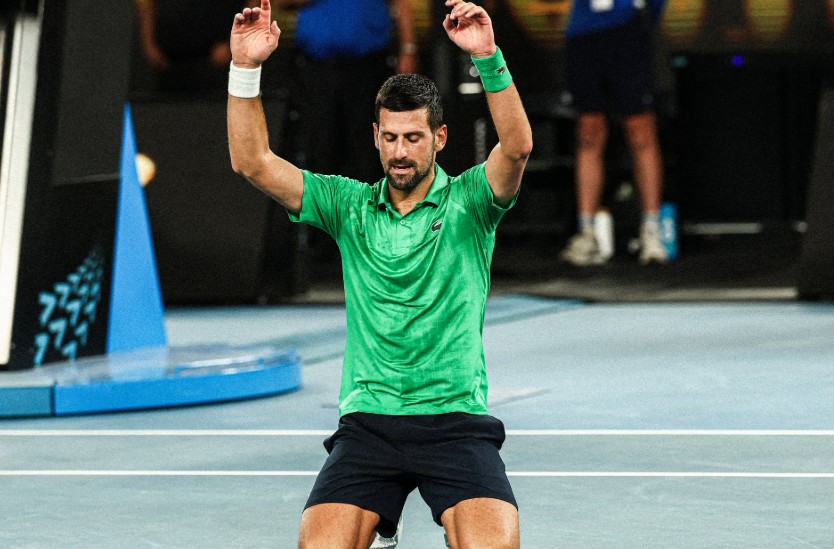
Novak Djokovic staged a dramatic comeback against reigning champion Jannik Sinner to book his place in yet another Australian Open final, keeping UK tennis fans glued to early-morning coverage as the Serbian legend chased more history in Melbourne.
The 10-time champion fought back from behind in a gruelling five-set semi-final at Melbourne Park, securing his 11th Australian Open final appearance.
The win sets up a blockbuster Sunday final against Spain’s Carlos Alcaraz, who survived his own marathon clash against Alexander Zverev earlier in the day.
The result matters hugely for tennis followers across the UK, with Djokovic now closing in on yet another major record while facing the sport’s next dominant force in Alcaraz.
How did Novak Djokovic overturn Jannik Sinner in Melbourne?
Djokovic, 38, showed why Melbourne remains his most successful hunting ground. After dropping early momentum to Sinner, the defending champion and one of the sport’s fastest-rising stars, Djokovic steadied himself with tactical precision.
He lengthened rallies, targeted Sinner’s backhand under pressure, and relied on trademark defensive resilience. As the match stretched into the fifth set, experience trumped youth.
Lost for words pic.twitter.com/vQRGZwLDOd
— Novak Djokovic (@DjokerNole) January 30, 2026
The crowd inside Rod Laver Arena witnessed nearly four hours of relentless tennis, with Djokovic absorbing Sinner’s aggressive baseline game before taking control late on.
In his on-court interview, Djokovic said, “These are the matches you work for your whole career. Playing in Melbourne always gives me extra motivation.”
Tennis Australia officials later praised the contest as one of the tournament’s best matches in recent years.
Why does this win matter for UK tennis viewers?
The Australian Open airs overnight for UK audiences, yet Djokovic’s matches consistently pull strong viewing numbers because of his record-breaking pursuits.
Australian Open king is back
Djokovic defeated Jannik Sinner He proved once again age is just a number.
Now final between Novak djokovic and Carlos Alcaraz.#AustraliaOpen2026 #AusOpenpic.twitter.com/cCBpshqqda
— (@WeTheThinkers) January 30, 2026
British tennis fans are watching two major storylines unfold:
• Djokovic extending his dominance at age 38
• Alcaraz aiming to take control of men’s tennis’s new era
Sunday’s final promises a generational showdown, experience against explosive youth.
Sports broadcaster analysis suggests this could be the most anticipated Australian Open final since Djokovic’s clashes with Rafael Nadal in previous years.
What challenge does Carlos Alcaraz pose in the final?
Alcaraz battled cramps and fatigue in his semi-final victory over, eventually prevailing after a punishing five-and-a-half-hour contest.
The Spaniard’s physical recovery could play a decisive role on Sunday. However, Alcaraz’s speed, creativity, and attacking instinct present a completely different challenge compared to Sinner’s power baseline game.
Former British No.1 Tim Henman told broadcasters: “Djokovic knows how to manage big finals, but Alcaraz brings an energy and unpredictability that tests anyone physically.”
Can Novak Djokovic still dominate at 38?
Djokovic’s Melbourne run again raises questions about longevity in modern tennis.
Few players in history have competed at this level approaching 40. His success relies on:
• Strict fitness and recovery routines
• Tactical intelligence
• Mental resilience under pressure
• Experience in five-set battles
Sports scientists frequently cite Djokovic as a case study in elite athletic longevity. UK tennis academies increasingly use his recovery and flexibility training models as teaching examples.
What reaction has the tennis world given?
Social media lit up following the victory, with players and pundits praising the quality of the contest. Many highlighted Djokovic’s refusal to fade against younger rivals.
Fans on UK tennis forums described the semi-final as “classic Djokovic survival mode”, a familiar storyline for those who have followed his dominance over the last decade.