


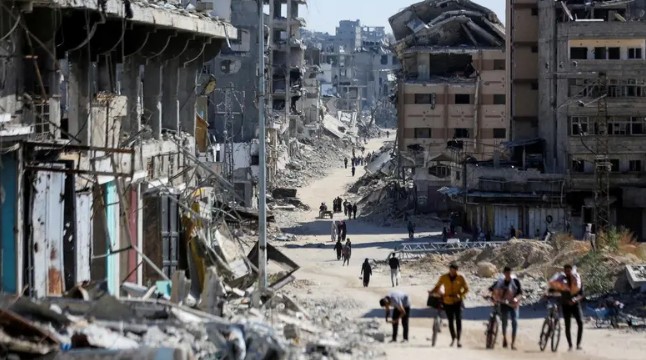
An Israeli airstrike killed five people in Gaza on Thursday, according to health officials in the territory, raising new questions about the stability of the US-brokered ceasefire between Israel and Hamas.
The deaths were reported in Gaza City, Khan Younis and near Bureij refugee camp, as Israel said its forces had targeted a militant posing an “imminent threat”.
The incidents come months after a truce began last October following more than a year of war.
The latest violence matters because it highlights growing tension around the ceasefire agreement and could affect diplomatic efforts to stabilize the region.
Civilians in Gaza remain at the centre of the crisis, while Israel maintains its security operations in parts of the enclave.
What happened during the Israeli airstrike in Gaza?
Health officials in Gaza said two people died when an Israeli airstrike hit a group of Palestinians in the Tuffah neighbourhood of Gaza City in the north of the territory. Several others suffered injuries, some described as serious.
Later the same day, medics reported three further deaths in drone strikes on two police checkpoints in Khan Younis and in the Abu Hujair area, northwest of the Bureij refugee camp in central Gaza.
Additional visual evidence from the scene, including these mid-air blast images, shows the scale of destruction reported by local responders.
In a statement, the Israeli military said its forces operating in southern Gaza killed a militant who had crossed into an area still occupied by Israeli troops.
It described the individual as posing an “imminent threat” and called the incident a breach of the ceasefire agreement.
Why is the ceasefire under strain?
The ceasefire between Israel and Hamas began in October 2025 following US mediation. The agreement aimed to reduce fighting, allow aid into Gaza and begin phased military withdrawals.
However, both sides have accused each other of breaching the truce. According to Gaza’s health ministry, more than 600 people have been killed by Israeli fire since the ceasefire came into effect last October.
Israel, meanwhile, says four of its soldiers have been killed by militants in Gaza during the same period.
The conflict itself began after the October 7, 2023, attack by Hamas on southern Israel, in which around 1,200 people were killed, according to Israeli authorities. Since then, Gaza’s health ministry says more than 72,000 people, mostly civilians, have died in Israeli strikes.
For UK readers, the ceasefire’s stability carries diplomatic and humanitarian significance. Britain has consistently called for restraint, protection of civilians and the release of hostages, while supporting negotiated efforts to prevent further regional escalation.
What does Israel say about the latest strikes?
The Israeli military said the targeted killing in southern Gaza followed what it described as a direct threat to its forces. Officials framed the action as defensive and necessary under current security conditions.
Israel maintains that it reserves the right to act against militants it believes violate the ceasefire terms. Military spokespeople have repeatedly argued that armed groups continue to operate in areas that were meant to be stabilized.
A recent statement from the Israel Defence Forces (IDF) said: “Forces eliminated a terrorist who advanced towards troops and posed an immediate threat.”
No independent verification of the specific circumstances has yet been made public.
How difficult is the humanitarian situation in Gaza?
Large parts of Gaza remain heavily damaged after more than a year of conflict. Infrastructure, including homes, hospitals and public buildings, has suffered widespread destruction.
Aid agencies continue to warn of shortages in medical supplies, clean water and shelter. The United Nations and British humanitarian groups have called for uninterrupted aid corridors and strict adherence to the ceasefire terms.