

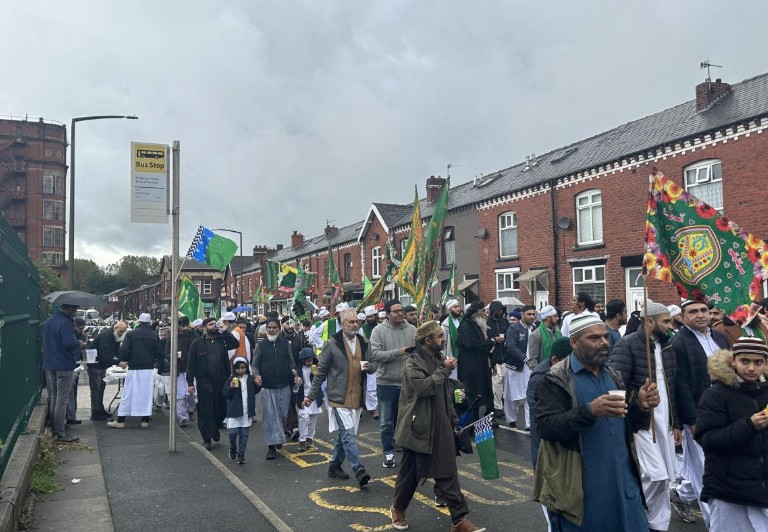
Thousands of Muslims from across the UK and Europe will gather in Great Lever, Bolton, on Sunday, August 23, for the annual Milad un-Nabi procession celebrating the birthday of Prophet Muhammad (pbuh).
Organised by local leaders including coordinator Bilal Ahmed, the milestone faith walk commences at Makkah Mosque near Rishton Lane, weaves past Derby Street, and concludes at the 3D Centre Marriage Hall.
- International and Domestic Scale: Pilgrims and visitors travel from European nations like Spain and Italy, alongside UK regions including Scotland and Cornwall.
- Route and Schedule: The procession kicks off at 1.00 pm on Sunday, August 23, moving from Makkah Mosque through Derby Street to the 3D Centre.
- Community Legacy: The event honours the memory of influential local youth figure Sufi Mushtaq while highlighting multicultural integration within British society.
Why Is the Bolton Muslim Community Hosting This Major Procession?
The Bolton Muslim community is preparing for one of its most prominent annual fixtures as worshippers converge on the town to celebrate Milad un-Nabi.
Starting at the Makkah Mosque near Rishton Lane, the procession winds its way past the Derby Street area, a cultural heartland within the town, before terminating at the 3D Centre Marriage Hall for communal prayers, food, and traditional refreshments.
Event coordinator Bilal Ahmed noted that international travellers from Spain and Italy, alongside domestic visitors from Scotland and Cornwall, regularly make the journey. Beyond active participants marching in the parade, local residents frequently observe and support the procession from their doorsteps.
The timeline of the community’s evolution dates back to the post-war industrial era. Early migration waves in the late 1950s and 1960s brought workers from India and Pakistan to Greater Manchester to labour in the region’s historic textile mills.
Today, this heritage has matured into a well-established demographic core concentrated heavily in wards such as Great Lever, Rumworth, and Halliwell.
How Does This Event Impact Local Infrastructure and Regional Economy?
The vitality of the Bolton Muslim community plays a measurable role in the socio-economic framework overseen by Bolton Council and regional transit networks managed by Transport for Greater Manchester (TfGM).
According to official demographic metrics released by the Office for National Statistics (ONS) via the Census, the local footprint is substantial:
- Population Share: Worshippers and individuals identifying as Muslim account for approximately 17.4% to nearly 20% of Bolton’s total urban population, marking a notable upward trajectory from prior decades.
- Local Authority Engagement: The Bolton Council of Mosques (BCOM) officially coordinates across roughly 28 distinct mosques in the borough, providing social services, youth work, and educational support to an estimated 6,000 pupils attending local madrasas.
- Economic Footprint: Large-scale religious assemblies inject notable custom into local retail, hospitality, and transport sectors along the A666 corridor and local bus networks, driving localized economic activity during weekend gatherings.
What Do Community Organisers and Local Leaders Say?
Emphasising the cultural integration of the event, event organiser Bilal Ahmed stated: “The main purpose is to get people together and for people to understand that Islam is actually within British culture, and for all people with different ways of life.
We have a lot of local people who do not participate in the parade, but they watch from their houses. We have got everyone joining in together.”
Reflecting on the community ties and local figures foundational to Bolton’s cohesion, Mr Ahmed added remembrance for the late Sufi Mushtaq: “He passed away four or five years ago, but he was a good local figure for the younger people on the streets in Bolton. He was really influential.”
What Is the Future Outlook for Multicultural Integration in Bolton?
As preparations conclude for the August 23 procession, local authorities and community leaders are mapping out logistical support for future cultural calendars.
The continuous growth of multi-faith and ethnic minority demographics, highlighted in ongoing Department for Levelling Up, Housing and Communities (DLUHC) local integration metrics, ensures that civic partnerships between Bolton Council and regional faith groups remain a top priority.
Future municipal planning will increasingly focus on managing public space requirements for large-scale gatherings, ensuring traffic management coordination via Greater Manchester Police, and expanding youth mentorship programs to preserve the community-focused legacy left by figures like Sufi Mushtaq.