


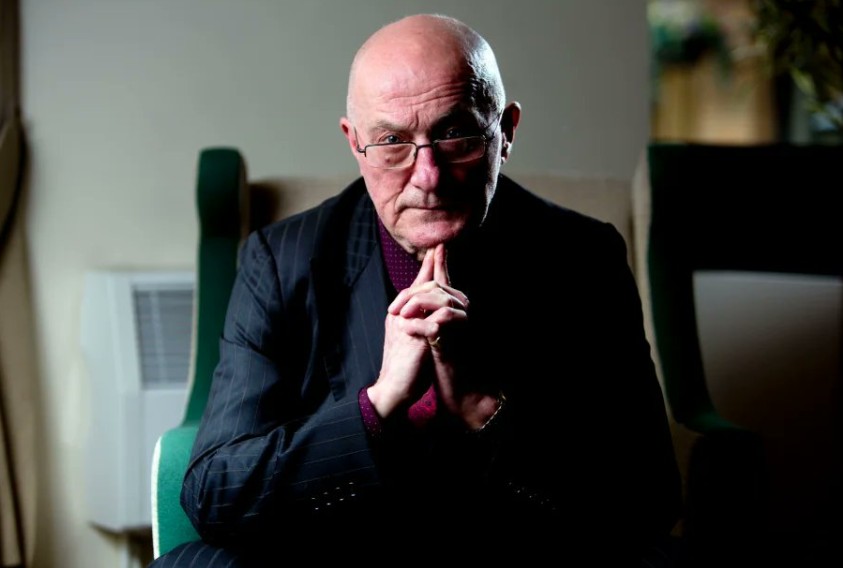
Former London gangster turned prison reform campaigner Bobby Cummines has died aged 74. Cummines, who gained notoriety in the 1970s as an armed robber and gang leader before later becoming a respected voice for criminal justice reform in the UK, died on Thursday, 5 March, according to a statement released by his family.
His relatives confirmed the news through a message posted on his official Instagram account, describing his death as sudden.
“It is with great sadness that we announce the sudden death of our beloved Bobby Cummines OBE, who died on Thursday, March 5.
The family has asked for privacy at this difficult time. Details regarding the funeral will be shared in due course.”
Cummines’ life story, from gangland crime to national recognition for prison reform work, made him one of the most unusual figures in modern British criminal history.
Who was Bobby Cummines?
Born in Islington, North London, in 1951, Bobby Cummines was the youngest of eight children in a working-class family.
Despite growing up in what he later described as a stable and law-abiding household, he struggled academically and left school at the age of 16 without formal qualifications.
Soon after leaving education, he became involved in criminal activity across London. During the late 1960s and early 1970s, he entered the capital’s organised crime scene and quickly developed a reputation within the underworld.
By his early twenties, Cummines had become known among both criminals and police as a skilled armed robber and gang organiser, involved in a series of high-value robberies targeting banks and security vans.
Why was Bobby Cummines known as the “King of the Robbers”?
Within London’s criminal circles during the 1970s, Cummines earned the nickname “King of the Robbers.”
Police investigators linked him to numerous armed robberies carried out across London and parts of southern England.
These crimes often targeted financial institutions and cash-in-transit vehicles, which at the time were considered among the most lucrative targets for organised gangs.
Although exact totals varied across cases, authorities believed robberies connected to Cummines and his associates involved hundreds of thousands of pounds, a significant amount during the decade.
His activities eventually led to several convictions and long periods behind bars in high-security prisons.
What was “Britain’s Alcatraz” where Cummines served time?
One of the most notable periods of Cummines’ prison sentence was spent at HMP Parkhurst on the Isle of Wight.
During the 1970s and 1980s, Parkhurst gained a reputation as one of the toughest prisons in the UK. Because of its high security and the dangerous criminals it held, the facility was widely nicknamed “Britain’s Alcatraz.”
While incarcerated, Cummines encountered several high-profile offenders, including members of the infamous London crime family led by the Ronnie Kray and Reggie Kray.
The Kray twins dominated organised crime in London’s East End during the 1950s and 1960s and were among the most notorious gangsters in British history.
Their presence in the same prison reinforced Parkhurst’s reputation as a facility housing some of the country’s most dangerous offenders.
How did Bobby Cummines turn his life around?
After serving his sentences, Cummines began distancing himself from organised crime and gradually rebuilt his life outside prison.
Instead of returning to gang activity, he chose to focus on crime prevention and rehabilitation, using his personal experiences to educate others about the consequences of criminal lifestyles.
Over the following decades, he became involved in prison reform campaigns, youth outreach initiatives and rehabilitation programmes across the UK. His work often focused on helping former prisoners reintegrate into society and avoid reoffending.
Cummines regularly spoke at community events and youth programmes, warning young people about the realities of criminal life.
“Prison is not a badge of honour,” he said during one public talk. “It is a place where your future disappears if you don’t change.”
His work eventually earned him national recognition.
Why was Bobby Cummines awarded an OBE?
Cummines later received an OBE (Officer of the Order of the British Empire) in recognition of his contribution to prison reform and reducing reoffending in the UK.
The honour acknowledged years of advocacy work with charities, criminal justice organisations and community groups focused on helping former offenders rebuild their lives.
His campaigns often highlighted the importance of:
- education programmes in prisons
- employment opportunities for ex-offenders
- mentoring schemes for young people at risk of crime
- support systems for prisoners leaving custody
Many criminal justice experts considered his perspective valuable because he had experienced the prison system from inside.
Timeline of Bobby Cummines’ life
| Year | Key event |
|---|---|
| 1951 | Born in Islington, London |
| 1967 | Leaves school at age 16 |
| Early 1970s | Becomes involved in organised crime and armed robbery |
| 1970s–1980s | Served prison sentences, including time at HMP Parkhurst |
| 1990s onwards | Begins working in prison reform and youth crime prevention |
| Later years | Awarded OBE for services to rehabilitation |
| 2026 | Dies aged 74 |
Why did his story stand out in Britain’s criminal justice history?
Bobby Cummines’ life remains one of the most striking examples of personal transformation within Britain’s criminal justice system.
A few former gang leaders later became public advocates for prison reform. His journey from organised crime to community leadership illustrated the potential impact of rehabilitation programmes and second chances.
For many organisations working to reduce reoffending, Cummines became a powerful example that change is possible — even for individuals with serious criminal pasts.