


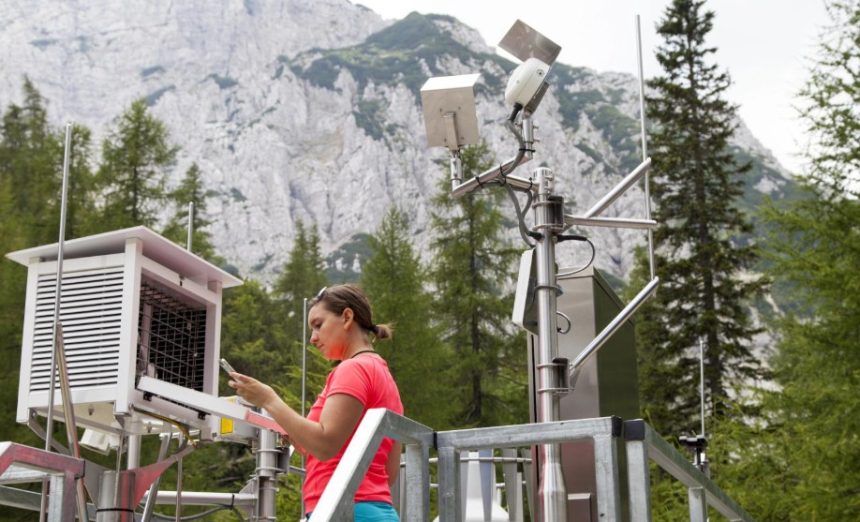
Amsterdam’s weather can often feel unpredictable, but in the Netherlands, a growing number of amateur weather enthusiasts are helping to improve forecasting accuracy.
Nearly 1,000 hobbyist weather stations across the country now provide real-time data to the Royal Netherlands Meteorological Institute (KNMI).
This citizen-powered network adds extra detail to maps of temperature, humidity, and wind speed, giving more precise insights into local weather patterns, from cooler coastal areas to warmer city centres.
How Do Amateur Weather Stations Help Forecasts?
The KNMI uses the information collected by hobbyists to enhance its official weather maps, which are shared with around 1.2 million app users.
Gerard van der Schrier, a KNMI researcher, told NOS: “These maps are far more detailed than those based only on our official stations.
They show differences such as cooler coastal temperatures, warmer urban zones, and lower wind speeds in areas like the Veluwe and Utrechtse Heuvelrug.”
Although the readings from amateur stations can be less precise than professional instruments, the KNMI adjusts for inconsistencies when creating its forecasts, ensuring the maps remain reliable for both everyday use and planning for extreme weather.
Who Are the Hobbyists Sharing Data?
One notable contributor is Sjaak de Wit from Utrecht, who runs two stations, one at his home and another at his allotment. Both devices automatically measure temperature, humidity, rainfall, and air pressure, sending the data directly to the KNMI in real time.
“I’ve been interested in weather since I was young, recording temperatures every day. Today, the equipment does it automatically, and the data is shared instantly,” De Wit told NOS.
While many hobbyists purchase pre-built stations costing several hundred to over a thousand euros, De Wit built his own, combining his passion for electronics with his interest in meteorology.
Why Is This Data Valuable for Forecasting?
The KNMI’s hobbyist network complements its 37 official stations, which are mostly situated in open, rural areas. Using citizen data allows the KNMI to:
- Identify urban heat islands in cities such as Amsterdam
- Detect cooler coastal zones
- Monitor wind variations in forests and hilly areas like the Utrechtse Heuvelrug
Van der Schrier noted that these contributions improve flood risk mapping and provide citizens with more accurate daily weather predictions.
Could the UK Use a Similar Approach?
While amateur weather stations exist in many countries, the Netherlands offers a well-organised example of how citizen science can improve national forecasting.
For the UK, involving hobbyists in official weather networks could:
- Improve localised forecasts, particularly in cities
- Strengthen flood warnings for London, Manchester, Bristol, and other flood-prone areas
- Support renewable energy management, including wind farms, with real-time data
By integrating citizen-generated measurements into official systems, the UK could achieve richer, more accurate weather forecasts, especially during storms or other extreme events.