
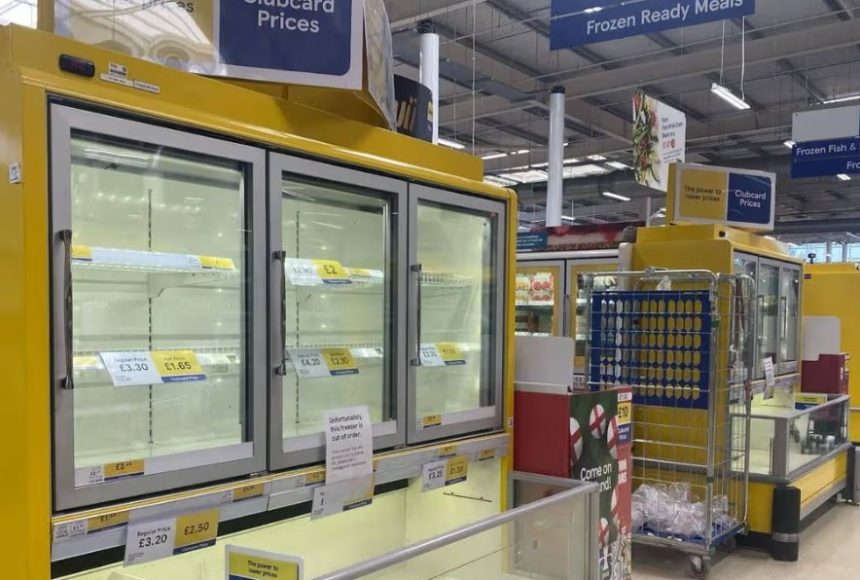
Widespread refrigeration failures left UK supermarket shelves empty on Wednesday, 24 June 2026, as a record-shattering 36.1°C heatwave forced major retailers including Tesco, Sainsbury’s, and Marks & Spencer to shut down malfunctioning chilled aisles, leaving consumers unable to buy essential milk, meat, and fresh produce.
- Nationwide Supply Fault: Commercial chillers at major hubs failed under a historic, provisional 36.1°C peak, leaving fresh food aisles completely bare.
- Massive Food Waste: Faulty units prompted local store managers to cordon off dairy and meat aisles to protect remaining cooling capacity.
- Red Alert Status: A rare Met Office Red Extreme Heat warning remains in effect; warning infrastructure is not built for sustained tropical conditions.
Why are UK Supermarket Fridges Breaking Down in the June Heatwave?
Major British supermarket chains are battling widespread infrastructure breakdowns after the UK recorded its hottest June day since records began. Shoppers across England and Wales were met with empty aisles, printed apology notices, and taped-off partitions where fresh food should be.
The disruption hit major locations simultaneously on Wednesday. Branches of Tesco in Altrincham, Crewe, and Haslingden were forced to completely clear out their fresh meat and dairy selections.
Similar scenes played out at Marks & Spencer in Crewe and High Wycombe retail park, alongside multiple Sainsbury’s and Waitrose outlets in Sandbach and Swindon.
Rather than a shortfall in supply chains, the empty shelves are entirely due to localised engineering failures. Standard commercial refrigeration systems used across the high street are designed to operate efficiently up to external temperatures of around 32°C; when ambient store conditions spike higher, the compressor units overheat and automatically shut down to prevent electrical fires, triggering immediate food spoilage risks.
How is the 2026 Heatwave Straining Regional Logistics and Council Budgets?
The severe breakdown of cold storage architecture highlights a significant vulnerability within the UK’s retail infrastructure when subjected to climate-induced heat strain.
| Metric / Insight | Impact Data | Source |
| Record Temperature | 36.1°C logged at Gosport, Hampshire (Beating 1976) | Met Office |
| Refrigeration Demand | 6% increase in power load per 2°C rise above seasonal norms | Industry Data |
| Retail Alert Level | Red Extreme Heat Warning covering Central & Southern England | UK Gov / Met Office |
The Systemic Toll on Local Municipalities and Transport
The financial fallout extends far beyond spoiled stock inside retail properties. When supermarkets dump metric tonnes of dairy and meat due to standard automated unit shutdowns, the weight lands squarely on municipal waste infrastructure.
Local council budgets face sudden, un-budgeted tipping fees to process hundreds of tonnes of rapid-onset commercial organic waste before it poses a secondary public health hazard.
Furthermore, the extreme temperatures triggered Network Rail to implement heat-related speed restrictions across the southern network to prevent track buckling.
Consequently, time-critical logistics deliveries destined for regional distribution centres along the M25 corridor and major transport hubs were delayed, meaning replacement stock could not be easily moved to unaffected stores.
What are Retailers and Consumers Saying on the Ground?
Store managers across the country took emergency measures, prioritising structural preservation over active sales.
Signage at Altrincham Tesco: “This unit is not currently in use. This is to ensure the remaining fridges/freezers in this store can operate at full capacity.”
Social media platforms quickly filled with accounts from frustrated shoppers witnessing a system pushed past its limits.
One shopper in Haslingden reported: ” The meat aisle is completely empty, and they won’t let you take anything out of the yoghurt aisle. Will be loads of food gone to waste today.”
Another consumer at a Waitrose branch remarked: The two supermarkets have malfunctioning, and consequently entirely empty, fridges. That tells you this isn’t normal and we’re not built for it.
A spokesperson for Morrisons in Swindon formally apologised for bare freezer units, attributing the sudden localised stock clearance directly to a heat-induced maintenance issue.
What is the Recovery Timeline for the Fresh Food Supply Chain?
The critical window for supply recovery depends strictly on the easing of ambient conditions. Industry technical analysts warn that high street grocers will face rolling regional outages as long as overnight temperatures remain above 20°C, a threshold that prevents commercial condenser units from shedding internal thermal energy.
A backlog of commercial refrigeration call-outs means logistics networks are prioritising dry goods and ambient-stable supplies. Fresh produce lines are expected to remain volatile until early next week when supply operations normalise.