
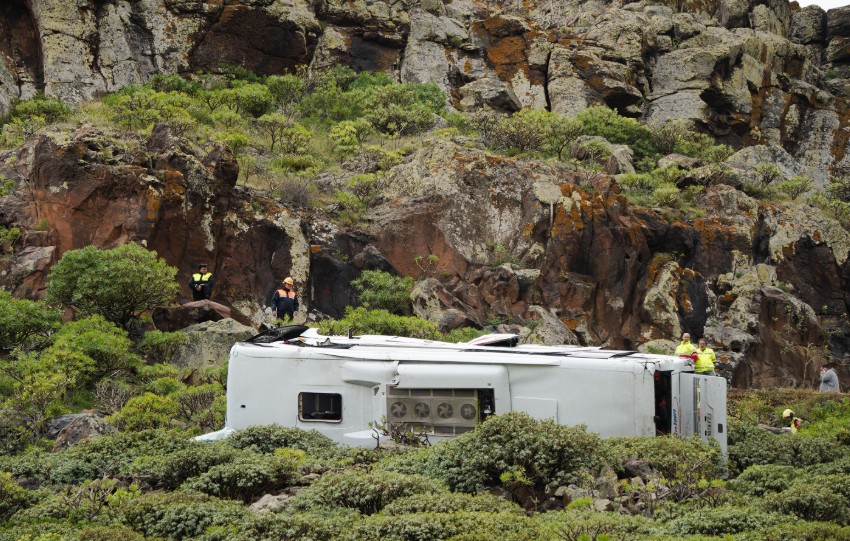
A major rescue operation is underway in the Canary Islands following a catastrophic bus crash that has left one British national dead and dozens more injured.
The incident, involving a group of UK holidaymakers, occurred on the island of La Gomera when their tour vehicle veered off a steep mountain road and plummeted approximately 10 metres into a ravine.
The Foreign, Commonwealth & Development Office (FCDO) has confirmed it is supporting the families of those involved, as Spanish authorities launch an urgent investigation into a suspected mechanical failure.
With three passengers, including children, reported to be in critical condition, the tragedy has sent shockwaves through the UK travel community and prompted a “state of emergency” declaration from the local island government.
How did the La Gomera bus crash happen?
The accident took place at approximately 1:15 pm local time on Friday, April 10, 2026. The bus, operated by local firm Gomera Tours, was transporting a group of 27 British tourists from a resort in Playa de Santiago to the ferry terminal in San Sebastián de La Gomera.
They were scheduled to board a ferry to neighbouring Tenerife to continue their journey or catch return flights to the UK.
Latest Canary Islands UK Tourists Bus Crash Update (11th April 2026)
On April 11, 2026, Authorities and medical teams are providing new details following yesterday’s tragic bus crash on La Gomera, Canary Islands.
Current Casualty & Victim Status
– Fatalities:
One confirmed… pic.twitter.com/d5qAD65bbX— Foskaay Animations (@SolomonFoskaay) April 11, 2026
As the vehicle navigated the GM-2 highway, specifically a notorious hairpin bend near the island’s capital, the driver reportedly lost control.
According to preliminary reports from the Civil Guard (Guardia Civil), the driver, a 63-year-old Spanish national, detected a brake failure and attempted to “fight” the vehicle to keep it on the road.
Despite his efforts to steer the bus into a dirt track to slow its momentum, the vehicle struck the rear of a Toyota pick-up truck before rolling off the embankment and landing on its side in rocky terrain.
Emergency services, including 112 Canarias, were on the scene within minutes. The impact resulted in the immediate death of a 77-year-old British man.
While his identity has not been released pending formal notification of next of kin, UK officials have confirmed he was part of a larger tour group.
Where is the accident site and why is the road dangerous?
The crash occurred on the GM-2, the primary arterial road that traverses the rugged, volcanic interior of La Gomera. Unlike the flatter coastal roads of Lanzarote or Fuerteventura, La Gomera is defined by its deep ravines (barrancos) and steep, winding mountain passes.
- Specific Location: The vehicle veered off near San Sebastián de La Gomera, the island’s main port and administrative hub.
- Terrain Challenges: The GM-2 is known for its narrow lanes and sharp elevation changes, often frequented by hikers and nature enthusiasts.
- Access Issues: Because La Gomera lacks an international airport capable of handling large commercial jets, most British tourists arrive via ferry from Los Cristianos, Tenerife. This makes the road journey to the dock a standard part of any UK holidaymaker’s itinerary on the island.
Local residents have previously raised concerns about road safety on this specific stretch. In 2025, a similar traffic incident on the same road resulted in one fatality, leading to calls for improved safety barriers.
What are UK and Spanish officials saying about the tragedy?
The gravity of the incident has prompted high-level responses from both the UK and Spanish governments.
UK Government Response
Foreign Secretary Yvette Cooper issued a statement via X (formerly Twitter) expressing her condolences: “My thoughts are with those affected by the tragic incident involving a bus carrying British holidaymakers in the Canary Islands. We are in touch with the local authorities and ready to support Brits and their families.”
My thoughts are with those affected by the tragic incident involving a bus carrying British holidaymakers in the Canary Islands.
We are in touch with the local authorities & ready to support Brits & their families, who can contact the FCDO on +44 20 7008 5000 or
+34 928 262 508— Yvette Cooper (@YvetteCooperMP) April 10, 2026
The British Embassy in Madrid confirmed that consular staff have been deployed to both La Gomera and Tenerife to assist the 27 injured survivors.
Spanish Authorities
The President of the Canary Islands, Fernando Clavijo, declared a local state of emergency to facilitate the rapid movement of medical resources between islands.
Héctor Cabrera, head of emergency operations in La Gomera, praised the driver’s actions, noting that he “tried to fight” to control the vehicle after the malfunction, potentially preventing an even steeper fall.
How are the survivors being treated and what is the impact on UK travellers?
The crash has had an immediate impact on UK travel logistics and the local holiday industry.
- Medical Repatriation: Of the 27 injured, 21 were treated and discharged from the Hospital Nuestra Señora de Guadalupe in La Gomera. However, four individuals, including a 73-year-old man and a 42-year-old man, sustained “severe traumatic injuries” and were airlifted by medical helicopter to specialized units in Tenerife.
- Children Involved: Reports indicate that three children were among those on board; their conditions are currently being monitored, with one understood to be among the seriously injured.
- Tour Operator Action: The tour operator, Holiday Property Bond (HPB), has confirmed they are working with the FCDO to arrange emergency accommodation and return flights for the survivors.
For British families awaiting news, the NHS and British Red Cross are reportedly on standby to provide psychological support for returning passengers who witnessed the traumatic event.
What is the current status of the “Brake Failure” investigation?
Investigators are currently focused on the mechanical integrity of the bus and the circumstances leading up to the plunge.
- Forensic Examination: The Civil Guard’s traffic division is examining the vehicle’s braking system and tachograph data to determine the exact speed at the time of the crash.
- The Driver’s Account: The 63-year-old driver, who also sustained injuries, has provided a statement detailing the moment the brakes stopped responding.
- Safety Infrastructure Review: The Canary Islands’ Department of Public Works is under pressure to review the safety of the GM-2 hairpin bends, with local councils demanding the installation of reinforced “high-containment” crash barriers.