


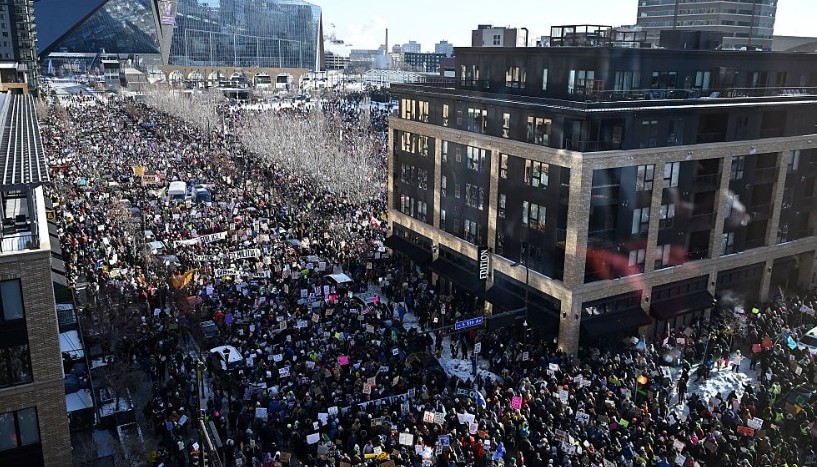
Thousands of Minnesotans walked out of work, shut their shops, and filled the streets of Minneapolis this week as part of a coordinated protest against US immigration enforcement.
The action, called “ICE Out Day,” took place on Monday in Minneapolis, Minnesota, during one of the coldest weeks of the year, after a series of immigration-related incidents sparked anger across local communities.
Organizers say the strike aimed to pressure politicians to curb the powers of Immigration and Customs Enforcement (ICE) and protect migrant families.
While the events unfolded in the United States, the scale of the protest, the role of major employers, and the political fallout have drawn attention well beyond Minnesota, including in the UK, where immigration enforcement and workers’ rights remain hot political issues.
What is ‘ICE Out Day’ and who organized it?
Community leaders, faith groups, and labour unions jointly organized ICE Out Day as a one-day economic blackout. The call was simple: no work, no shopping, and no school.
Organizers wanted to show how much local economies rely on migrant workers and immigrant-owned businesses.
According to protest leaders, more than 700 businesses, including bookshops, museums, cinemas, cafés, and restaurants, closed across Minneapolis for the day.
The action followed two flashpoint incidents:
- The killing of Renee Good, linked by organizers to an immigration enforcement operation earlier this month
- The detention of a preschool-aged child during an ICE action earlier this week
Both cases triggered widespread public outrage. “People are tired of living in fear,” one union organizer told local media. “This strike shows what happens when communities say ‘enough’.”
How did Minnesotans protest despite extreme weather?
Temperatures in Minneapolis plunged to dangerous levels, with wind chills reaching -40°F (around -40°C).
Despite this, thousands of Minnesotans marched through the city centre, wrapped in heavy winter gear, carrying signs calling for ICE to leave the state.
Most schools had already closed due to the cold, but the protest still disrupted daily life. Streets were quiet, shops sat dark, and public spaces that usually buzz with activity stood empty.
The New York Times reported widespread business participation, with many storefronts displaying handwritten signs explaining why they had closed in solidarity.
Which organizations and political leaders backed the strike?
The protest gained unusual institutional backing:
- The Minneapolis City Council formally endorsed the action
- A coalition representing over 1,000 local labour unions supported the strike
- Several faith groups staged sit-ins and prayer protests
At Minneapolis Saint Paul International Airport, police arrested around 100 clergy members who were protesting deportation flights leaving the airport.
Organizers just confirmed that 50,000+ Minnesotans showed up to march today.
50,000 people. On one of the coldest days in the last decade.
Minnesotans couldn’t be more clear: ICE out now.
— Minnesota House DFL (@mnhouseDFL) January 23, 2026
Not everyone approved. The Minneapolis Regional Chamber of Commerce distanced itself from the strike.
“We don’t particularly love the idea,” the Chamber’s president told HR Brew, while acknowledging businesses’ right to protest.
Why are major US companies watching closely?
Minnesota is home to Target, 3M, UnitedHealth Group, and at least 14 Fortune 500 companies. While none have commented publicly, US media reports suggest some firms issued internal guidance to staff following the Trump administration’s renewed immigration crackdowns.
This matters because large employers fear staff shortages, reputational damage, and operational disruption if enforcement intensifies.
Earlier this week, US Vice President JD Vance blamed the situation on state officials, saying tensions stemmed from “a failure of cooperation” between Minnesota authorities and federal agencies.
Why should the UK public care about what Minnesotans are doing?
Although this is a US story, the themes resonate strongly in Britain. The strike highlights how:
- Economic pressure can amplify political protest
- Migrant labour underpins local and national economies
- Enforcement-heavy immigration policies can trigger social unrest
UK debates around asylum processing, deportations, and workforce shortages in sectors like hospitality and healthcare echo many of the same tensions now visible in Minnesota.