


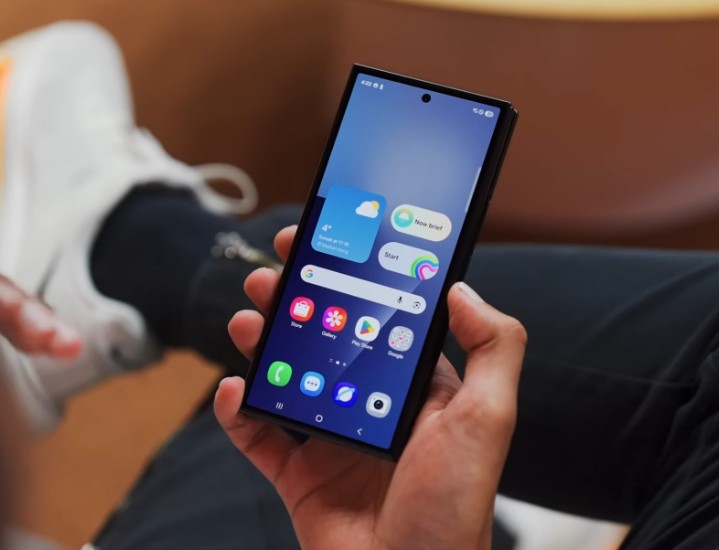
Samsung has officially revealed the Galaxy Z TriFold, its first-ever tri-fold smartphone, marking a major milestone in the company’s foldable lineup and a bold response to rising pressure from Chinese rivals.
With Apple also preparing to enter the foldable space, Samsung wants to show it still leads the charge in innovative phone designs.
The Galaxy Z TriFold will land first in South Korea on 12 December, with launches in China, Taiwan, Singapore and the UAE to follow shortly after. A US release is planned for early 2026, though Samsung says further details will be provided at a later time.
The handset will come in one configuration, black, 16GB RAM, 512GB storage, priced at ₩3,594,000, which works out to roughly $2,449.
Tri-Fold Design With a 10-Inch Display
Samsung’s new flagship stands out thanks to its binary inward- folding hinges, letting the phone open out into a 10- inch tablet- suchlike display with a 2160 × 1584 resolution.
It’s slightly lower than an 11-inch iPad but ample enough to feel like a proper tablet when completely spread out.
When folded, the Galaxy Z TriFold measures 12.9 mm. Yes, it’s a touch thicker than the Galaxy Z Fold6 and Fold7, but considering the redundant panel and the more complex hinge mechanism, it’s still unexpectedly movable.
We don’t just follow what’s next. We shape it.
Introducing the Galaxy Z TriFold.
Coming to Singapore soon, exclusively on https://t.co/mV7xyuMHbf.
Stay tuned for more. pic.twitter.com/5tmWURA2dk
— Samsung Singapore (@SamsungSG) December 2, 2025
Samsung says the device is the result of times of engineering work involving flexible OLED technology,multi-panel continuity tests and advanced hinge systems, areas the company wants to cover as rivals step up their game.
A Strategic Release Ahead of a Reshaped Foldable Market
Industry analysts say the device isn’t meant to be a mainstream bestseller straight away. Instead, it’s more of a “look what’s coming next” moment from Samsung.
“Samsung’s first tri-fold model will ship in very limited volume, but scale is not the objective,” said Liz Lee, Associate Director at Counterpoint Research.
She explained that Samsung is using the TriFold to test real-world hinge durability, multi-screen software behaviour, and long-term reliability, all must-solve challenges before multi-fold devices become everyday gadgets.
Lee added that Apple’s expected entry into the foldable category could “significantly reshape market dynamics,” which makes Samsung’s early experimentation “a strategic move to reinforce its technology leadership.”
Multi-Window Apps and a Bigger Battery
Samsung is pitching the TriFold as a device for people who want a phone and a tablet in one. Thanks to its three perpendicular display panels, druggies can run three apps at the same time, turning the device into a mini productivity machine.
It also includes a desktop-style interface, allowing PC- suchlike workflows without demanding an external examiner.
Underneath it all sits Samsung’s biggest battery ever used in a foldable, paired with fast charging that reaches 50% in 30 minutes.
TM Roh, Samsung’s co-CEO and head of the Device eXperience division, said the TriFold reflects “years of work refining portability, performance, and productivity inside a single foldable device.”
Chinese Rivals Raise the Stakes
The timing of Samsung’s tri-fold phone is no coincidence. Chinese smartphone brands have been rapidly pushing the limits of foldable technology.
Huawei launched its alternate-generation tri-fold in September, offering a folded consistency of 12.8 mm, while Honour continues its global expansion with further affordable galère models.
These brands are pushing hard on weight reduction, thin designs, and competitive pricing, areas where Samsung once comfortably held the lead.
With China gaining instigation in the foldable smartphone request, Samsung’s move signals that the company knows the competition is only going to consolidate.
Durability Still the Biggest Challenge for Multi-Fold Devices
The Galaxy Z TriFold comes with an IP48 rating, providing solid water resistance but still limited dust protection, something that becomes more complicated with every additional hinge and layer.
Dust intrusion, crinkle operation and icing apps bear duly across three separate defences remain ongoing challenges for the entire foldable industry. As emotional as the technology is, continuity continues to be a pivotal talking point for consumers.
Although the Galaxy Z TriFold won’t transport in massive figures, it easily signals where Samsung sees the future headingmulti-panel bias that can double as tablets and indeed laptop reserves, all while still folding small enough to fit in a fund.
With Chinese brands accelerating and Apple anticipated to jump in by 2026, the race to define the coming major foldable form factor is officially underway.
And with the launch of the Galaxy Z TriFold, Samsung has made it clear it intends to remain frontal and centre in that race.