


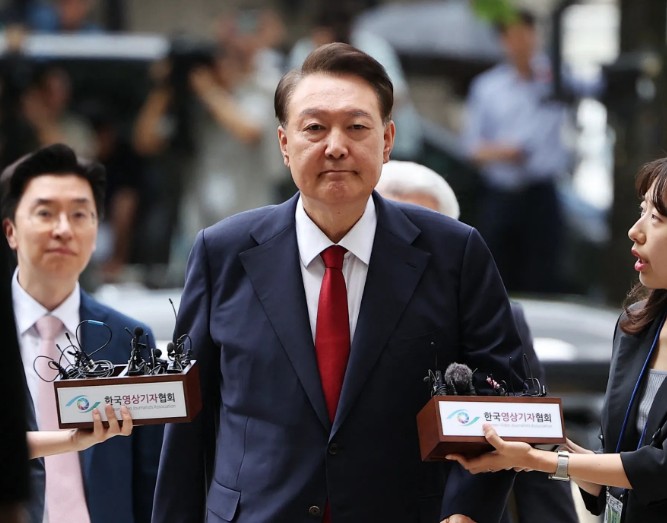
Former South Korean president Yoon Suk Yeol has been sentenced to life imprisonment after a court found him guilty of leading an insurrection linked to his failed martial law attempt in December 2024.
The ruling, delivered in Seoul on Thursday, is one of the most dramatic political verdicts South Korea has seen in decades and has sparked global attention.
The decision matters because it shows how modern democracies respond when leaders attempt to use military force to override political institutions.
It also raises wider questions about constitutional power, political stability, and how far presidents can go during national crises.
What Was Yoon Suk Yeol Found Guilty Of?
A Seoul court ruled that Yoon Suk Yeol played a leading role in an insurrection, accusing him of trying to undermine South Korea’s constitutional system when he declared martial law.
The judge said Yoon’s actions went beyond political decision-making and crossed into deliberate efforts to disrupt the democratic process.
The court also noted that the former president allegedly showed little remorse during proceedings and refused to appear for parts of the trial.
Prosecutors had reportedly pushed for the death penalty, but the court instead imposed a life sentence.
Why Did Yoon Suk Yeol Declare Martial Law in December 2024?
Yoon declared martial law during a late-night announcement on 3 December 2024, claiming that political opponents were threatening national security.
He accused the opposition of engaging in “anti-state activities” and suggested hostile foreign influence played a role. Critics dismissed those claims as political justification for a power grab.
South Korea had not seen martial law in decades, making the move deeply alarming to many citizens and international observers.
What Happened During the Martial Law Crisis?
Shortly after the declaration, troops were deployed to the National Assembly, where lawmakers gather to vote on national policy.
Reports from the night described chaos outside parliament, with police and soldiers clashing with protesters.
Footage aired at the time showed security forces attempting to enter the assembly building, while parliamentary staff used furniture to block access.
#BREAKING | 🇰🇷 — Former South Korean President Yoon Suk Yeol Sentenced to Life Imprisonment for Insurrection
Former South Korean President Yoon Suk Yeol has been sentenced to life imprisonment with labor after a Seoul court found him guilty of leading an insurrection related to… pic.twitter.com/UTU9tlV4JC
— don stefan (@DonStefan____) February 19, 2026
Despite the military presence, lawmakers acted quickly. Around 190 members of parliament reportedly managed to gather and unanimously voted to overturn the martial law order. Yoon later withdrew the declaration within hours.
Who Else Was Sentenced Over the Martial Law Attempt?
Several high-ranking officials linked to Yoon’s administration were also sentenced in connection with the failed bid.
Among them was former defence minister Kim Yong-hyun, who reportedly received a lengthy prison sentence. Other senior figures, including former cabinet ministers and government allies, have also faced serious jail terms.
These convictions suggest South Korea’s justice system has treated the incident as more than a political scandal, instead framing it as a direct constitutional threat.
How Does This Sentence Compare to Other Political Cases in South Korea?
The life sentence is considered extremely severe, even by South Korean legal standards.
Although prosecutors sought the death penalty, South Korea has not carried out an execution for decades, meaning life imprisonment is often the harshest practical punishment.
The ruling also follows a separate conviction earlier this year, when Yoon reportedly received a prison term for attempting to obstruct his arrest after impeachment proceedings began.
Why Does the Yoon Suk Yeol Case Matter to the UK?
For UK readers, the case is significant because it highlights the danger of executive overreach, when leaders attempt to use state power to silence opposition or bypass parliament.
The UK has its own constitutional safeguards, including Parliament, the courts, and public accountability. But political experts often warn that democratic stability depends on leaders respecting limits, not simply having them written into law.
This case also reinforces a wider global message: even heads of state can face criminal consequences if they abuse power.