

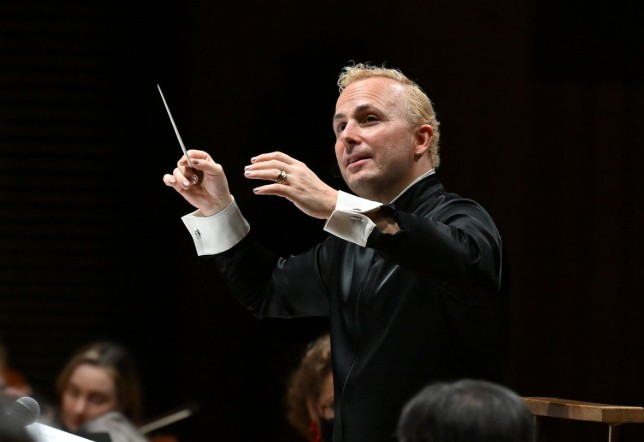
When the Vienna Philharmonic’s New Year’s Day Concert airs across the UK this January, the man on the podium will embody far more than musical excellence.
Yannick Nézet-Séguin’s appointment is the result of a rare convergence of geopolitics, professional trust and split-second decision-making that reshaped one of classical music’s most guarded traditions.
For British audiences familiar with the concert as a fixture of the festive schedule, this marks a notable shift in how the world’s most famous orchestra is choosing its future leaders.
How did Yannick Nézet-Séguin end up leading such a historic concert?
The story begins not in Vienna, but in New York in February 2022, at a moment when Russia’s invasion of Ukraine sent shockwaves through global cultural institutions.
The Vienna Philharmonic moved swiftly to sever ties with conductor Valery Gergiev, a prominent supporter of the Russian president.
His scheduled appearances at Carnegie Hall became untenable almost overnight.
With performances imminent and cancellation looming, the orchestra needed a conductor who was not only world-class but available at extremely short notice.
Por no hablar del look que me lleva, con pendientes incluído.
Que maravilla de señor, Yannick Nézet-Séguin.#ConciertoDeAñoNuevo pic.twitter.com/NOVED6HxVr— Leyzel in Chaos (@AngryLemcn) January 1, 2026
Yannick Nézet-Séguin, then preparing to conduct the Philadelphia Orchestra, answered the call.
Chairman of the Vienna Philharmonic, Daniel Froschauer, later acknowledged the scale of that intervention, describing the conductor’s availability as essential in rescuing the tour at a moment of international uncertainty.
What made the Carnegie Hall concerts so pivotal?
The New York concerts were organised under intense time pressure and political scrutiny. Just days separated the invasion of Ukraine from the performances themselves, leaving little room for artistic reconsideration.
Nézet-Séguin opted to keep the original programme intact, including Rachmaninoff’s Piano Concerto No. 2, arguing that music should remain distinct from political endorsement.
The decision was widely seen as measured and respectful, particularly given the sensitivities of the moment.
Pianist Seong-Jin Cho, flown in from Berlin at the last possible moment, faced his own challenges.
Unable to rehearse late at night due to local regulations, he practised in a hotel bar after hours, an episode that underlined just how improvised the entire operation had become.
Against expectations, the concerts were not only completed but critically praised. More importantly, they forged a renewed artistic bond between Nézet-Séguin and the Vienna Philharmonic.
Why has this relationship grown so quickly?
Although Nézet-Séguin first conducted the Vienna Philharmonic back in 2010, their collaboration had been sporadic for more than a decade. The events of 2022 changed that trajectory.
Since then, he has led high-profile performances with the orchestra, including a major open-air summer concert at Schönbrunn Palace, followed by appearances in Vienna and on tour in California.
These engagements came as the orchestra itself began planning for generational change.
Managing director Michael Bladerer has spoken openly about the need to broaden the Philharmonic’s circle of conductors, moving beyond an older, long-established group to voices capable of shaping the orchestra’s next era.
Nézet-Séguin’s calm leadership under pressure made him a natural fit for that transition.
Who is Yannick Nézet-Séguin in today’s classical music world?
At 50 years old, Yannick Nézet-Séguin occupies a uniquely influential position. He is music director of both the Philadelphia Orchestra and the Metropolitan Opera in New York, while continuing his long-standing role with Montreal’s Orchestre Métropolitain.
Until recently, his reputation was strongest in North America. The fallout from 2022, however, accelerated his European visibility, placing him firmly among the most trusted conductors on the continent.
Why does the New Year’s Day Concert matter so much?
The Vienna Philharmonic’s New Year’s Day Concert is broadcast to millions worldwide, with UK audiences traditionally watching via BBC television and radio.
Rooted in the music of the Strauss family, the concert is as much about cultural continuity as it is about performance.
Only a select group of conductors, including Herbert von Karajan, Claudio Abbado and Riccardo Muti, have been entrusted with this role. Nézet-Séguin’s inclusion places him firmly within that elite lineage.
Reflecting on the appointment, he has described it as deeply emotional, likening the moment to seeing a childhood dream unexpectedly come true.
Will Nézet-Séguin change the concert’s direction?
While tradition remains central, Nézet-Séguin has indicated that future programmes will gently expand beyond the familiar canon.
Plans for upcoming concerts include works by Josefine Weinlich, a 19th-century Austrian composer, and Florence Price, whose symphonic music has gained renewed international recognition.
The approach mirrors a wider shift across European classical institutions: preserving heritage while acknowledging voices long left unheard.
Where do UK audiences follow the story?
Editors may consider embedding BBC News or BBC Radio 3 coverage explaining the history of the New Year’s Day Concert, alongside Sky News cultural analysis on the impact of the Ukraine war on international arts organisations.
Official Vienna Philharmonic announcements shared on Twitter/X would also provide authoritative context.