

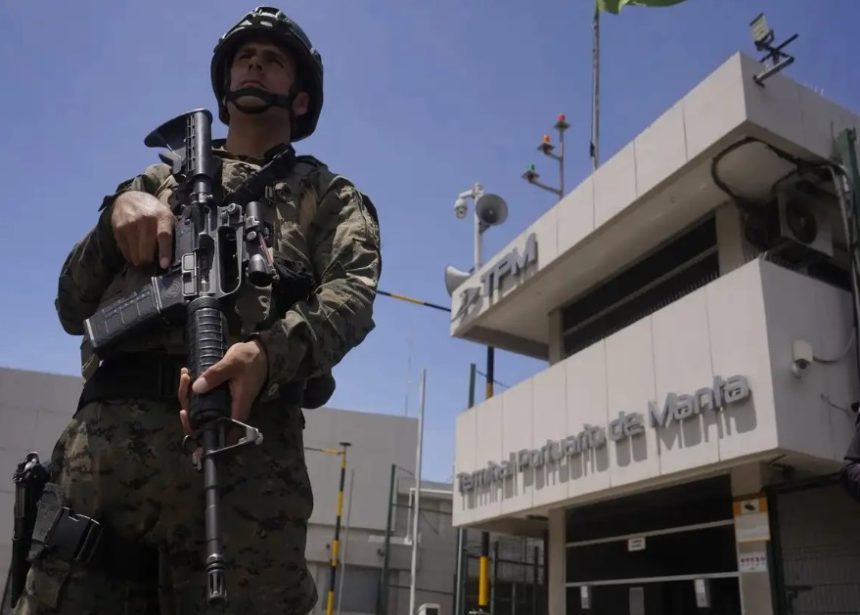
The US military operations Ecuador were confirmed on Tuesday after the US Southern Command announced joint military action with Ecuadorian forces against what it described as “designated terrorist organisations.”
The operations are taking place inside Ecuador, a South American country that has faced rising gang violence and drug trafficking since early 2024.
The move signals an escalation in the US counter-narcotics strategy under President Donald Trump and raises questions about regional stability and global drug routes that ultimately affect countries, including the UK.
The announcement did not include operational details, but US officials said the action forms part of a broader crackdown on narco-terrorist groups operating across Latin America.
Who is behind the US military operations in Ecuador?
The operations involve US forces working alongside Ecuador’s armed forces. The mission is being led by the United States Southern Command, the branch of the US military responsible for operations in Central and South America.
Marine General Francis L. Donovan, Commander of Southern Command, praised Ecuadorian troops in a public statement.
He said: “We commend the men and women of the Ecuadorian armed forces for their unwavering commitment to this fight, demonstrating courage and resolve through continued actions against narco-terrorists in their country.”
On March 3, Ecuadorian and U.S. military forces launched operations against Designated Terrorist Organizations in Ecuador. The operations are a powerful example of the commitment of partners in Latin America and the Caribbean to combat the scourge of narco-terrorism.
Together,… pic.twitter.com/MrkKZcrDbs
— U.S. Southern Command (@Southcom) March 4, 2026
Ecuador’s government has not released detailed figures about troop numbers or locations.
Why has Ecuador become a focus for US counter-drug operations?
Ecuador has seen a dramatic deterioration in security over the past two years. The country has become a key transit hub for cocaine, leaving neighbouring Colombia and Peru, the world’s two largest cocaine producers.
In January 2024, armed gangs stormed a television studio during a live broadcast, taking staff hostage. The violence triggered a state of emergency declared by President Daniel Noboa.
Since then, Ecuador’s government has described the situation as an “internal armed conflict” against criminal groups.
Security analysts say the country’s ports have become strategic routes for cocaine shipments bound for Europe, including the UK.
According to the UK’s National Crime Agency (NCA), cocaine purity and availability in Britain reached record levels in 2023–24, with seizures at major ports such as Felixstowe and Southampton increasing year on year.
How does this fit into wider US military strategy?
Since returning to the office, President Donald Trump has expanded military involvement in anti-smuggling missions across the Caribbean and Pacific.
US officials say around 45 strikes have targeted suspected smuggling vessels in those waters since January. More than 150 people were reportedly killed in those operations, although independent verification remains limited.
Earlier this year, US forces also carried out a controversial raid in Venezuela aimed at detaining President Nicolás Maduro over alleged drug trafficking charges. That mission drew international scrutiny and heightened diplomatic tensions.
Security experts say the Ecuador operation appears to extend that doctrine, using direct military force rather than traditional law enforcement partnerships.
Could this increase regional instability?
There are competing views. Supporters argue that joint military operations could:
- Disrupt trafficking networks
- Strengthen Ecuador’s state authority
- Reduce cocaine supply chains
Critics warn that:
- Militarisation may escalate violence
- Civilian casualties could undermine public support
- Criminal networks may relocate rather than disappear
Ecuador recorded one of the highest homicide rates in Latin America in 2023 and 2024, largely linked to organised crime.
Analysts caution that dismantling entrenched drug networks often requires long-term economic and judicial reform, not only armed intervention.
What has Ecuador said about US involvement?
President Noboa has actively sought closer ties with Washington. He attended President Trump’s second inauguration and has repeatedly called for international support.
During a visit to Ecuador in September, US Secretary of State Marco Rubio said Washington would take strong action against criminal groups if required. He told reporters the US would “blow up” criminal networks if necessary, a remark that drew global headlines.
So far, Ecuador’s government has framed the joint operation as cooperative rather than foreign-led.