


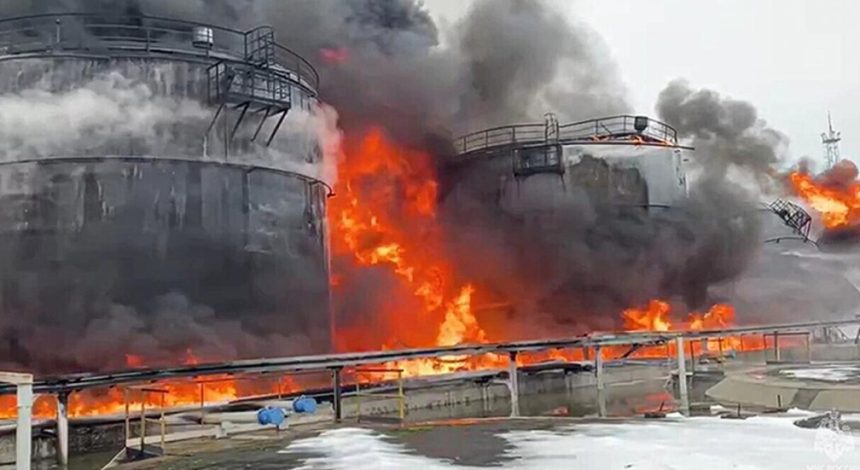
A suspected Ukrainian drone attack has set two oil storage tanks ablaze at Russia’s southern port of Temryuk, according to regional authorities, underlining how the war in Ukraine is increasingly reaching deep into Russian infrastructure.
The fire, which spread across a large industrial area, comes as Moscow also confirms strategic bomber flights near Scandinavia and strengthens military ties with North Korea.
What happened at the Temryuk port?
Regional officials in Russia’s Krasnodar region said two oil product tanks caught fire at the port of Temryuk on Thursday following what they described as a Ukrainian drone strike.
Statements posted on the Telegram messaging app said the flames covered an area of around 2,000 square metres before emergency crews moved in to contain the blaze.
Krasnodar operational headquarters: “Two oil product tanks were damaged as a result of a drone attack. Firefighting units are working at the site. The fire has spread over approximately 2,000 square metres.”
No injuries were reported, and there was no immediate confirmation from Kyiv. Ukraine rarely comments on individual strikes inside Russia, particularly when they involve energy infrastructure.
Why does Temryuk matter in the Ukraine war?
Temryuk is not just a regional port. It plays an important role in oil storage and transport along Russia’s southern maritime routes connecting the Azov and Black Seas.
Damage to facilities like this can disrupt fuel supplies, slow exports, and create pressure on Russia’s logistics network at a time when the war is already straining resources.
Over the past year, Ukraine has increasingly relied on long-range drones to hit refineries, depots, and ports far from the front line.
The alleged strike follows an escalation in fighting after diplomacy stalled, with Russia launching fresh attacks on the Ukrainian capital.
These developments come shortly after Russian strikes on Kyiv following failed peace talks, underscoring how both sides are intensifying pressure away from the front line.
Is this part of a wider pattern of attacks?
The Temryuk incident fits a clear trend seen since 2023, with multiple reported drone strikes on Russian fuel and energy sites.
While each attack may cause limited physical damage on its own, analysts say the cumulative effect is significant, forcing Russia to divert air defences, repair crews, and funding away from the battlefield.
Energy facilities have become a particular focus because they are both economically valuable and difficult to fully protect across Russia’s vast territory.
What else is happening militarily this week?
On the same day as the reported port fire, Russia’s Defence Ministry confirmed that Tu-95MS nuclear-capable bombers carried out what it described as a “scheduled” patrol flight over the Norwegian and Barents Seas.
Russian Defence Ministry: “Strategic bombers conducted a scheduled flight over neutral waters. At certain stages, fighter jets of foreign countries escorted the aircraft.”
Although Moscow did not name the countries involved, such flights are routinely monitored by NATO members, including the UK.
RAF Typhoon jets based at RAF Lossiemouth have previously been scrambled to track similar Russian patrols near UK and Scandinavian airspace.
How does North Korea fit into this escalation?
The broader geopolitical picture is also shifting. North Korean state media reported this week that leader Kim Jong Un visited a nuclear submarine facility and received a message from President Vladimir Putin praising the “invincible friendship” between the two countries.
KCNA quoting Vladimir Putin: “The heroic efforts of North Korean soldiers clearly proved the invincible friendship between our nations.”
Western analysts believe North Korea has supplied Russia with troops, ammunition, and weapons, while Moscow has provided economic aid, food, energy supplies, and military technology in return. This growing partnership is closely watched by the UK and its allies.
What does this mean for the direction of the war?
The alleged Ukrainian drone attack at Temryuk highlights how the conflict is becoming more dispersed and more international in impact.
Strikes on ports and oil facilities, bomber patrols near NATO borders, and new military alliances all point to a war that is no longer confined to eastern Ukraine.
For Western governments, including the UK, these developments raise concerns about escalation, energy security, and long-term regional stability.