


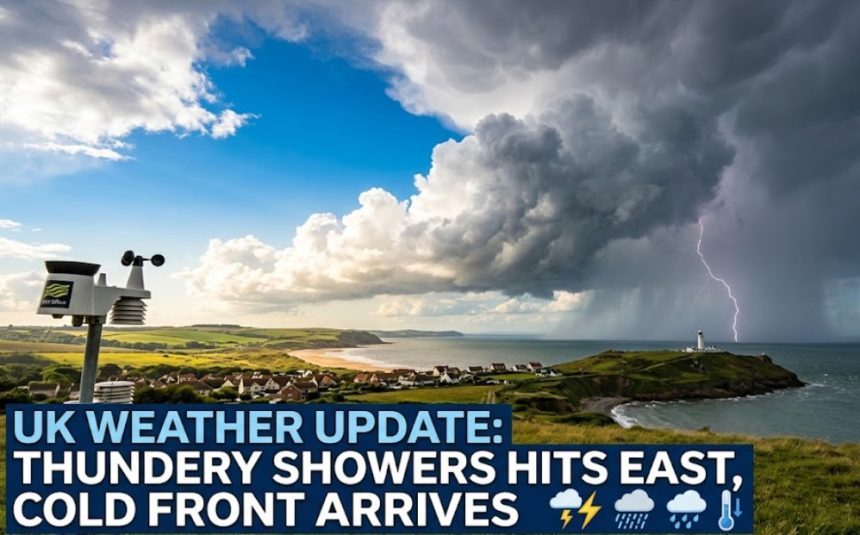
The United Kingdom is currently caught in a meteorological “tug-of-war” as a localized plume of unstable air triggers heavy, thundery showers across eastern counties, while a persistent Atlantic front douses northern Scotland.
After a bright and unseasonably warm start to the week for many in the South, the Met Office warns that the pleasant conditions are set to give way to a “grey, drizzly, and significantly cooler” Tuesday.
For commuters in East Anglia and the Southeast, the primary concern is a sudden shift this afternoon. High-energy cells are expected to develop, bringing not just heavy rain but a genuine risk of lightning and localized surface water flooding.
Meanwhile, the North is bracing for a more prolonged “washout” that will likely impact visibility on major transport routes.
Why Is the Weather Changing So Rapidly Today?
The sudden deterioration in the weather is the result of two distinct systems clashing over the British Isles. A weakening band of cloud and patchy rain is currently moving southeast across the country.
In the South of England, where temperatures climbed into the high teens (reaching up to 19°C in some areas this morning), the heat has provided the fuel necessary for “convective activity.”
As this warmer air meets the advancing cooler front, it is being forced upwards rapidly, creating the perfect conditions for thundery showers.
Morning low cloud and fog lifting to sunny spells on Monday morning across England and Wales ☁️➡️⛅
Scattered showers for Northern Ireland and Scotland 🌦️ pic.twitter.com/JWCZAr9Ebn
— Met Office (@metoffice) April 26, 2026
Unlike the steady rain seen in the North, these showers will be “hit-and-miss” but high-intensity, capable of dropping a significant volume of water in a very short window.
Which Areas Are Bracing for the Worst Conditions?
The impact of this weather shift is being felt most acutely in three specific UK zones:
The “Thunder Zone”: East and Southeast England
Residents in Norwich, Ipswich, Colchester, and Canterbury are on high alert. The afternoon peak is expected to see the heaviest activity.
These thundery bursts could lead to hazardous driving conditions on the A12 and A14 corridors, where spray and sudden downpours are known to reduce visibility to near-zero.
The “Persistent Rain” Belt: Northern Scotland
In contrast to the sudden bursts in the South, Inverness, Aberdeen, and the Highlands are enduring a more traditional Atlantic “soaking.”
This rain is expected to move into the North and East later this evening, turning what was a dry day into a damp and dreary night for millions.
The Coastal Mist Fringe: North Sea Coastlines
As we head into Monday night, the “low and thick” cloud will settle along the eastern seaboard. Towns like Whitby, Scarborough, and Skegness should prepare for “drizzly outbreaks” and thick sea haar (fog) that could persist well into Tuesday morning.
What Are the Experts and Official Bodies Saying?
The Met Office has emphasized the cooling trend that will follow this afternoon’s volatility. Forecaster Greg Dewhurst noted that while the South started Monday “bright and warm,” the transition to a cooler north-westerly flow is inevitable.
“The showers spreading south and east will locally be heavy with thunder at times. By Monday night, these merge into longer spells of rain before the entire country turns cloudy and much cooler for Tuesday.”
From a safety perspective, the Environment Agency has maintained groundwater flood alerts for parts of Berkshire and Oxfordshire, specifically around Great Shefford and West Ilsley.
While the immediate rainfall might not cause rivers to burst their banks, the high groundwater levels mean that any intense thundery downpour could cause immediate surface-water issues for local residents.
How Will This Affect Your Tuesday Morning Commute?
The aftermath of Monday’s thundery activity will be felt most during the Tuesday morning rush hour.
- Visibility Issues: The “low and thick” cloud expected tonight will result in widespread mist and fog. Drivers on the M25 and M1 should expect slower transit times.
- Temperature Drop: After peaks of 19°C on Monday, Tuesday will feel “raw” by comparison. A brisk northeasterly breeze will make it feel several degrees colder than the recorded 13–15°C.
- Public Transport: While National Rail has not issued major alerts, thundery conditions are frequently linked to signaling faults in the Southeast. Passengers are advised to check their journey apps before departing.
Is This Weather Typical for Late April?
While many hope for consistent spring sunshine, this “changeable” pattern is entirely typical for the UK in April.
Data from the Met Office 3-Month Outlook suggests that April 2026 is following a “Near Average” trend for precipitation, though the frequency of these thundery “convective events” is slightly elevated compared to the long-term average for the East of England.
What Should We Expect for the Rest of the Week?
The “grey start” on Tuesday is just the beginning of a more unsettled phase. While the cloud will “slowly lift and break” through Tuesday afternoon to bring some brighter spells, the overall trend is one of declining temperatures.
Looking further ahead toward Wednesday and Thursday, the UK remains under a “mobile” Atlantic pattern. This means more rain is likely to spread into northern and western areas, with the potential for “wintry showers” over the highest peaks of the Scottish mountains as the air remains unseasonably cool.