


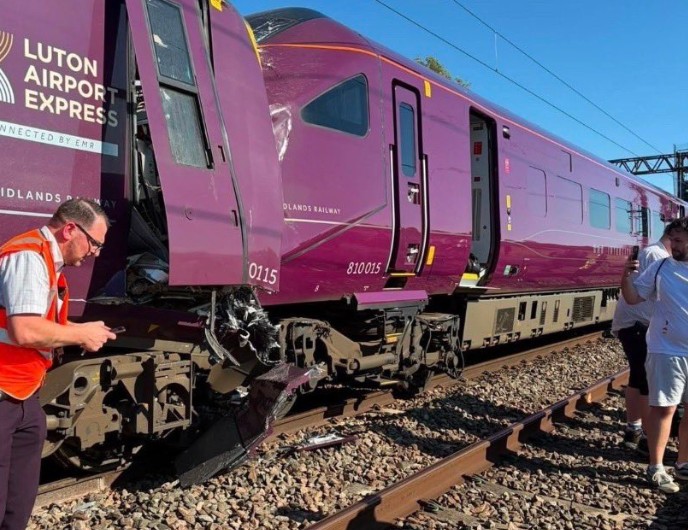
A train driver has died, and 89 passengers are injured, 11 critically, after two London-bound East Midlands Railway trains collided near Bedford on Friday evening. The crash occurred at approximately 5:15 PM at Elstow, triggering a major incident declaration, a massive emergency response, and total suspension of services to London St Pancras.
- Fatal Impact: The driver of the rear train tragically died at the scene; 11 passengers sustained life-threatening injuries, 22 are seriously hurt, and 56 suffered minor injuries.
- The Collision: The 4:40 PM commuter service from Corby collided into the rear of the stationary 3:50 PM Nottingham to London St Pancras service on the Midland Main Line.
- Travel Gridlock: The line remains completely closed, completely disrupting East Midlands Railway and Govia Thameslink Railway services, with a major investigation underway by the Rail Accident Investigation Branch (RAIB).
What Happened During the Friday Commuter Crash at Elstow?
The serious incident unfolded during the height of the Friday evening rush hour just south of the Elstow interchange, between the A421 and the A6 bypass in Bedfordshire.
Two high-speed southbound passenger trains, both operated by East Midlands Railway (EMR), part of the private Transport UK group- were travelling on the same track towards London St Pancras.
🚨 TERRIFYING TRAIN SMASH: Two East Midlands Passenger Trains Collide Near Bedford Leaving Multiple People Seriously Injured! 🚆💥
Latest Update Friday 19 June 2026: A major rail disaster unfolded this evening on the Midland Main Line south of Bedford. Two East Midlands Railway… pic.twitter.com/q8TVw9FcHw
— J Stewart (@triffic_stuff_) June 19, 2026
According to track data and passenger accounts, the leading 3:50 PM train from Nottingham had braked suddenly and come to a halt on the tracks. Moments later, the trailing 4:40 PM service from Corby collided with its rear car.
Witnesses on board described a terrifying impact with zero warning. Passengers reported being thrown violently out of their seats, filling the carriages with thick smoke, shattered glass, and screams. While the carriages remained largely upright, the front cab of the rear train bore the brunt of the crushing impact.
How Will the Mainline Shutdown Impact Regional Transport and Local Budgets?
The collision represents a severe structural shock to the UK rail network. It stands as the first fatal collision between two passenger trains on a British mainline this century, prompting an immediate multi-agency deployment.
The East of England Ambulance Service dispatched more than 20 ambulances, hazardous area response teams (HART), and six air ambulances to the rural crash site.
| Casualty Category | Number of Individuals |
| Fatalities | 1 (Train Driver) |
| Very Seriously Injured | 11 |
| Seriously Injured | 22 |
| Minor Injuries | 56 |
| Total Casualties | 90 |
The wider economic and logistical fallout across the region is substantial:
- The Infrastructure Bottleneck: The Midland Main Line is completely blocked. This route serves as the primary artery connecting London to the East Midlands and South Yorkshire, disabling long-distance links to Nottingham, Derby, and Sheffield.
- Thameslink and Commuter Chaos: Commuter links serving the northern home counties have been severed. Govia Thameslink Railway services running between Brighton, south London, Luton Airport, and Bedford are facing severe delays and cancellations.
- Local Public Services Strain: Local emergency response frameworks have been stretched thin. Nearby NHS infrastructure is under immense pressure; hospital administrators issued an urgent notice directing the public to completely avoid the emergency department at Luton and Dunstable University Hospital unless facing a genuine life-threatening emergency.
What Are Officials and Rail Unions Saying?
The political response to the tragedy was immediate, with leadership demanding a transparent look into network vulnerabilities.
Prime Minister Sir Keir Starmer stated: “Hugely concerning reports of a collision involving two passenger trains near Bedford. First and foremost, my thoughts are with the family of the person who has sadly lost their life, and with those who have been seriously injured. I am grateful to the emergency services for their swift response to this tragic incident.”
Transport Secretary Heidi Alexander commented: “Deeply saddened to hear one person has died and several people injured in the awful train collision near Bedford. Police have declared a major incident and Rail Accident Investigation Branch inspectors are on site. A full investigation will take place.”
Eddie Dempsey, General Secretary of the RMT Union, added: “We are devastated to learn that a train driver and former RMT rep has tragically died as a result of today’s crash between Luton and Bedford. The thoughts of RMT are with their family, friends, colleagues, and the ASLEF trade union at this awful time.”
Why Did Safety Systems Fail and What Happens Next?
The focus has firmly shifted to the formal inquiry overseen by the Rail Accident Investigation Branch (RAIB) alongside the British Transport Police (BTP) and the Office of Rail and Road (ORR).
Investigators face the urgent task of determining why automated safety mechanisms failed to prevent the collision. Following major accidents in the late 1990s and early 2000s, British lines were heavily retrofitted with the Train Protection & Warning System (TPWS) and the Automatic Train Protection (ATP) frameworks, designed to automatically apply emergency brakes if a train passes a red signal or approaches a blocked section too quickly.
A central point of scrutiny will be the rolling stock itself. The leading train from Nottingham was a brand-new Hitachi Aurora (Class 810) bi-mode train, which entered service less than a year ago as part of a major fleet modernisation programme.
The trailing train from Corby was an older model built by Siemens. RAIB teams will extract the data recorders (“black boxes”) from both trains to cross-examine braking metrics, signalling feeds, and low-adhesion track warnings.
The wreckage is expected to remain on the tracks south of Bedford for several days while forensic teams preserve evidence, meaning severe commuter disruption will ripple through the week.