


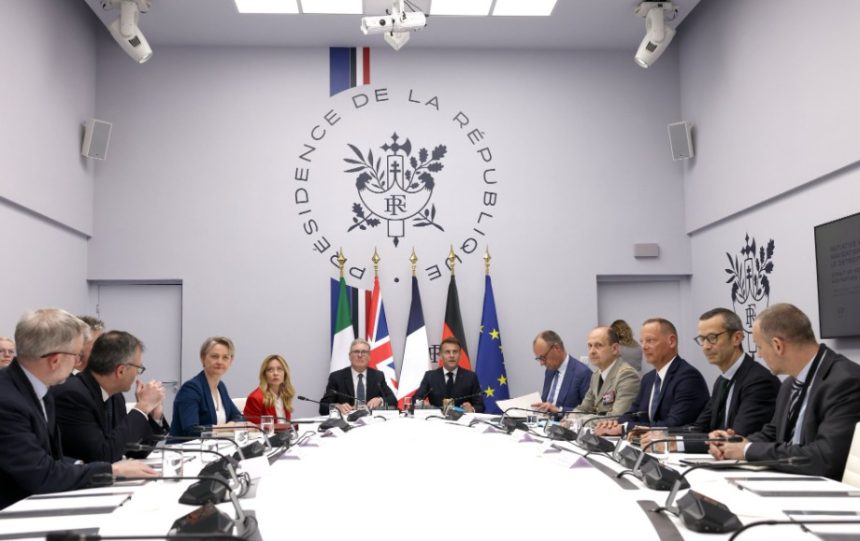
In a decisive move to stabilize global markets and secure the UK’s energy future, Prime Minister Keir Starmer has announced that the United Kingdom and France will lead a new multinational maritime mission in the Strait of Hormuz.
The announcement, made early Saturday following an emergency video conference with 49 nations and the International Maritime Organization (IMO), signals a major escalation in European diplomatic and military efforts to prevent a permanent closure of the world’s most vital oil artery.
The mission, described by Number 10 as “strictly peaceful and defensive,” arrives at a critical juncture.
While a fragile 10-day ceasefire between Israel and Lebanon has allowed for a temporary opening of the Strait, the underlying conflict between the US and Iran remains unresolved, with a separate truce set to expire on April 22, 2026.
For the British public, the success of this mission is not just a matter of foreign policy; it is a direct attempt to curb the “Hormuz Inflation” that has sent UK petrol and heating costs soaring since February.
Why has the UK-France Alliance stepped in now?
The joint leadership of London and Paris marks a significant shift in regional security dynamics. Following the US and Israeli strikes on Iran on February 28, 2026, the subsequent blockade of the Strait led to a 20-million-barrel-per-day disruption in oil flow.
With US President Donald Trump adopting a transactional stance, stating that reopening the waterway “is not America’s job” alone and maintaining a blockade on Iranian ports, the UK and France have moved to fill the leadership vacuum. This builds on earlier commitments where the UK pledges military force to stabilize the region.
Prime Minister Starmer accused Tehran of “holding the world’s economy to ransom,” while French President Emmanuel Macron warned that the disruption has had “very severe consequences” for food and energy security across the European continent.
🇫🇷🇬🇧 France and Britain have announced a joint naval mission aimed at protecting commercial shipping in the Strait of Hormuz, to be activated once conditions stabilize following US Iran talks.
They say discussions are ongoing with more than 50 countries, with further details… pic.twitter.com/OXWPq5QYXr
— WAR (@warsurv) April 17, 2026
Where is the Impact Being Felt Across the United Kingdom?
While the naval assets will be deployed to the Persian Gulf, the “front line” of this crisis is visible across British transport and energy infrastructure:
- The Port of Milford Haven: The UK’s primary gateway for Qatari LNG (Liquefied Natural Gas) has seen a 60% reduction in arrivals, threatening industrial gas supplies in Wales and beyond.
- Northwood Headquarters: The UK’s permanent joint headquarters in Hertfordshire is set to host a high-level military planning conference next week to finalize the mission’s rules of engagement.
- UK Petrol Forecourts: Between February 28 and late March, petrol prices in the UK rose by 14p per litre, while diesel spiked by 29p, placing immense pressure on logistics firms and commuters from Cornwall to the Highlands.
Who is Backing the Mission?
The coalition, dubbed the Strait of Hormuz Maritime Freedom of Navigation Initiative, has already gained the “ready to contribute” status of over a dozen nations.
- The UK Government: Prime Minister Starmer confirmed that military planning is being “accelerated” to ensure the mission can deploy “as soon as conditions allow.”
- Germany: Chancellor Friedrich Merz highlighted a “broad consensus” among the 49 summit participants, stressing that the mission must ensure “toll-free” passage, countering Iranian attempts to “privatize” the strait through transit fees.
- Italy: Prime Minister Giorgia Meloni confirmed Italy’s readiness to send naval assets, pending parliamentary approval, noting that 20% of global oil and gas passes through the narrow 21-mile waterway.
- Iran’s Response: Tehran’s Foreign Ministry stated the strait is “completely open” for the duration of the current ceasefire, but only along a “coordinated route” overseen by Iranian ports.
How Will This Mission Affect the UK Public and Economy?
The House of Commons Library and the Bank of England have both issued warnings regarding the economic fallout of the Hormuz crisis.
The primary objective of the UK-France mission is to provide the “maritime reassurance” necessary to lower the following risks. Concerns remain high as Cooper warns of energy risk for domestic consumers if the waterway is restricted again.
| Economic Factor | Impact Recorded (March 2026) | Target Post-Mission |
| UK Inflation (CPI) | Projected to hit 3.5% in Q2 | Return to 2% target |
| Brent Crude Oil | $120+ per barrel | Stabilization below $85 |
| Energy Bills | 75% increase in wholesale gas | Prevention of the July Price Cap hike |
| Shipping Insurance | Record “War Risk” premiums | Normalization of maritime trade |
What are the Next Steps for the Royal Navy and the French Navy?
The mission is not an immediate deployment of a battle group but a tiered security response:
- London Summit (Next Week): Military planners will meet at Northwood to coordinate ship-sharing and “safe passage” corridors.
- Mine Clearance: Specialized UK mine-hunters, such as those typically based in Bahrain, will lead efforts to clear “unattributed” sea mines found in commercial lanes.
- The April 22 Deadline: The coalition is preparing for the possibility that the US-Iran ceasefire expires without a long-term deal in Islamabad. If hostilities resume, the UK-France mission will transition into providing active naval escorts for merchant tankers.