

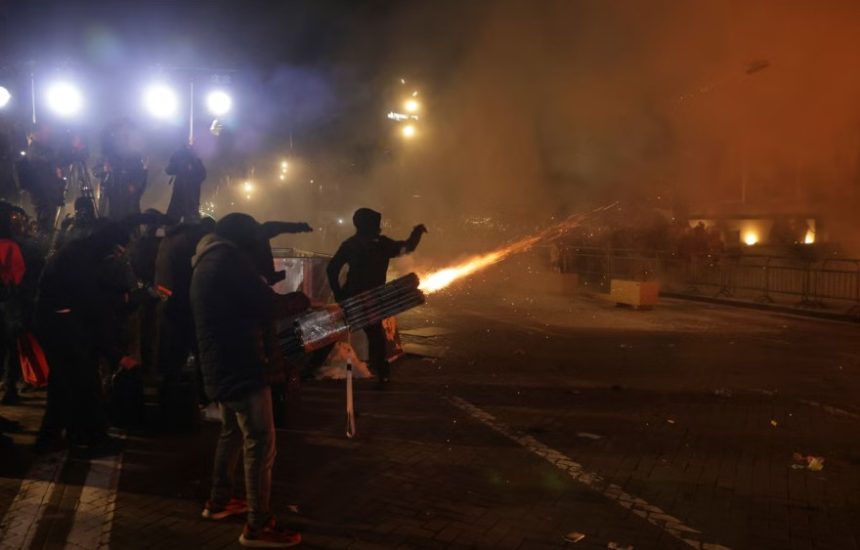
Violence broke out during an anti-government protest in Albania’s capital, Tirana, on Tuesday night, after thousands of opposition supporters gathered in the city centre demanding the resignation of Prime Minister Edi Rama and his government.
Riot police used tear gas and water cannons to disperse crowds after protesters threw Molotov cocktails, fireworks, and flares near key government buildings.
The latest unrest has once again pushed Albania’s political crisis into the spotlight, raising concerns over public trust, corruption allegations, and the country’s hopes of joining the European Union.
What happened at the anti-government protest in Tirana?
The protest unfolded in central Tirana and attracted thousands of demonstrators, making it one of the most significant public gatherings against the government in recent months.
The atmosphere quickly turned tense as protesters confronted police lines and targeted state property.
Witness accounts and official statements suggest protesters threw incendiary devices and flares in the direction of officers and government buildings.
Police responded by firing tear gas into the crowd and using water cannons to force demonstrators away from restricted areas.
Authorities deployed more than 1,300 police officers in an effort to prevent damage and keep control of the city centre. Despite the heavy presence, clashes still escalated as the protest continued into the night.
Why are people protesting against Prime Minister Edi Rama?
The protest was driven largely by anger over corruption allegations involving senior members of the government.
Much of the opposition’s criticism has focused on Deputy Prime Minister Belinda Balluku, who also serves as Albania’s Minister for Energy and Infrastructure.
Violent clashes between protesters and police during a protest against corruption organized by the opposition in Tirana. Around 16 police officers were injured.
The video shows the moment police arrest protesters.#Albania #Tirana #protest #election pic.twitter.com/bv8WwPCbZ8— Mili Xhani (@milixhani) February 10, 2026
Anti-corruption prosecutors have accused Balluku of interfering in public procurement processes, with claims that certain companies may have benefited unfairly from construction and infrastructure contracts.
Opposition figures argue the allegations represent deeper issues inside the Albanian state, accusing the government of protecting senior officials rather than allowing transparent legal accountability.
Prime Minister Rama has resisted calls to dismiss Balluku, while political opponents have demanded that parliament lift her immunity so prosecutors can pursue legal action.
Who is leading the demonstrations, and what are they demanding?
The main force behind the protests is Albania’s opposition Democratic Party, led by former Prime Minister Sali Berisha.
Speaking to supporters, Berisha described the demonstration as a “peaceful uprising” and accused the government of undermining the justice system.
However, Berisha remains a divisive figure. Critics point out that he has faced corruption accusations in the past, which weakens the opposition’s moral authority in the eyes of some voters.
Even so, the size of the protests suggests a significant portion of the public remains deeply frustrated with Albania’s political direction.
Many protesters have called not only for Balluku’s removal, but for Rama himself to step down, arguing that the current leadership has lost credibility.
How serious were the clashes and what happened afterwards?
The violence resulted in multiple injuries and several arrests. Police reported that at least 13 people were detained, while several others required hospital treatment, including officers and demonstrators.
The clashes also caused damage around parts of the city centre, including near government buildings, though authorities moved quickly to regain control of the area.
This was not an isolated event. Albania has seen similar protests in recent months, with previous demonstrations also ending in violence after protesters threw rocks and incendiary devices.
Each incident has fuelled further public debate over whether Albania is heading toward deeper political instability.
What are analysts saying about Albania’s political crisis?
Political analyst Mentor Kikia suggested that the protests are unlikely to force immediate political change, mainly because Albanian voters have grown distrustful of both major political sides.
He argued that many citizens feel trapped between two political forces they do not fully trust, believing that corruption has shaped both the government and opposition over many years.
This growing frustration, analysts say, has created a climate where protests are becoming more common, but real reform remains difficult to achieve.
The wider issue appears to be not just one corruption case, but a deep national feeling that Albania’s political system repeatedly fails to deliver accountability.
Why does this unrest matter for Albania’s EU membership ambitions?
Albania has said it hopes to complete its EU accession process by 2027, but membership depends heavily on meeting strict standards around the rule of law, transparency, and the fight against corruption.
European institutions have repeatedly stressed that Albania must show credible progress in tackling high-level corruption and strengthening the independence of its courts.
Violent protests, rising political confrontation, and accusations of interference in justice processes could slow that progress.
If Albania cannot convince EU officials that it can enforce accountability without political pressure, its membership ambitions may face delays.
What does this mean for UK?
Although the clashes happened outside the UK, events in Albania often attract British interest due to wider European security concerns and ongoing political discussions around migration.
The UK has closely monitored Albania in recent years, particularly as the country has become part of the public debate on irregular migration routes into Europe.
If Albania experiences prolonged unrest or political uncertainty, it could place further pressure on the economy and increase the number of citizens seeking work or stability abroad.
For UK policymakers, instability in the Balkans also matters because the region plays an important role in European security, organised crime prevention, and diplomatic cooperation.