


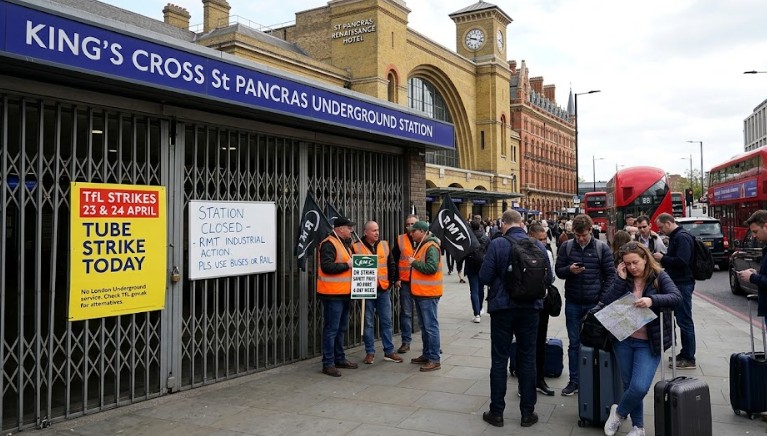
London’s transport network is braced for a second consecutive day of severe disruption as members of the RMT union continue 24-hour strike action across the London Underground.
Commuters across the capital have been warned to expect “significant disruption” from midday today, Thursday, 23 April, as the dispute between Transport for London (TfL) and the Rail, Maritime and Transport (RMT) union remains deadlocked.
The walkout, which coincides with St George’s Day, follows a similar stoppage on Tuesday. With nearly half of the Underground’s driving force on the picket lines, the dispute centres on a controversial plan to compress the working week, a move the union claims prioritises cost-cutting over driver safety and fatigue management.
Why are the Tube Strikes Happening?
At the heart of the standoff is a TfL proposal to transition drivers to a voluntary four-day working week. While the headline sounds like a benefit for workers, the RMT has branded the scheme a “fake four-day week” and a “Trojan horse” for worsening conditions.
The TfL Proposal:
- Compressed Hours: Drivers would work their current 35–36-hour week over four days instead of five.
- Increased Flexibility: TfL claims this brings the Underground in line with other modern rail operators and provides staff with an extra day off.
- Voluntary Basis: Management insists no driver will be forced to switch from the traditional five-day roster.
The RMT Objection:
- Safety & Fatigue: The union argues that longer shifts, some reaching up to 8 hours and 45 minutes of driving time, will lead to dangerous levels of fatigue in deep-tunnel environments.
- Shift Imposition: RMT General Secretary Eddie Dempsey has accused TfL of a “U-turn,” claiming they are now seeking to impose these rosters regardless of worker opposition. As the London tube strike today intensifies, both sides remain far apart on a resolution.
- Work-Life Balance: Drivers have expressed concerns that they could be notified of their shift start times as late as 3:00 AM, making childcare and family planning impossible.
Which Tube Lines are Closed?
The strike action is not uniform, but the strategic choice of lines has crippled cross-city travel. Large-scale suspensions are focused on “safety-critical” sections where RMT membership is highest.
Total Suspensions and Severe Disruptions:
- Piccadilly Line: No service across the entire line.
- Circle Line: No service across the entire line.
- Waterloo & City Line: Fully suspended.
- Metropolitan Line: No service between Baker Street and Aldgate. Limited service on the rest of the line.
- Central Line: No service between White City and Liverpool Street (the core section through Central London).
Hi,
Thanks for getting in touch. The Central line is in service between Stratford and Wanstead. https://t.co/DCSaEYU7ww
There are delays due to the earlier strike action. You can check before you travel at https://t.co/DCSaEYU7ww. You can also use the TfL Go App. for real-time…
— TfL (@TfL) April 22, 2026
Major Transport Hubs Impacted:
- King’s Cross St Pancras: Severe crowding as passengers divert to the Victoria Line (which remains operational but delayed).
- Waterloo & Stratford: Major delays as commuters flood the Elizabeth Line and Jubilee Line as alternatives.
Who is Saying What? Official Statements from the Frontline
The rhetoric between City Hall and the unions has sharpened as the strikes progress into late April.
Transport for London (TfL): Claire Mann, TfL’s Chief Operating Officer, stated: “We have set out proposals for a four-day working week to offer train operators an additional day off at no additional cost.
These changes are voluntary. Those who wish to continue a five-day pattern would be able to do so. We urge the RMT to meet with us rather than disrupt Londoners.”
The RMT Union: Jared Wood, RMT London Transport Regional Organiser, told: “We would like to see a four-day week, but not at any cost.
We cannot accept longer shifts and earlier starts when you’re already tired. TfL is trying to make this ‘worker against worker’ by claiming it’s voluntary, but the reality on the ground is an imposition of new, fatigue-inducing shifts.”
Political Response: Susan Hall, Conservative Leader at City Hall, was blunt in her assessment: “For train drivers who are on £80,000 a year to inflict this on people in our city earning significantly less is callous and obscene. This strike is driving small hospitality businesses to the wall.”
What is the Economic Impact of the TfL Strikes?
The financial toll of the current industrial action is staggering. Fresh analysis from the Centre for Economics and Business Research (Cebr) suggests that the total cost of the strikes across April, May, and June could reach £760 million.
UKHospitality chair Kate Nicholls warned that “commuter footfall is almost non-existent,” causing families to cancel St George’s Day plans in the capital and hitting coffee shops and sandwich outlets particularly hard.
St George’s Day & The Politics of Striking
The decision to strike on 23 April (St George’s Day) has sparked a wider debate within the trade union movement. Some critics argue that striking on a national day alienates the public.
However, the Workers of England Union suggested that rather than striking, unions should be campaigning for St George’s Day to be a statutory Bank Holiday, similar to St Andrew’s Day in Scotland, to give all workers a genuine day off rather than just symbolic disruption.
What Happens Next? Future Strike Dates for May and June
If negotiations at ACAS do not resume, the RMT has already authorised a further series of 24-hour strikes. These are designed to maximise disruption by running “midday to midday,” effectively ruining two days of commuting for each 24-hour window.
Confirmed Future Strike Dates:
- May: Tuesday 19th – Wednesday 20th
- May: Thursday 21st – Friday 22nd
- June: Tuesday 16th – Wednesday 17th
- June: Thursday 18th – Friday 19th