


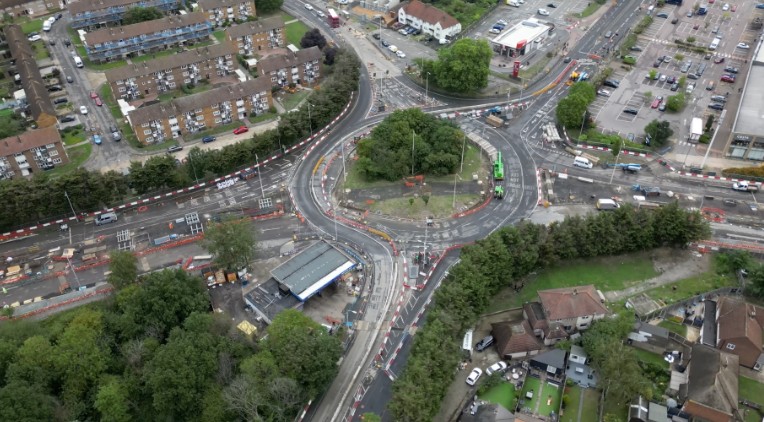
The multi-million-pound restoration of Gallows Corner, Havering’s most critical transport artery, has plunged into further chaos. Despite repeated assurances from Transport for London (TfL) that the junction would return to normal by the end of April 2026, a “last-minute” technical failure has forced an indefinite extension of the closure.
For the thousands of commuters who traverse the A12 and A127 daily, the news is a bitter pill to swallow. What was originally framed as a strategic summer upgrade in 2025 has spiraled into a year-long saga of missed deadlines, “uncharted” utility discoveries, and engineering setbacks that have effectively cut Romford off from its eastern neighbors.
What went wrong with the April 2026 reopening?
The latest delay, confirmed on April 24, 2026, centers on the complex interplay between transport infrastructure and utility resilience.
While TfL has finished the structural “heavy lifting” on the flyover, the junction remains unusable due to critical failures in the water infrastructure beneath.
During the final pressure testing phase, engineers from Essex & Suffolk Water (ESW) identified a lack of “assurance” in the new strategic water main. This pipe is not a minor local link; it is a primary trunk main supplying drinking water to hundreds of thousands of homes across North East London.
Until the main can withstand the immense pressure required for full operation, the road surface above cannot be safely reinstated.
Where is the disruption most severe for Havering residents?
The “Gallows Corner Gridlock” is no longer confined to the junction itself. The closure of this primary link between the London-Essex corridor has caused a ripple effect across the borough:
- The Gidea Park Bottleneck: Traffic diverted through Main Road and Squirrels Heath Road has led to peak-hour standing traffic.
- Harold Hill Isolation: Residents in the North of the borough report that journeys into Romford town centre, which usually take 10 minutes, are now exceeding 45 minutes.
- A12/A127 Diversion Points: Major congestion is being reported at the M25 Junction 28 (Brook Street) as drivers avoid the area entirely.
The “Broken Promise” Timeline: How 2025 became 2026?
The project has been characterized by a shifting finish line. Below is the definitive sequence of events leading to the current stalemate:
- February 2025: TfL confirms the refurbishment of the 1970s “temporary” flyover. The original plan suggests a completion date by September 2025.
- June 2025: Full closure begins. TfL claims the summer timing is chosen to minimize impact during lower traffic periods.
- August 2025: The first major blow. ESW encounters “unforeseeable” ground conditions, including localised shale and uncharted gas mains, forcing a complete redesign of the pipe-laying route.
- November 2025: Julia Lopez MP and local leaders are informed that the reopening is pushed to Spring 2026.
- February 2026: A “firm” deadline is set. In a site visit with Havering Council Leader Ray Morgon, executives promise a full reopening of the flyover and roundabout by the end of April.
- March 2026: Success is teased. The first “milestone” is reached as the 13 new individual bridge sections are fully installed.
- April 24, 2026: The current crisis. Just six days before the promised reopening, TfL and ESW admit that final water main “assurance” tests have failed.
Official Reaction: “Surprise, Surprise”
The political fallout has been swift. Julia Lopez, MP for Hornchurch and Upminster, expressed the community’s weariness, noting that she had been given “emphatic” assurances just weeks ago that the deadline would be met.
“We’ve been here before on this project. Late last night, I got emails from both TfL and ESW to confirm what we were beginning to fear… I will be taking a meeting next week to demand clarity for local people,” Lopez stated.
Scott Haxton, TfL’s Director of Capital Delivery, defended the decision to delay: “All significant TfL works are complete. However, during testing, ESW identified further work needed to ensure the water main is fully assured. We are exploring whether a partial reopening may be possible in the meantime.”
How is this impacting local Romford businesses?
The financial toll on the local economy has been staggering. To mitigate the damage, Havering Council successfully lobbied the Valuation Office Agency (VOA) to grant temporary Business Rates Reductions.
- 10% Reduction: Applied to properties on estates south of the A12.
- 5% Reduction: For businesses on Ashton Road and Tonbridge Road.
- Eligibility: The reduction is backdated to June 23, 2025, the day the junction first closed.
Local traders at the Gallows Corner Retail Park have reported that while the stores remain open, the “navigation nightmare” has deterred casual shoppers, leading to a significant drop in weekend footfall.
What happens next for the Gallows Corner project?
The immediate priority is “disinfection and sampling.” Once the technical fault in the water main is corrected, ESW must:
- Flush the system to remove contaminants.
- Conduct a 48-hour biological sampling to ensure the water is safe for the public.
- Backfill and Surface: Only once the water main is signed off can the final layers of tarmac be laid on the roundabout.
TfL is currently under pressure to open the flyover only as a temporary measure. However, engineers warn that this could lead to safety issues at the merge points where traffic would normally be regulated by the roundabout signals.