


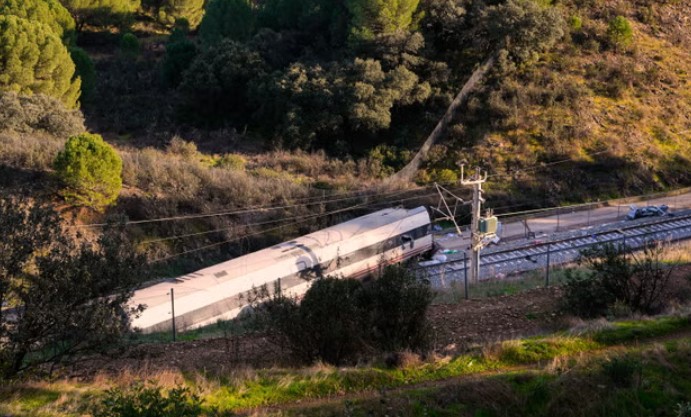
The Spain train crash that killed at least 40 people is increasingly being linked to a damaged section of track, as investigators focus on a worn rail joint that may have triggered the disaster.
The collision happened on Sunday evening near Adamuz in Córdoba, on a busy high-speed line connecting Madrid and Andalusia.
Spanish authorities say the inquiry is still in its early stages, but technical evidence now points to a gap in the track, caused by long-term wear, as a possible starting point for the derailment.
This catastrophe came after initial reports, including an earlier update on the train accident that 21 killed in a high-speed collision, indicated a significant loss of life and dozens of injuries, highlighting how rapidly the situation was evolving.
How did the Spain train crash unfold?
According to emergency services, a Madrid-bound Iryo high-speed train derailed first on a straight stretch of track.
Roughly 20 seconds later, a second train travelling in the opposite direction at around 200km/h struck either the rear of the derailed train or debris left on the line.
The impact caused widespread destruction, pushing carriages off the rails and trapping passengers inside twisted metal.
🚨🇪🇸:Breaking,
Train crash in Spain:
Death toll rises to 41,
The number of people killed after two high-speed trains derailed in Spain has risen to 41, reports the Spanish newspaper ABC.
It is one of the deadliest railway tragedies in Spain in recent years. pic.twitter.com/hiYIUCd7yw
— TW Explains (@TWExplainsNews) January 20, 2026
At least 12 people remain in intensive care, while police have logged 43 missing-person reports across several regions.
Why is a rail joint being blamed?
Investigators examining the site discovered heavy wear on a rail joint, also known as a fishplate, which connects sections of track.
Sources briefed on the investigation say the joint had been deteriorating for some time, creating a small but dangerous gap that widened as trains continued to pass over it.
That defect is now seen as central to understanding why the train lost stability.
RTVE: “What always plays a part in a derailment is the interaction between the track and the vehicle, and that is what the commission is currently looking into.” Ignacio Barrón, Head of Spain’s Commission for the Investigation of Rail Accidents (CIAF)
Were earlier safety warnings ignored?
Questions are also being asked about whether the crash could have been prevented.
Spain’s train drivers’ union SEMAF confirmed it wrote to rail infrastructure operator ADIF in August, warning about what it described as severe wear on parts of the high-speed network.
The union raised concerns about uneven tracks and problems with overhead power lines, claiming these issues were causing breakdowns and damaging trains. Those warnings are now likely to be examined closely as part of the official inquiry.
Why is this crash considered so serious?
With 40 confirmed deaths, the Córdoba collision is being described as one of the worst railway disasters in Europe in 80 years.
What has shocked investigators is that the accident happened on a straight section of line that had been fully renovated in May, at a cost of around €700 million, roughly £600 million.
Andalusian president Juan Manuel Moreno, who visited the scene, called the incident “extremely strange” and said he expected the investigation to provide clear answers.
Was the train itself found to be faulty?
So far, there is no evidence to suggest the train malfunctioned. A source familiar with the inquiry told Reuters that the Iryo train was inspected last week and no problems were found.
At the time of derailment, it was travelling at about 110km/h, well below the speed of the oncoming train involved in the collision.
Iryo only began operating in late 2022, following Spain’s decision to open its high-speed rail network to private competition.
What does this say about Spain’s rail network?
Spain has the largest high-speed rail network in Europe, spanning more than 3,600 kilometres, but it has faced mounting criticism over reliability.
Since 2022, passengers have experienced repeated delays caused by signalling failures, power issues and cable theft, particularly on routes running through remote areas.
The crash has intensified concerns over whether maintenance standards have kept pace with rapid expansion and recent investment.
What happens next?
Transport minister Óscar Puente has confirmed that the high-speed line between Madrid and Andalusia will remain closed until at least 2 February.
Alternative transport arrangements have been put in place while investigators continue their work and engineers assess the damage.
Emergency crews are still recovering bodies from the wreckage, a task made difficult by the weight of the trains and the scale of destruction.
Families still searching for loved ones
As the investigation continues, families of passengers are facing agonising uncertainty. Many have turned to social media to appeal for information, hoping for news of missing relatives.
“We’ve been trying to contact my father since 9pm… My father is my life.” Álvaro Gallardo, searching for his missing father
Hospitals across southern Spain remain filled with anxious relatives awaiting updates.