


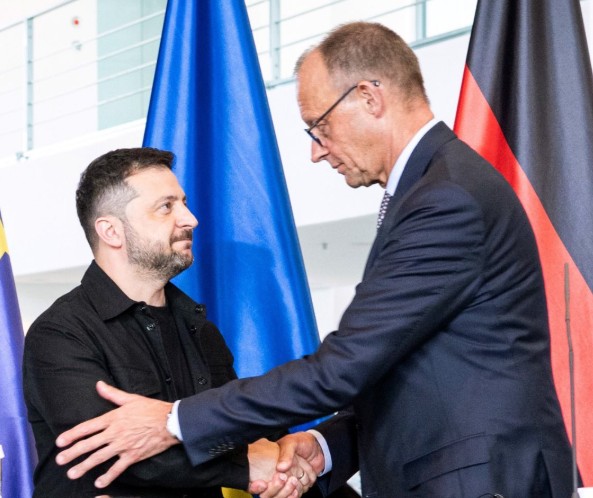
The Russia-Ukraine war reached its fourth anniversary on Tuesday as more than a dozen senior European officials arrived in Kyiv to show public support for Ukraine.
Leaders from across the European Union travelled to the Ukrainian capital to mark four years since Russia launched its full-scale invasion in February 2022.
The visit comes at a critical moment in Europe’s biggest armed conflict since the Second World War, with peace talks stalled and casualty numbers continuing to rise.
Ukrainian President Volodymyr Zelenskyy said the country has defended its independence despite relentless attacks. Meanwhile, European leaders warned that the war’s outcome would shape the continent’s future security.
Who travelled to Kyiv and why does it matter for Europe?
- Volodymyr Zelenskyy
- Ursula von der Leyen
- António Costa
- Alexander Stubb
Seven European prime ministers and three foreign ministers also joined the delegation. European leaders made clear that their own national security is directly to Ukraine’s survival.
Germany’s Chancellor, Friedrich Merz, wrote on X: “For four years, every day and every night has been a nightmare for the Ukrainians, and not just for them, but for us all. Because war is back in Europe.”
Seit vier Jahren ist jeder Tag und jede Nacht für die Ukrainerinnen und Ukrainer ein Albtraum. Und nicht nur für sie, sondern für uns alle. Denn der Krieg ist zurück in Europa. Nur mit gemeinsamer Stärke werden wir ihn beenden. Denn das Schicksal der Ukraine ist unser Schicksal. pic.twitter.com/xAvVPqYplX
— Bundeskanzler Friedrich Merz (@bundeskanzler) February 24, 2026
He added that Europe must remain “strong together” because Ukraine’s fate affects the whole continent.
For the UK, the stakes remain high. Britain has committed billions of pounds in military and humanitarian support since 2022. UK defence officials continue to describe the war as a defining conflict for European stability.
How much territory has Russia gained after four years?
Despite Russia’s larger military and greater resources, progress on the battlefield has slowed significantly.
According to the Institute for the Study of War, Russian forces captured just 0.79% of Ukraine’s territory over the past year.
The fighting has largely turned into a grinding war of attrition, especially in eastern Ukraine’s Donbas region.
President Zelenskyy said: “Looking back at the beginning of the invasion and reflecting on today, we have every right to say: we have defended our independence, we have not lost our statehood.”
He also claimed Russian President Vladimir Putin has “not achieved his goals”.
How many casualties has the Russia-Ukraine war caused?
A report from the Centre for Strategic and International Studies estimated last month that total military casualties, killed, wounded or missing, on both sides could reach 2 million by spring 2026.
If confirmed, that would make it one of the deadliest conflicts involving a major power since 1945. Analysts say Russia has suffered the highest troop losses of any major power in a single conflict since the Second World War.
Civilian casualties remain significant, though exact numbers vary due to ongoing fighting and limited access to occupied areas.
Why are peace talks still stalled?
Diplomatic efforts led by the United States have yet to produce a breakthrough. Talks remain deadlocked over two major issues:
- Control of the Donbas region – Russia occupies most of the industrial east but has failed to take it fully.
- Post-war security guarantees – Ukraine wants binding protections to prevent any future invasion.
European leaders have insisted they must be consulted in negotiations, arguing that any settlement will directly impact EU and NATO security structures.
How involved are NATO and other countries?
The Russia-Ukraine war has grown far beyond a regional dispute.
- NATO countries continue to supply military aid.
- Russia has received support from North Korea, including troops and artillery shells.
- Iran has supplied drone technology.
- Western officials claim China has provided machine tools and electronic components.
The UK remains a key military supporter. British Armed Forces Minister Al Carns described the conflict as: “The most defining conflict in decades.”
How much will rebuilding Ukraine cost?
Reconstruction costs present another major challenge. A joint report by the World Bank, European Commission, United Nations and the Ukrainian government estimates rebuilding Ukraine will cost $588 billion (approximately £460 billion) over the next decade.
That figure stands at nearly three times Ukraine’s nominal GDP for last year, underlining the scale of destruction.