


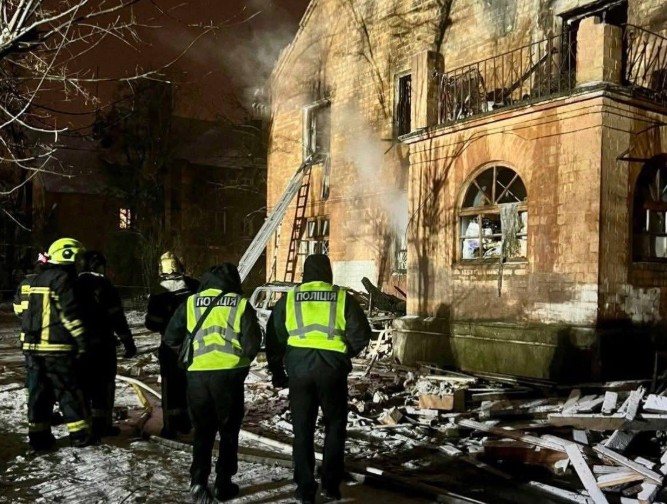
Russia has launched a powerful new wave of overnight attacks on Ukraine, using the rarely-deployed Oreshnik hypersonic ballistic missile in strikes that killed civilians, damaged infrastructure and sent shockwaves across Europe.
Ukrainian authorities confirmed that four people were killed and at least 25 were injured in Kyiv after explosions echoed across the capital for several hours on Thursday night.
The attacks also reached western Ukraine, including the city of Lviv, just kilometres from the Polish border, heightening concern among NATO allies.
What happened during the latest Russian attack on Ukraine?
Russia carried out one of its heaviest combined assaults in recent months, firing dozens of missiles alongside hundreds of drones at multiple Ukrainian cities overnight.
In Kyiv, repeated explosions struck residential areas, damaging apartment blocks and a high-rise building in the city centre.
Emergency services said a paramedic was killed while responding to an earlier strike, after a second explosion hit the same location.
Kyiv Mayor Vitali Klitschko described the tactic as a “double-tap” attack, where a follow-up strike is deliberately timed to target rescuers.
‼️Oreshnik EXPLAINED
Russia’s Oreshnik Missile Hits Ukraine After Putin Residence Attack
Oreshnik (Russian: Орешник, lit. ‘Hazel shrub’), is a Russian intermediate-range ballistic missile (IRBM) characterized by its reported speed exceeding Mach 10 (12,300 km/h; 7,610 mph;… pic.twitter.com/RvdWWVwXpr
— Ignorance, the root and stem of all evil (@ivan_8848) January 9, 2026
“This is a brutal tactic designed to increase civilian casualties,” Klitschko said.
Power cuts were reported across several neighbourhoods, leaving homes without heating as temperatures plunged well below freezing.
What is the Oreshnik missile, and why is its use alarming?
The Oreshnik is an intermediate-range hypersonic ballistic missile, believed to be capable of travelling up to 5,500 kilometres. It moves at extreme speeds and is designed to release multiple inert projectiles during its final descent, causing a series of explosions seconds apart.
This strike marks only the second confirmed use of the Oreshnik missile, after its first deployment against the city of Dnipro in November 2024. Military analysts say the missile’s use is as much psychological as tactical, signalling Russia’s willingness to escalate with advanced weaponry.
Hypersonic missiles are especially difficult to intercept, raising serious concerns about air defence limitations not only in Ukraine but across Europe.
Why does Russia say it launched the strike?
Russia’s defence ministry claimed the attack was retaliation for an alleged Ukrainian drone strike on President Vladimir Putin’s residence in late December. Ukraine has firmly denied carrying out any such operation.
European officials have also expressed scepticism. The EU said there was no evidence to support Moscow’s claim, while former US President Donald Trump stated publicly last week that he did not believe the alleged drone attack had taken place.
Ukraine’s Foreign Minister Andrii Sybiha dismissed Russia’s justification entirely.
“Such a strike close to the EU and Nato border is a grave threat to security on the European continent,” he said, calling it a test of Western resolve.
Why is the strike on Lviv especially concerning for Europe and the UK?
One of the missiles struck infrastructure in Lviv, around 60 kilometres from the Polish border, making it one of the closest major attacks to NATO territory since the war began.
For the UK and its European allies, the location of the strike raises fears of accidental escalation, airspace violations, or miscalculation near NATO borders.
British defence officials have repeatedly warned that attacks in western Ukraine carry wider security implications for Europe as a whole.
How is winter making the situation worse for civilians?
The timing of the attack has intensified its impact. Ukraine is facing severe winter conditions, with temperatures expected to fall to -15°C in some areas.
Russia has consistently targeted power stations, heating systems and water infrastructure throughout the conflict. As a result, millions of Ukrainians have endured rolling blackouts, frozen homes and limited access to basic services.
The UK Ministry of Defence has previously stated that attacks on energy infrastructure are intended to weaken civilian morale rather than achieve clear military gains.
Is Ukraine also striking inside Russia?
While Russia’s assault was ongoing, Ukrainian strikes reportedly disrupted energy infrastructure inside Russia.
Regional officials said around half a million people were left without power in Belgorod, while damage to a power plant in Oryol affected heating and water supplies.
The mutual targeting of energy systems on both sides suggests the conflict is entering a more dangerous phase, with civilians increasingly caught in the middle.