


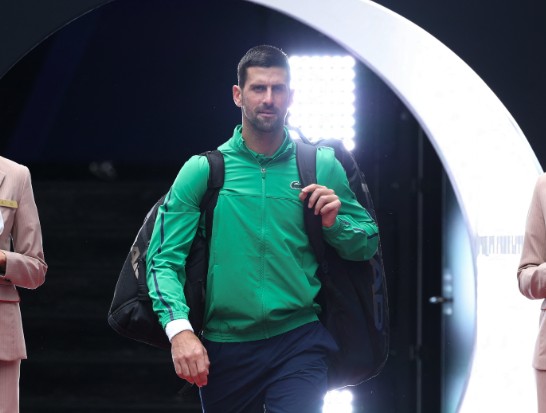
Novak Djokovic clashed with a chair umpire during his Australian Open quarter-final after receiving a time violation warning, a moment that briefly overshadowed his on-court struggles against Italy’s Lorenzo Musetti in Melbourne on Tuesday night.
The incident happened mid-match at Rod Laver Arena, leaving the 10-time champion visibly frustrated, and quickly sparked debate among fans and commentators about umpiring consistency at Grand Slam events.
What exactly happened between Novak Djokovic and the umpire?
The incident occurred late in the first set with Novak Djokovic trailing 4-3 after losing an early break advantage.
As Musetti waited to serve, Djokovic spent extra time searching through his bag for a cap to shield himself from the sun. The shot clock ran down, and chair umpire James Keothavong issued a time violation warning.
Djokovic did not dispute the rule itself but questioned the lack of prior notice. While walking to his chair at the changeover, he confronted Keothavong, asking why he had not received a verbal “heads up” before the warning.
“You couldn’t give me a heads up before warning, no?. I was looking for my cap. You could’ve told me, ‘Hey Novak, you’re over.’” Djokovic said.
The last time Novak Djokovic played Lorenzo Musetti, this happened.
Tennis from the gods.pic.twitter.com/ASW25nqa9d
— Danny (@DjokovicFan_) January 26, 2026
Keothavong stood by his decision, applying the rules as written rather than offering discretion.
Why did the warning frustrate Novak Djokovic?
Time violation rules at Grand Slams are strict. Players have 25 seconds between points once the score is called, with no requirement for umpires to issue informal reminders.
Djokovic argued from a sporting respect angle rather than a legal one, pointing out his long career and the fact that it was his first time delaying the match.
“I’m not saying it’s against the rules. But you could have given me a heads up, as a gentleman,” Djokovic added.
For Djokovic, the frustration appeared to stem from timing and momentum. He had started the match strongly and was visibly unsettled as Musetti began to turn the set around.
How did commentators and broadcasters react?
Former world number one John McEnroe, commentating for Australian broadcaster Channel 9, questioned the call during live coverage.
“He’s just called a time violation on Djokovic. Does he know he’s won this 10 times? All they do is call the score and call the time warnings,” McEnroe said.
McEnroe’s comments echoed a long-running debate in tennis about whether umpires should show flexibility to senior players or apply the rules without exception.
Did the incident affect the match result?
Musetti appeared unfazed and closed out the opening set 6–4 in just under an hour. The Italian overturned a 2–0 deficit by winning four games in a row, capitalising on Djokovic’s growing error count.
First-set statistics highlighted the swing in momentum:
| Player | Unforced Errors (Set 1) |
|---|---|
| Novak Djokovic | 18 |
| Lorenzo Musetti | 8 |
The second set began with three consecutive breaks of serve, with Musetti again gaining the upper hand to take a set-and-break lead.
Djokovic’s sharp start faded as the Italian raised his level and played with greater control from the baseline.
How common are time violation disputes at the Australian Open?
Time violations have become more frequent since shot clocks were introduced to speed up play. At the recent Australian Open, players across the draw have received warnings regardless of ranking or reputation.
Tennis Australia has repeatedly stated that consistent enforcement helps fairness and viewing experience. Officials are instructed not to offer informal countdowns once the clock is active.
What does this mean for Novak Djokovic’s Australian Open campaign?
While the confrontation drew headlines, Djokovic’s bigger concern remained his level of play. Losing focus at key moments allowed Musetti to dictate rallies and control the match tempo.
For UK fans, the incident offered a reminder that even the most decorated champions face strict rule enforcement at Grand Slams, with no allowances for reputation or past success.