


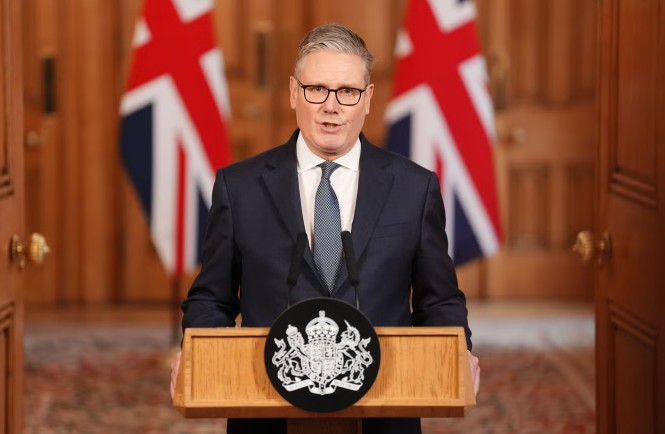
Prime Minister Keir Starmer has confirmed the UK will allow the United States to use British military bases to strike Iranian missile sites after a wave of attacks across the Gulf.
In a video statement released on Sunday night, Sir Keir said Britain would not join offensive strikes on Tehran, but had agreed to a US request to use UK facilities for what he called a “specific and limited defensive purpose”.
The decision follows two days of Iranian missile and drone launches across the region. Some strikes have hit airports, hotels and military facilities in countries hosting British citizens and UK forces. The government says at least 200,000 British nationals are currently in the Gulf region.
The Prime Minister says he must protect British lives and support allies under attack, without dragging the UK into another full-scale Middle East war.
What exactly did Keir Starmer announce?
Keir Starmer confirmed the US formally requested permission to use British bases to target missile depots and launchers inside Iran.
He said: “The US has requested permission to use British bases for that specific and limited defensive purpose.
We have taken the decision to accept this request to prevent Iran from firing missiles across the region, killing innocent civilians, putting British lives at risk and hitting countries that have not been involved.”
Sir Keir stressed that the UK was not involved in the initial strikes on Iran and would not join offensive bombing campaigns now.
My update on the situation in the Middle East. pic.twitter.com/DvsOVcTDMy
— Keir Starmer (@Keir_Starmer) March 1, 2026
Instead, he framed the decision under “collective self-defence”, a principle of international law that allows countries to assist allies under armed attack.
The government has said it will publish a summary of the legal advice underpinning the move.
Why has the UK taken this step now?
The Prime Minister said Iran has launched “sustained attacks” over the past 48 hours against countries that did not directly attack it.
He confirmed:
- Iranian strikes have hit airports and hotels used by British citizens
- A military base in Bahrain was struck, narrowly missing British personnel
- UK forces across the region face increased risk
“Our partners in the Gulf have asked us to do more to defend them, and it’s my duty to protect British lives,” Sir Keir said.
The government believes that destroying missile launchers and storage depots at source is the most effective way to reduce further attacks.
Which UK bases could the US use?
Downing Street has not named specific facilities for security reasons. However, defence analysts have pointed to two likely options:
- Diego Garcia in the Indian Ocean is a long-standing UK-US military facility
- RAF Fairford in Gloucestershire, which can host US long-range bombers
US President Donald Trump previously referenced Diego Garcia as a potential launch point during earlier regional tensions. The Ministry of Defence has declined to comment on operational details.
How is the UK military responding on the ground?
The Prime Minister confirmed that:
- British fighter jets are already airborne as part of defensive operations
- UK forces have successfully intercepted Iranian strikes
- Britain will bring Ukrainian counter-drone experts together with UK specialists to assist Gulf partners
Crucially, British aircraft are not conducting offensive strikes inside Iran. The government maintains that the UK remains in a defensive posture.
Why is this decision politically sensitive in Britain?
Foreign military involvement in the Middle East remains controversial, particularly after the Iraq War. Sir Keir directly addressed that concern: We all remember the mistakes of Iraq. And we have learned those lessons.”
Unlike 2003, the government argues that this action:
- Does not involve regime change
- Does not involve UK-led ground operations
- Is limited in scope
- Is legally justified under collective self-defence
Parliament is expected to scrutinise the move closely in the coming days. Opposition MPs have already called for full transparency over the legal advice.
How many British citizens are affected?
The government estimates that at least 200,000 UK nationals are currently in the wider Gulf region. That includes:
- Long-term residents
- Families on holiday
- Business travellers
- People passing through regional hubs
The Foreign Office has urged British citizens to register their presence and follow updated travel guidance.
Rising tensions could also affect:
- Oil prices and UK petrol costs
- Insurance premiums for travel to the region
- Air travel routes through Gulf hubs