


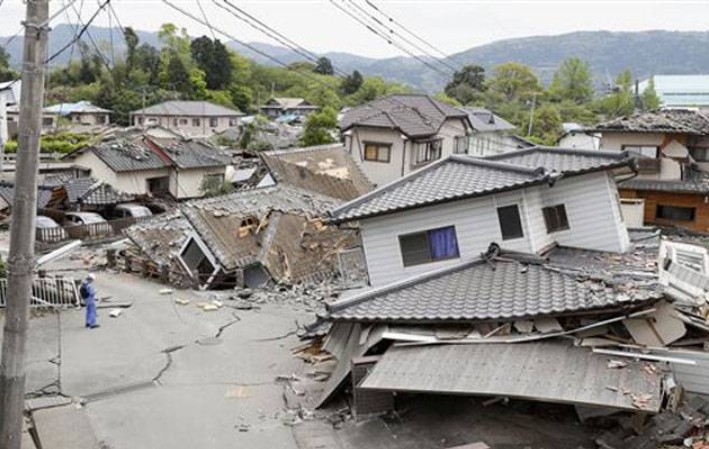
An important magnitude 7.5 earthquake shook northern Japan late on Monday night, triggering strong tremors through several regions and raising critical river warnings along the Pacific coast.
The earthquake struck at 1115 p.m. off the eastern seacoast of Aomori Prefecture, according to NHK. The unforeseen jolt caused considerable concern, particularly for communities near the reinforcement, where residents were prompted to move quickly to advanced and safer ground.
Japan’s Meteorological Agency (JMA) originally measured the earthquake at magnitude 7.6 but later revised it to 7.5 as more accurate seismic data became available.
Officers also streamlined the earthquake’s depth from 50 to 54 kilometres after further analysis, helping experts get a clearer picture of the event.
While the earthquake didn’t induce a large riptide, Japan’s littoral monitoring system recorded some conspicuous changes in ocean conditions.
Japan ka M7.6 earthquake ka live office-cam clip — pure chaos, pure shock. Ek second ka normal… next second sab hil gaya. #japanearthquake pic.twitter.com/SKMA3IGzYw
— Charu Yadav (@YadavCharu28) December 9, 2025
A 70-centimetre surge reached Kuji Port in Iwate, a 50-centimetre rise was observed in Urakawa, Hokkaido, and Mutsuogawara Port in Aomori endured a 40-centimetre swell.
Riffle warnings and advisories remained in effect for several hours as a safety measure before being completely lifted at 620 a.m. on Tuesday.
Government’s Swift Response as Residents React to Overnight Tremors
The Japanese government acted incontinently, cranking up an emergency operation task force within a nanosecond of the earthquake.
Prime Minister Sanae Takaichi arrived at the extremity centre shortly before night, prompting officers to push out clear updates and support evacuation sweats for communities near the seacoast.
“The central government will work closely with local governments and make the utmost effort to carry out measures, such as emergency response, including rescue for the affected people,” she was quoted as saying by NHK.
Chief Cabinet Secretary Minoru Kihara also addressed the public early Tuesday, explaining that damage assessments were still underway.
Exigency brigades, including police units, firefighters, the Self-Defence Forces, and the Coast Guard, were transferred out to carry out deliverance operations, check the littoral structure, and ensure affected neighbourhoods were safe from implicit secondary hazards.
The Prime Minister later verified that 30 people had been injured, many from falling objects or structural damage caused by the strong earthquake temblors.
Seismic Zone Off Japan’s Pacific Coast Remains a Concern for Experts
The earthquake began along a well-known seismic zone off the beachfronts of Hokkaido and northern Honshu, an area constantly covered due to the subduction of the Pacific Plate beneath Japan’s main islet.
This fault has long been linked as a hotspot for strong earthquakes and implicit rift-pitfalls, prompting nonstop monitoring from the JMA and global seismic experts.
This recent event is a reminder of Japan’s vulnerability to natural hazards such as littoral shakes, rill warnings, and unforeseen shifts in seismic pressure beneath the Pacific.
While full damage reports are still being collected, early signs suggest that Japan’s advanced early-warning systems and well-organised disaster response helped mitigate more serious consequences.