


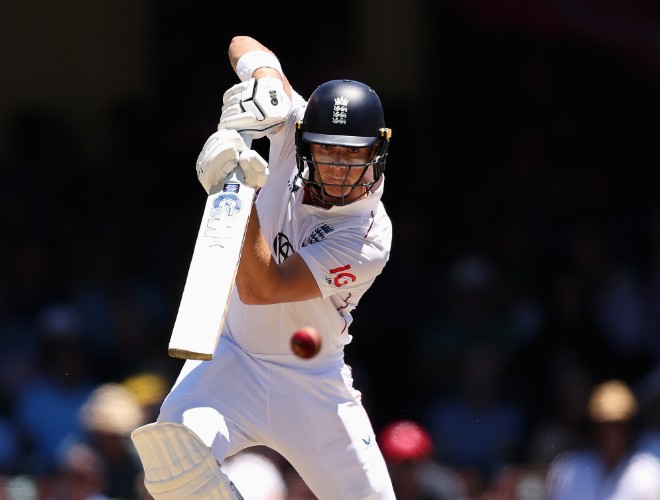
England’s fightback gathered real substance on Day 4 of the fifth and final Ashes Test as Jacob Bethell produced a calm, intelligent half-century, cutting Australia’s first-innings advantage to single figures by Tea at the Sydney Cricket Ground.
At the interval, England were 179 for 3 after 41 overs, still nine runs behind Australia, but firmly back in contention thanks to Bethell’s authority at the crease and growing belief in the dressing room.
Why was the second session so important for England?
England began the afternoon knowing that one poor passage of play could effectively end the contest. Instead, they delivered their most controlled session of the match.
The dismissal of Ben Duckett early after Lunch briefly tilted the momentum Australia’s way, but England responded with discipline rather than aggression.
Bethell absorbed pressure, rotated strike smartly and punished loose deliveries, ensuring the scoreboard kept moving even when boundaries dried up.
Jacob Bethell in Tests:
1st inns: 0 fifties in 6 innings
2nd inns: fifties in 6 innings#AUSvENG #Ashes pic.twitter.com/hUtquwdsDi— ESPNcricinfo (@ESPNcricinfo) January 7, 2026
By Tea, England had added 99 runs in the session for the loss of just two wickets, a significant shift in a Test match that had previously belonged to Australia.
How did Jacob Bethell show maturity beyond his years?
Bethell’s innings was a lesson in modern Test batting without recklessness. Facing a relentless Australian attack on a surface offering variable bounce, the left-hander trusted his defence and left the ball well outside off stump.
He reached his half-century from 87 balls, eventually moving to 79 not out from 132 deliveries, striking ten boundaries without ever appearing rushed.
“That’s a proper Test innings. He’s played the situation, not the scoreboard,” said a commentator on BBC Test Match Special during the Tea break.
For a player still establishing himself at this level, Bethell’s ability to dictate tempo under pressure stood out as one of England’s most encouraging signs of the series.
What summed up Ben Duckett’s Ashes struggles?
Duckett’s dismissal, bowled by Michael Neser with the first ball of the 20th over, brought an end to a difficult Ashes campaign. His 42 from 55 balls showed intent but lacked the longevity England needed at the top.
Across the series, Duckett scored 202 runs in 10 innings, failing to register a single score above fifty.
That statistic places him alongside a small and unfortunate group of Ashes openers who endured extended runs at the crease without a defining contribution.
The numbers underline England’s ongoing search for stability at the top of the order in overseas conditions.
Why was Joe Root’s wicket such a turning point?
When Joe Root was trapped LBW by Scott Boland for six, Australia sensed an opening. Root had already reached 400 runs for the series, making him England’s most reliable batter by some distance.
Although today’s contribution was brief, Root’s Ashes campaign remains impressive, highlighted by centuries at Brisbane and Sydney and an average above 44.
His departure placed responsibility firmly on Bethell and Brook, a challenge they embraced.
How did Harry Brook change the tempo late in the session?
While Bethell provided the foundation, Harry Brook injected urgency. His unbeaten 24 from 22 balls, featuring crisp drives and confident pulls, ensured Australia could not settle into defensive lines.

The Bethell–Brook partnership passed fifty without alarm and allowed England to head into the final session with renewed confidence rather than survival mode.
“England have wrestled control back here,” noted the analysis on Sky Sports Cricket as Tea was taken.
How did Australia build their commanding first-innings lead?
Australia’s advantage was constructed through patience and depth. Resuming Day 4 on 518 for 7, the hosts extended their total to 567, establishing a 183-run lead.
Travis Head’s aggressive 163, combined with Steve Smith’s technically flawless 138, drained England’s bowlers and shifted the match firmly Australia’s way earlier in the game. Contributions from Beau Webster, who made 71, ensured there was no collapse.
What happened earlier in the match?
England’s first innings of 384 was anchored by Joe Root’s superb 160, supported by Harry Brook’s 84 and Jamie Smith’s 46. Australia’s bowlers shared the spoils, with Michael Neser’s 4 for 60 proving decisive.
Australia then responded emphatically with their highest total of the series, putting England under sustained scoreboard pressure heading into the second innings.
What should fans watch in the final session?
England are now within a boundary of levelling the scores, but the match remains finely balanced. Australia will look to strike with the second new ball, while England’s focus will be on converting resilience into a platform for a decisive lead.
Much will depend on whether Jacob Bethell can turn his fifty into a career-defining hundred, and how long England’s middle order can continue to frustrate an experienced Australian attack.