


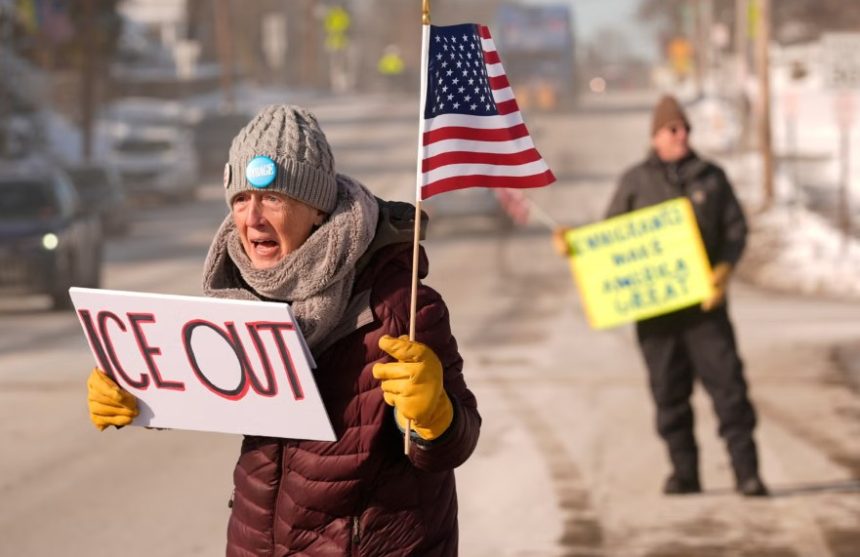
Federal immigration officers in the United States say they detained more than 100 people in Maine this week during a major enforcement push.
But court records and legal filings suggest the reality behind those ICE detentions in Maine is more complex than the official headline claim that officers targeted only the most dangerous criminals.
Immigration and Customs Enforcement (ICE) says the operation focused on serious offenders. Lawyers, judges and local officials say some of those detained had no criminal convictions at all.
The dispute matters because it goes to the heart of how immigration enforcement is carried out, how people are described publicly, and how much trust the public can place in official statements.
What is “Operation Catch of the Day”, and who did ICE detain?
ICE confirmed it detained more than 100 people across Maine this week as part of what it called “Operation Catch of the Day”, a name linked to the state’s fishing industry.
In a public statement, ICE said officers were targeting the “worst of the worst”, including people described as “child abusers and hostage takers”.
Officials said the operation formed part of a wider plan to target around 1,400 migrants in a state of roughly 1.4 million residents, where about 4% of the population is foreign-born.
However, a review of Maine court records shows a mixed picture:
- Some detainees have serious violent convictions.
- Others were arrested but never convicted.
- Several have ongoing immigration cases or entered the US legally.
Do court records back ICE’s “worst of the worst” claim?
Court documents support ICE’s description in some cases, but not all.
One example cited by ICE is Dominic Ali, originally from Sudan. Court records show:
- Convictions between 2004 and 2008 for assault, false imprisonment and violating a protective order.
- A judge described his actions as “nothing less than torture” during sentencing in 2009.
- An immigration judge ordered his removal in 2013.
This case clearly involves a serious violent crime. But other examples raised doubts. ICE highlighted Elmara Correia, an Angolan national, saying she had been arrested for “endangering the welfare of a child”.
Maine court records show a 2023 charge linked to learner driver permit rules, which was later dismissed.
Correia has now challenged her detention. A judge issued an emergency order blocking her transfer from Massachusetts while her case is reviewed.
Are arrests being confused with convictions?
Local officials say ICE’s public messaging may blur the line between arrests and proven criminal guilt.
Portland Mayor Mark Dion, a former county sheriff, questioned ICE’s language during a news conference.
“Was she found not guilty, or are we just going to be satisfied that she was arrested?” Mark Dion, Mayor of Portland, Maine
Dion also highlighted the case of Dany Lopez-Cortez, a Guatemalan national. ICE described him as a “criminal illegal alien” convicted of operating under the influence (OUI).
While OUI is a serious offence, Dion noted it is a common crime in Maine and questioned whether it fits the label “worst of the worst”.
Why are immigration lawyers filing emergency court challenges?
Immigration lawyers say rapid detentions and transfers make it hard for people to access legal help.
Boston-based immigration solicitor Caitlyn Burgess said her firm filed four habeas corpus petitions this week after clients were detained in Maine and moved to Massachusetts.
“The most serious charge any of them faced was driving without a licence. All had pending immigration cases or applications,” Burgess said.
Another attorney, Samantha McHugh, said she represents eight detainees and plans to file more emergency challenges.
“None of these individuals has any criminal record. They were at work or eating lunch when unmarked vehicles arrived,” McHugh said.
Is public backlash growing beyond Maine?
Lawyers and community leaders say the reaction in Maine reflects a wider national pattern.
Similar resistance has emerged elsewhere, including Mass ICE Out protests that led to business closures and organised walkouts as communities pushed back against large-scale immigration enforcement.
Legal experts say such enforcement surges often prioritise speed over clarity, leaving families and employers uncertain about who is being targeted and why.
Have similar concerns appeared elsewhere in the US?
Yes. Immigration lawyers say similar patterns have appeared during enforcement surges in other US states, where:
- People with unresolved immigration cases are detained
- Minor or old offences are highlighted publicly
- Transfers disrupt access to lawyers and courts
Federal court records also show immigration cases involving convictions can remain unresolved for decades or be reopened later.
One detainee featured in ICE materials, Ambessa Berhe, was convicted of cocaine possession and assault in the 1990s and early 2000s.
A federal appeals court later vacated his removal order in 2006, sending the case back for review after recognising his refugee background.