

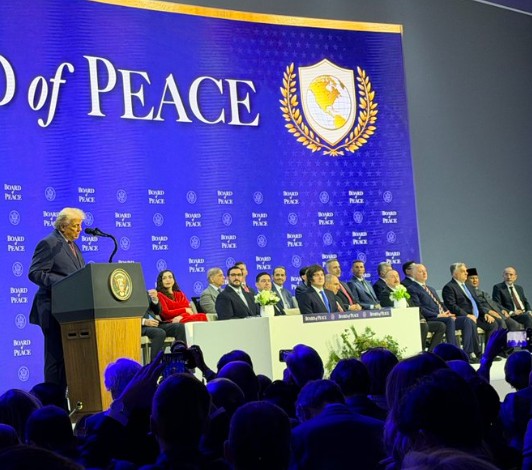
US President Donald Trump has launched a new international body called the Gaza Board of Peace at the World Economic Forum in Davos, claiming the world is now safer and more peaceful than it was a year ago.
The announcement was made on Thursday in Davos, Switzerland, with senior US officials and international leaders present.
According to a senior US administration official quoted by AFP, around 35 countries have agreed to take part after receiving invitations to 60 nations.
The move is significant because Gaza remains one of the most volatile regions in global politics, and any new peace framework could affect Middle East stability, international diplomacy, and UK foreign policy priorities.
What is the Gaza Board of Peace?
The Gaza Board of Peace is being promoted by the Trump administration as a multinational diplomatic forum designed to encourage political coordination on Gaza rather than military escalation.
Speaking to delegates at Davos, Trump linked the board’s launch to what he described as broader global progress.
“Today, the world is richer, safer, and much more peaceful than it was just one year ago,” Trump said during his address, according to AFP.
The timing of the announcement reflects growing international concern over Gaza’s humanitarian situation and repeated failures to secure long-term stability.
By unveiling the initiative at Davos, the White House appears to be seeking both political legitimacy and economic backing from influential global players.
Which countries and leaders were involved in the Davos meeting?
Although a full list of participating countries has not been released, the presence of senior diplomats and heads of state highlighted the administration’s attempt to give the Gaza Board of Peace early international weight.
WATCH: @POTUS takes the stage in Davos, Switzerland, alongside the founding members of the Board of Peace, for a signing ceremony pic.twitter.com/0L7N6fmWw1
— Rapid Response 47 (@RapidResponse47) January 22, 2026
According to AFP, expected attendees included Saudi Arabia’s Foreign Minister Prince Faisal bin Farhan, Azerbaijani President Ilham Aliyev, Armenian Prime Minister Nikol Pashinyan, Paraguayan President Santiago Peña, and Kazakhstan’s President Kassym-Jomart Tokayev.
Their attendance suggests the initiative is not limited to Western allies but is instead seeking support across the Middle East, Eurasia, and parts of Latin America.
Who represented the United States at the launch?
The US delegation underlined how closely the project is tied to Trump’s inner circle. Secretary of State Marco Rubio attended alongside US special envoy Steve Witkoff.
Jared Kushner, the president’s son-in-law and a key overseas negotiator during previous Middle East efforts, was also present.
Kushner’s role has drawn attention in diplomatic circles, given his involvement in earlier regional agreements.
His presence signals continuity in the administration’s approach to Middle East diplomacy, even as the Gaza Board of Peace is presented as a fresh initiative.
How has the Gaza Board of Peace been received internationally?
So far, reactions have been cautious rather than celebratory. While some governments appear willing to engage, others have yet to comment publicly.
.@realDonaldTrump calls on Hamas to release the last remaining hostage in Gaza in his foreign policy address ahead of the signing of the establishment of the Board of Peace pic.twitter.com/WdYCEFlKFL
— Sara Eisen (@SaraEisen) January 22, 2026
Diplomatic observers note that agreeing to “sign on” does not necessarily mean active participation or funding. Past peace initiatives on Gaza have struggled due to deep political divisions, lack of enforcement powers, and mistrust between regional actors.
No details have yet been released on:
-
Funding levels
-
Governance structure
-
Legal authority
-
Timelines for action
Without these, experts say it is too early to judge whether the Gaza Board of Peace will deliver real change on the ground.
Why does this development matter to the UK?
For the UK, any new international framework on Gaza has potential diplomatic and humanitarian implications.
Britain has a longstanding involvement in the region through aid commitments, security cooperation, and its role in international forums.
A US-led initiative like the Gaza Board of Peace could influence UK policy decisions, particularly if London is asked to provide political backing or financial support.
At the time of writing, the UK government has not publicly confirmed whether it intends to engage with the board.