


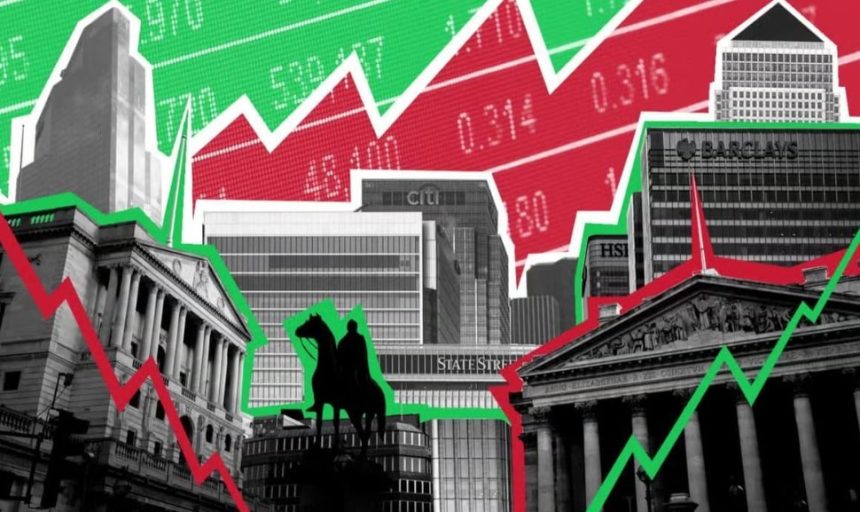
The FTSE 100 looks ready to claw back some of last week’s losses as investors brace for a packed few days of economic news in the UK and abroad.
After a shaky end to the previous week, early market signals suggest a slightly brighter start for London’s biggest companies.
On Friday, the FTSE 100 slipped by 0.6%, losing just over 54 points to close at 9,649.03. Despite this dip, futures trading points to the index opening around 0.4% higher today, offering some cautious optimism for UK investors.
This potential rebound comes even as global stock markets remain under pressure, highlighting the mixed mood currently shaping equity markets, share prices, and investor confidence.
Why are global markets, including the Nikkei 225, under pressure?
Overseas markets have struggled, largely due to ongoing concerns around technology stocks and economic uncertainty. In the US, tech shares continued to wobble on Friday.
The S&P 500 closed 1.1% lower, while the Nasdaq Composite dropped a sharper 1.7%. The Dow Jones Industrial Average also ended the session down by 0.5%.
Asian markets followed a similar path. Japan’s Nikkei 225 fell by more than 1%, while the Hang Seng index in Hong Kong dropped by roughly 1.3%. These losses reflect wider worries about global growth, interest rates, and the outlook for major economies.
As shares across global stock markets dipped, many investors shifted towards safer assets. Gold, often seen as a safe haven during uncertain times, continued its strong run, rising by 1% to trade at record levels near $4,343 an ounce.
What UK economic data could move the FTSE 100 this week?
Closer to home, the UK economic calendar is firmly in focus. Fresh labour market data is due tomorrow, followed by the latest inflation figures on Wednesday. These updates will provide key clues on wage growth, employment levels, and the cost of living.
All eyes then turn to Thursday, when the Bank of England announces its latest interest rate decision. Any hints about future rate cuts or further tightening could have a direct impact on the FTSE 100, sterling, and broader UK stock market sentiment.
For households, these decisions matter too, as they influence mortgage rates, savings returns, and everyday borrowing costs.
Hikma Pharmaceuticals CEO departs
Company news has also caught investors’ attention, particularly at FTSE 100-listed Hikma Pharmaceuticals. The drugmaker said today that its chief executive, Riad Mishlawi, has stepped down by mutual agreement.

Mishlawi had been in the role since September 2023. Said Darwazah, Hikma’s executive chairman and former chief executive, will take on CEO responsibilities with immediate effect.
The company said its 2025 guidance remains unchanged, following a November update in which it warned that margins in its injectables division would be affected by delays in ramping up a new manufacturing facility in Ohio.
Hikma also trimmed its longer-term outlook, scaling back revenue growth expectations for the 2024 to 2027 period to the lower end of its previously stated 6% to 8% range.
Shares in Hikma have had a tough year so far and are down more than 20% year to date, reflecting investor concerns around margins, growth, and execution.
How will new cryptocurrency rules affect UK investors and markets?
Away from traditional markets, the government has confirmed plans to bring cryptocurrencies under tighter regulation.
Under new legislation expected to take effect in 2027, digital assets such as Bitcoin will be regulated more like mainstream financial products.
The Treasury says crypto firms operating in the UK will need to meet clear standards and follow rules overseen by the Financial Conduct Authority (FCA).
The move aims to improve consumer protection and increase trust in a market that has grown rapidly but remains volatile.
Cryptocurrencies have become popular both as alternative investments and as payment methods, but recent years have seen sharp price swings and high-profile collapses, strengthening calls for stronger oversight.
What does all this mean for everyday UK investors?
For now, the FTSE 100 appears poised for a modest bounce, even as uncertainty lingers across global financial markets. With inflation data, jobs figures, and a crucial Bank of England decision all landing this week, market volatility is likely to remain high.
For everyday investors, it’s a reminder that stock markets don’t move in straight lines. Global events, economic data, interest rates, and even digital asset regulation all play their part in shaping share prices and investment confidence.