



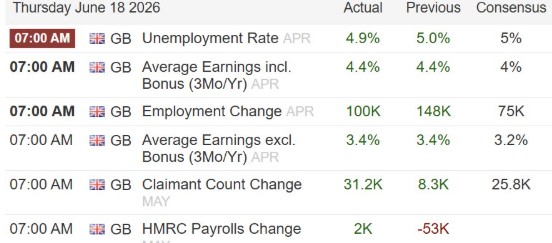
The UK labour market defied analyst expectations as the unemployment rate fell to 4.9% in the three months to April 2026. While payrolled employment remains stable at 30.3 million, a decline in job vacancies to a five-year low of 705,000 signals a cooling economy, leaving the Bank of England in a cautious hold pattern on interest rates.
- Unemployment Decline: The rate dropped to 4.9%, lower than the forecasted 5.0%, with a notable decrease in long-term unemployment.
- Wage Growth Dynamics: Regular pay growth (excluding bonuses) held steady at 3.4%, with a widening gap between public sector (5.1%) and private sector (2.9%) pay increases.
- Vacancy Contraction: Job vacancies fell to 705,000, the lowest level since early 2021, suggesting a cautious approach to hiring across major industries.
Why is the UK Labor Market Showing Resilience?
Despite broader economic headwinds and persistent inflationary pressures, the UK workforce has demonstrated surprising durability. The Office for National Statistics (ONS) reported that total employment increased by 100,000 in the latest quarter, driven largely by a shift toward full-time roles.
We’ve published the latest labour market figures.
Commenting on today’s figures, ONS Director of Economic Statistics Liz McKeown said ⬇️
Read the latest Labour market overview ➡️ https://t.co/hL7W506WAw pic.twitter.com/r5hOyUHVVa
— Office for National Statistics (ONS) (@ONS) June 18, 2026
This resilience is being closely monitored by the Treasury and the Monetary Policy Committee (MPC) to determine if the economy can avoid a significant downturn.
Analysts suggest that the UK Labour Market is softening rather than collapsing, as redundancy levels remain historically low compared to previous cycles of economic uncertainty.
What is the Impact on Public Infrastructure and Local Budgets?
The current labor market environment is creating a significant ripple effect for local authorities and transport bodies. As wage growth in the public sector (5.1%) outpaces the private sector (2.9%), local councils face heightened pressure to maintain competitive salaries while balancing constrained budgets.
For transport networks like TfL and National Rail, these trends manifest as increased operational costs. Recruiting and retaining skilled technical workers to maintain ageing infrastructure has become increasingly expensive.
Consequently, local council budgets are being stretched, often resulting in difficult decisions regarding the prioritisation of capital projects versus essential day-to-day service delivery.
The talent competition is forcing regional leaders to reconsider long-term workforce planning to avoid service disruptions.
How Will the Bank of England Pivot in Response to Wage Data?
The Bank of England’s primary concern remains the stickiness of wage growth. While a 3.4% rise in regular earnings is lower than previous peaks, it remains above the level the MPC deems consistent with the 2% inflation target. Governor Andrew Bailey and his colleagues are currently navigating a meeting-by-meeting approach.
With energy-driven inflation risks still present, the consensus among economists is that the central bank will maintain interest rates at 3.75% for the immediate future to avoid prematurely stimulating an economy that is still exhibiting inflationary symptoms.
Are We Heading Toward a Labor Shortage or Surplus?
The data present a dual reality. While we are seeing a reduction in job vacancies, typically a sign of a surplus of labor, we are also experiencing persistent economic inactivity, with 21% of the working-age population currently outside the labour force. This structural inactivity prevents a true labor surplus from forming.
Under the Equality Act 2010, employers are being encouraged to make reasonable adjustments to bring long-term sick or carers back into the workforce, which the Department for Work and Pensions (DWP) views as the primary mechanism for easing current labour shortages.