


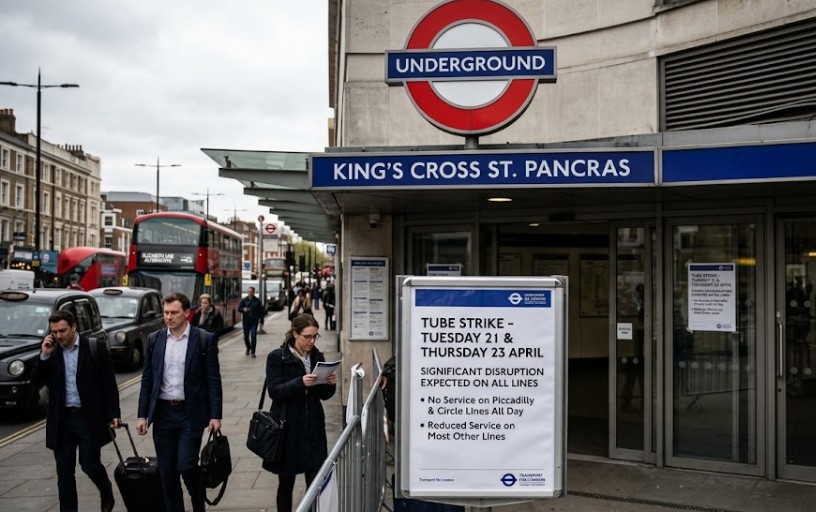
London’s transport infrastructure is facing its most significant challenge of the year as members of the Rail, Maritime and Transport (RMT) union begin a 24-hour walkout today, Tuesday, April 21, 2026.
This industrial action is set to cripple the London Underground network, leaving millions of commuters and visitors searching for alternative routes as a result of the escalating London tube strikes currently affecting the city.
While early morning services operated at near-normal levels, Transport for London (TfL) has warned that the network will begin to wind down rapidly from 11:00 AM.
By midday, commuters will face a “severely reduced” service, with the knock-on effects expected to last until at least the afternoon of Wednesday, April 22.
This walkout is the first in a scheduled series of strikes extending through June 2026, as the bitter dispute over working conditions and shift patterns remains unresolved.
Why are Tube Drivers Striking Today? The Battle Over the 4-Day Week
The heart of this dispute lies in a radical proposal by TfL to modernise driver schedules. Management has put forward a plan for a voluntary four-day working week, which would see drivers’ current 35-hour week compressed into four shifts rather than five.
The TfL Case for Reform
Claire Mann, TfL’s Chief Operating Officer, argues that the move is essential for the network’s future:
- Alignment: It brings the Underground in line with other UK train operating companies.
- Flexibility: It offers drivers an extra day off each week without reducing contractual hours or pay.
- Cost-Neutral: TfL insists the changes can be implemented at no additional cost to the taxpayer.
The RMT’s Safety and Fatigue Concerns
However, the RMT, led by General Secretary Eddie Dempsey, has branded the move as an “imposition” that compromises worker safety. The union’s concerns include:
#tubestrike service info : pic.twitter.com/LSoYgMzL4c
— Tom Edwards (@BBCTomEdwards) April 20, 2026
- Shift Intensity: Longer shifts could increase driver fatigue, potentially endangering passengers.
- Management Power: New clauses could allow management to change shifts with just 24 hours’ notice.
- Work-Life Balance: The union is counter-proposing a 32-hour week over four days, arguing that simply compressing the 35 hours doesn’t go far enough to protect staff wellbeing.
Which Underground Lines are Closed? A Guide to the Disruption
The impact of today’s strike is not uniform across the capital, but certain “black zones” will see a total cessation of service.
Full Line Closures
- Piccadilly Line: No service across the entire line. This will severely impact travel to Heathrow Airport.
- Circle Line: No service all day. Orbital travel in Zone 1 will be nearly impossible via the Underground.
Partial Closures & Gridlock
- Central Line: No service between White City and Liverpool Street, effectively cutting off the West End from the City.
- Metropolitan Line: No service between Baker Street and Aldgate.
- All Other Lines: Expect a “reduced and unpredictable” service. TfL warns that stations may close at short notice due to overcrowding or staff shortages.
How is the Rest of London’s Transport Affected?
While the Underground is the focal point, the displacement of millions of passengers will put immense pressure on other UK transport hubs.
- Elizabeth Line and DLR: These services are running normally but are expected to be exceptionally busy. Passengers are warned they may not be able to board the first three or four trains at hubs like Paddington or Canary Wharf.
- London Overground: Operating normally, though the Windrush line may face separate signalling issues.
- Bus Network: Most buses are running, but a separate strike by Stagecoach drivers will hit eight specific routes (8, 25, 45, 205, 425, N8, N25, N205) later this week, starting Friday, April 24.
What is the Official Guidance from TfL and the Government?
The government and TfL have issued a “last train” warning for tonight. Commuters are advised to aim to be home or at their final destination by 8:00 PM, as services that are running will terminate early to secure trains for the following morning’s reduced start.
“We have approached negotiations with TfL in good faith, but they seem unwilling to make any concessions. This approach does not lead to industrial peace.” Eddie Dempsey, RMT General Secretary
“We urge the RMT to call off this action and continue to work with us on the pilot scheme. We are offering more flexibility at no cost to the driver.” Claire Mann, TfL COO
What Happens Tomorrow and Later This Week?
This strike is part of a “rolling” action. Even when today’s walkout ends at midday on Wednesday, the network will not recover immediately.
- Wednesday, April 22: No service before 7:30 AM. Disruption will continue until at least mid-afternoon as staff and rolling stock are repositioned.
- Thursday, April 23: A second 24-hour walkout begins at 12:00 PM, mirroring today’s chaos.
- Friday, April 24: Network recovery from midday, though the separate bus strike in East London will begin at 5:00 AM.