


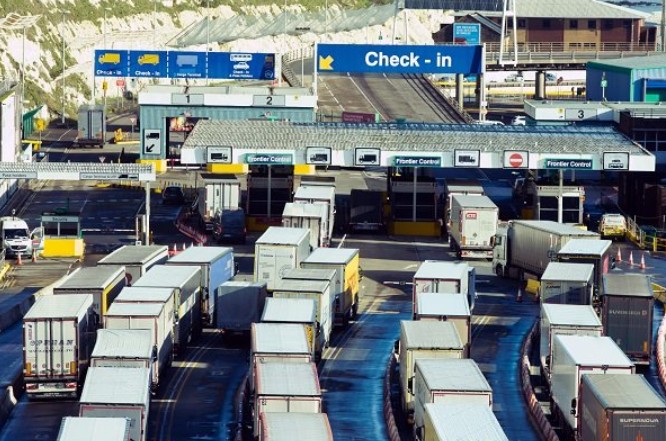
The Brexit haulage crisis has entered a “danger zone” that threatens the very stability of the UK’s internal supply chain. Exclusive data revealed this week shows a staggering 92% increase in business failures within the transport sector.
Between 2021 and 2025, 2,051 haulage companies were forced into insolvency, a haunting figure compared to the 1,068 recorded in the five years prior to the transition.
This is not merely a statistical anomaly; it is a structural collapse. The combination of post-Brexit regulatory friction, the imminent threat of the EU Entry-Exit System (EES), and the global energy shock triggered by the Iran war has created an environment where only the largest, most capital-rich firms can survive.
For the average British household, this means the era of cheap, “just-in-time” delivery is effectively over.
How 2,051 Companies Vanished?
The numbers, brought to light by Al Pinkerton MP, the Liberal Democrat Europe spokesperson, illustrate a sector being squeezed from both ends.
While the COVID-19 pandemic provided a temporary artificial cushion due to government grants, the “Brexit reality” hit home once those supports were withdrawn.
- Pre-Brexit (2016–2020): 1,068 Insolvencies.
- Post-Brexit (2021–2025): 2,051 Insolvencies.
- Percentage Increase: Approximately 92%.
Industry analysts suggest that the “hidden cost” of Brexit, customs declarations, veterinary checks for food products, and the loss of cabotage rights has added roughly £1.5 billion in annual overheads to the UK haulage industry.
Why is the April 2026 EES Deadline Causing Panic in Kent?
While the insolvency figures are backward-looking, the industry is terrified of what happens next. On April 10, 2026, the EU’s new biometric Entry-Exit System (EES) becomes fully operational.
Currently, UK HGV drivers are required to have their fingerprints and facial images registered to enter the Schengen Area. However, there is no facility to do this away from the border.
The Road Haulage Association (RHA) warns that 80% of operators expect a significant downturn in business as Dover and the Eurotunnel face “permanent gridlock.”
“The hit to the UK economy from EES delays could reach £400 million in the first year alone,” warned a coalition of industry bodies.
How Global Conflict Hits the British Pump?
The Brexit haulage crisis is being exacerbated by the Iran war, which has driven up oil prices. With Iran’s military presence in the Strait of Hormuz, global tanker traffic has been throttled, leading to a surge in crude prices.
The Bank of England’s Decision Maker Panel (DMP) survey released this month indicates that UK finance bosses expect to hike prices by 3.5% over the next year, a direct result of soaring energy and transport costs.
For a haulier, fuel represents roughly 30% of total operating costs. When fuel prices rise by 20% in a month, profit margins (which average a measly 1.5%) simply evaporate.
Is the Government Planning a “Customs Union Lite”?
The political fallout is intensifying. Sir Keir Starmer has recently signaled that the “volatile” international situation demands a closer partnership with the EU. However, he remains trapped between economic necessity and political promises.
- The Liberal Democrat Stance: Al Pinkerton MP is calling for an immediate Customs Union negotiation, describing it as the “single biggest lever” to slash Brexit bureaucracy.
- The Labour Position: Despite the crisis, the Prime Minister has reiterated his manifesto “red lines”: no return to the Single Market or the Customs Union. Instead, the government is hoping for a “veterinary agreement” and a “youth mobility scheme” to ease some friction.
Will Supermarket Shelves Go Bare?
The collapse of 2,000+ haulage firms has a direct “cascading effect” on the UK public:
- Price Inflation: As transport firms go bust, the survivors charge more. These costs are passed directly to the consumer at Tesco, Sainsbury’s, and ASDA.
- Product Scarcity: Smaller, niche importers who cannot afford the high freight rates are stopping shipments of European cheeses, meats, and specialty goods.
- Delivery Delays: The loss of 1,000 extra firms means fewer lorries on the road, leading to longer lead times for furniture, electronics, and construction materials.
What is the Survival Strategy for Remaining Hauliers?
For the firms still standing, the focus has shifted from “growth” to “survival.” Many are:
- Downsizing Fleets: Reducing the number of HGVs to lower insurance and maintenance overheads.
- Switching Routes: Avoiding the Dover-Calais bottleneck in favor of longer, more expensive sea routes from Hull or Portsmouth to avoid EES queues.
- Automation: Investing in AI-driven logistics software to squeeze every possible penny out of fuel efficiency.
Common Questions
Why can’t HGV drivers just register their biometrics online?
Currently, the EU EES regulations require the first registration to be done in person at a border crossing under the supervision of a border guard. The UK government is currently lobbying for “remote registration,” but no agreement has been reached.
Is the driver shortage still a factor in 2026?
Yes, but the nature of it has changed. While there are more licensed drivers now than in 2021, many are refusing to do “Continental runs” due to the 15-hour wait times expected at the border, leading to a shortage of drivers willing to work international routes.
Will joining a Customs Union actually solve the crisis?
A Customs Union would eliminate the need for rules-of-origin checks and most tariffs, significantly reducing paperwork. However, it would not necessarily remove the need for the EES biometric checks, which are a security/immigration measure rather than a trade measure.
How much more will my weekly shop cost because of this?
Analysts at the Centre for Business and Economic Research (CEBR) suggest that the logistics crisis could add an average of £180 per year to the typical UK household’s grocery bill by the end of 2026.