
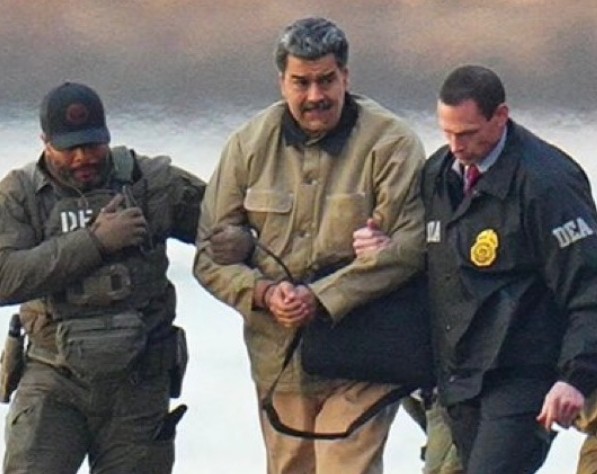
Claude AI, the artificial intelligence model developed by US firm Anthropic, has reportedly been used in a classified United States military operation that led to the capture of Venezuelan leader Nicolás Maduro.
The report claims US special operations forces captured Maduro and his wife during a covert mission last month, before transferring them to the United States to face major narcotics-related charges.
While details remain unclear, the alleged use of Claude AI has sparked renewed debate about how commercial artificial intelligence tools may now influence modern warfare and intelligence operations, even when the AI companies behind them publicly restrict violent or military use.
What happened in the Maduro operation, and when did it take place?
Reports suggest the operation happened last month, when US special forces carried out a targeted raid resulting in the arrest of Nicolás Maduro and his wife.
The couple were reportedly taken out of Venezuela and flown to the United States, where prosecutors intend to pursue wide-ranging criminal charges, including allegations linked to drug trafficking networks.
The U.S. 🇺🇸 used the AI Claude 🤖 in the capture of Maduro 🇻🇪, reports the WSJ 📰.
Anthropic’s developer rules prohibit using the model to “assist violence, develop weapons, or conduct surveillance” ⚠️. It’s possible other AIs were involved in the Pentagon operation as well.… pic.twitter.com/lI5k3FyzJR
— dvmc (@deviumcoin) February 14, 2026
This development matters because it signals a growing shift in how intelligence-led missions may now rely on AI-supported analysis, rather than purely human-driven assessment.
Why is Claude AI being mentioned in this story?
Claude AI is reportedly the AI model used to support parts of the mission planning and intelligence process.
The report claims Claude AI was deployed through a partnership arrangement involving the US defence sector and a data technology platform that supports government intelligence work.

While it is not publicly confirmed exactly how the tool was used, the suggestion is that Claude AI may have helped process, summarise, and interpret large volumes of intelligence data quickly, allowing military decision-makers to act faster.
That type of capability is seen as a major advantage in modern operations where speed often determines success.
Did Anthropic confirm Claude AI was used in the raid?
No. Anthropic has not confirmed that Claude AI was used in the Maduro capture mission.
A spokesperson for the company reportedly stated that it could not comment on whether Claude, or any other AI model, had been used in a specific classified operation.
However, the company has publicly emphasised that any use of Claude must comply with its strict policies.
Does Claude AI allow military or violent use under its policies?
Anthropic’s published usage guidelines state that Claude AI must not be used for:
- violence-related purposes
- weapons development
- surveillance-based targeting
This is where controversy arises. If Claude AI played any meaningful role in assisting a military raid, critics may argue that the tool supported an operation involving force, even if the AI itself did not directly guide weapons or combat decisions.
Supporters, however, may claim the AI simply helped with document processing, intelligence sorting, or summarising information, which could still technically fall within policy boundaries depending on the context.
Is this a sign that AI is now part of modern warfare?
Yes, and this is the bigger story. Military organisations increasingly view AI as a key tool for:
- Analysing intelligence faster
- identifying patterns in communications
- mapping movements or logistics
- supporting mission planning
- Reducing human workload in complex decision-making environments
Even if AI does not “pull the trigger”, its ability to shape decisions could influence the outcome of operations.
This is why AI’s presence in defence settings has become a growing ethical and political issue.
Could this affect UK defence policy and public debate?
It could. The UK has already signalled interest in expanding artificial intelligence across government services and defence-related systems, especially where AI can improve efficiency and reduce administrative burden.
However, any story involving AI use in foreign military raids may increase public concern in Britain, particularly around:
- transparency in government contracts
- accountability when AI supports intelligence decisions
- ethical limits on defence technology partnerships
- whether UK-based AI firms could face similar pressure
If commercial AI becomes normal in military operations abroad, UK policymakers may face questions about where Britain stands on AI involvement in security missions.
What are the risks of using AI tools like Claude AI in defence operations?
The main risks include:
1. Accountability
If AI influences decisions that lead to arrests or casualties, it becomes harder to identify who holds responsibility when things go wrong.
2. Errors and false assumptions
AI models can produce incorrect conclusions, misread context, or generate misleading summaries if the input data is flawed.
3. Ethical drift
Even if AI begins as a “support tool”, governments may push for wider use over time, potentially crossing into more controversial territory.
4. Public trust
People may lose confidence if they believe major military decisions rely on software systems that are not publicly understood or transparent.