


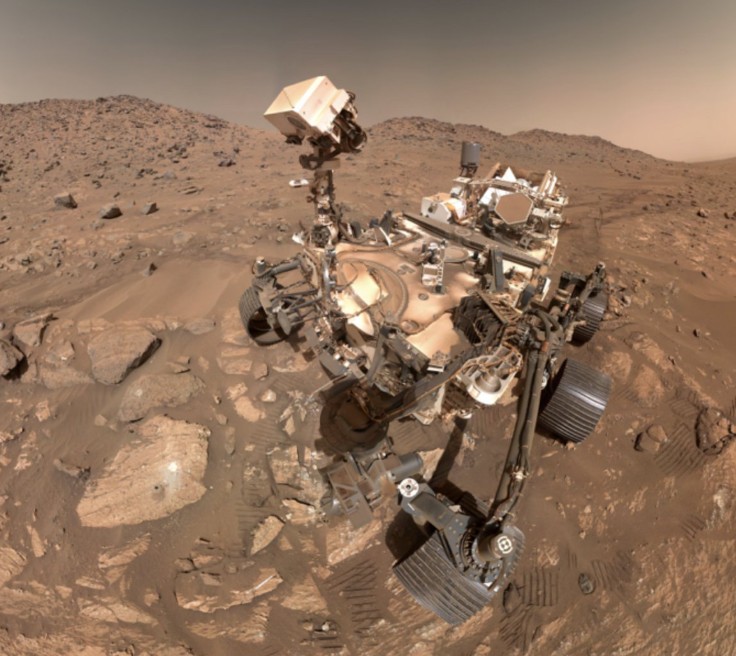
NASA Mars Rover Uncovers “Sapphire Canyon” Rock on Mars – Possible Clues to Ancient Life
In an advance that’s transferring ripples through the scientific community, NASA’s Mars rover has uncovered a rock on the Red Planet that could hold the most compelling hints of ancient life yet.
The rock, named Sapphire Canyon, was collected by the Perseverance rover in July 2024 within the Jezero Crater, a region long suspected to have been home to a lake billions of years agone.
Early analysis reveals the presence of minerals similar to vivianite and greigite, both of which are frequently associated with microbial activity in Earth’s washes and lake sediments.
Scientists have also set up organic composites with structures that mimic natural remnants, arranged in ways that ordinary geological processes are unlikely to produce.
Potential biosignature on Mars: confirmed. ✔️
After a year of scientific review, we are more sure than ever that our Mars Perseverance’s ‘Sapphire Canyon’ sample could contain signs of ancient microbial life. Learn more about the discovery: https://t.co/RMO2UFfnjv pic.twitter.com/IJn8r6udv3
— NASA Solar System (@NASASolarSystem) September 10, 2025
“This is the most confident I have felt in over 20 years of working on Mars missions that we may be looking at a potential biosignature,” explained Joel Hurowitz, planetary scientist at Stony Brook University and lead author of the study.
Hurowitz further pointed out that microbes on Earth often form these minerals as metabolic by-products in wetland or lake environments.
But he was quick to add a note of caution: abiotic processes could also account for the formation of these minerals.
“I would only bet a modest sum that the rock holds proof of past life,” he admitted.
Adding to the excitement, Janice Bishop, senior scientist at the SETI Institute, called the discovery “exciting,” stating that it reinforces the belief that Mars once had conditions conducive to life.
Yet she also warned that non-biological processes are still highly plausible explanations for the patterns seen.
The rock’s surface exhibits peculiar “poppy seed” and “leopard spot” textures, where the minerals are most densely clustered, patterns strikingly similar to microbial sediments found in Earth’s ancient lakes.
While the findings are tantalising, scientists advise that definitive answers could take time.
NASA’s Mars Sample Return charge, designed to bring Mars jewels back to Earth for detailed study, has faced significant lapses.
The charge’s cost has soared past US$11 billion, igniting debates in Washington about whether to cancel it altogether. This isn’t the only challenge facing space exploration efforts.
The UK is also preparing for major changes in its space governance, with plans to collaborate on a DSIT overhaul from 2026, signalling how governments are reshaping space policy to better support long-term missions.
Until samples like Sapphire Canyon and Cheyava Falls are examined using advanced laboratory instruments on Earth, the question of life on Mars is set to remain unresolved.
Janice Bishop reiterated, “The final answer may have to wait until the samples can be analysed on Earth with more advanced technology.”
For now, the discovery has added a fresh subcaste of conspiracy to the hunt for life beyond Earth, proving once again why the NASA Mars rover continues to be one of humanity’s most ambitious and inspiring studies.