

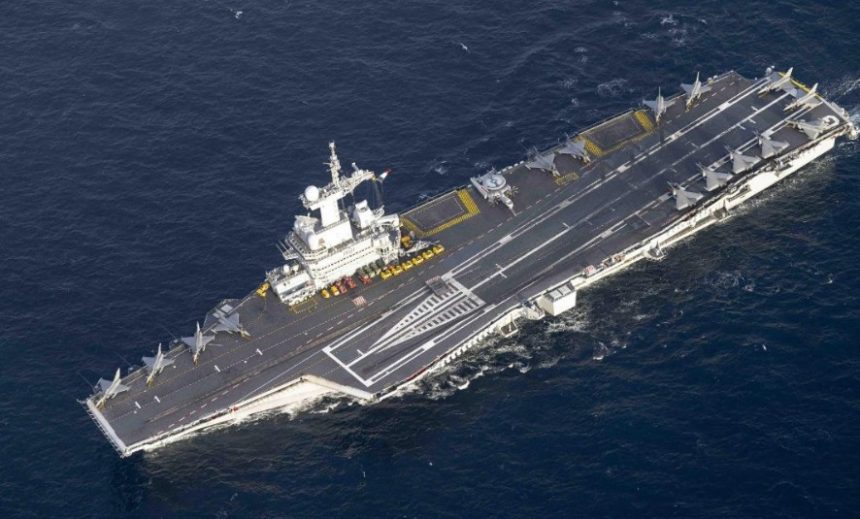
The United States has deployed the largest concentration of US warships and aircraft to the Middle East in decades, with two aircraft carrier strike groups now operating in the region as President Donald Trump intensifies pressure on Iran over its nuclear programme.
The build-up began in late January and accelerated through February, spanning the Arabian Sea, Israel, Jordan and key Gulf bases.
Washington says the move aims to secure a “meaningful deal” with Tehran. Defence analysts warn it could trigger retaliation and destabilise an already fragile region.
This matters for the UK because Britain maintains defence assets in the Gulf, relies on stable energy markets, and often coordinates closely with US security policy. Any escalation could affect fuel prices, shipping lanes and British forces overseas.
How large is the current US military build-up?
The Pentagon has confirmed the deployment of two carrier strike groups:
- USS Abraham Lincoln
- USS Gerald R. Ford
Each carrier operates with guided-missile destroyers and support vessels. Combined, they significantly increase US naval presence in the region.
By late February, the United States had:
- At least 16 warships are operating in or near the Middle East
- More than 100 additional fighter jets, including F-35s, F-22s, F-15s and F-16s
- Over 10,000 additional service personnel
- More than 100 aerial refuelling tankers and 200 cargo aircraft tracked heading towards regional bases
Open-source flight analysts reported intense air traffic movements in mid-February, suggesting rapid reinforcement of air power.
Defence experts say this is the most substantial American naval concentration in the region since the 2003 Iraq invasion, although current troop levels remain far below that war’s peak deployment of roughly 250,000 US personnel.
Why is Washington increasing US warships and aircraft in the region?
President Trump has repeatedly warned Iran that failure to reach an agreement on its nuclear programme could result in military consequences.
He previously stated: “It’s proven to be, over the years, not easy to make a meaningful deal with Iran, and we have to make a meaningful deal. Otherwise, bad things happen.”
The White House appears to be applying maximum pressure, combining diplomatic negotiations with visible military strength.
US officials argue that Iran continues to advance elements of its nuclear capabilities. Tehran insists its programme remains for civilian purposes. The stand-off follows years of strained relations since the US withdrew from the 2015 nuclear agreement.
Unlike previous conflicts, this build-up focuses almost entirely on naval and air assets. Analysts stress there is no indication of a large-scale US ground invasion force assembling.
What military options could the US consider?
Security experts outline several potential scenarios if talks collapse:
- Limited strikes targeting Iranian air defence systems
- Precision attacks on nuclear-related infrastructure
- Broader operations designed to degrade military capabilities
Ali Vaez of the International Crisis Group warned that escalation may not remain contained: “It will be very hard for the Trump administration to do a one-and-done kind of attack in Iran this time around.
Because the Iranians would respond in a way that would make all-out conflict inevitable.”
Michael O’Hanlon of the Brookings Institution noted that long-range bombers could carry out targeted strikes without relying solely on regional carriers.
However, he added that the current positioning suggests preparation for both offensive action and defensive retaliation.
How could Iran respond to a strike?
Iran previously launched missiles at Al Udeid Air Base in Qatar following earlier US strikes, causing limited damage. Analysts believe Tehran may act more forcefully if it perceives a direct threat to its leadership or strategic assets.
Possible retaliation could include:
- Ballistic missile strikes against US bases
- Drone and cruise missile attacks
- Proxy operations through allied groups in the region
- Disruption of shipping through the Strait of Hormuz
Behnam Ben Taleblu of the Foundation for Defence of Democracies said Iran still holds significant missile capability that could reach US positions and Israel.
Any broader confrontation risks pulling in regional actors and escalating beyond a limited exchange.
Why does this escalation matter to the UK?
The UK maintains naval deployments in the Gulf and depends on secure energy supply routes. Around a fifth of global oil passes through the Strait of Hormuz. Disruption there could rapidly increase global oil prices.
The Government is already reviewing contingency planning for British nationals in high-risk areas.
Officials previously outlined emergency measures when nearly 94,000 Britons registered for support during regional tensions, underlining how quickly evacuation planning can escalate, a situation reflected in the UK’s own plans for a potential large-scale evacuation as tensions rose.
In practical terms, UK households could feel the impact through rising fuel costs, higher energy bills and market volatility affecting pensions and investments.
In practical terms, UK households could feel the impact through:
- Higher petrol and diesel prices
- Rising energy bills
- Market volatility affecting pensions and investments
The UK Government has not announced additional deployments, but British forces in the region would likely raise alert levels if tensions intensify.