


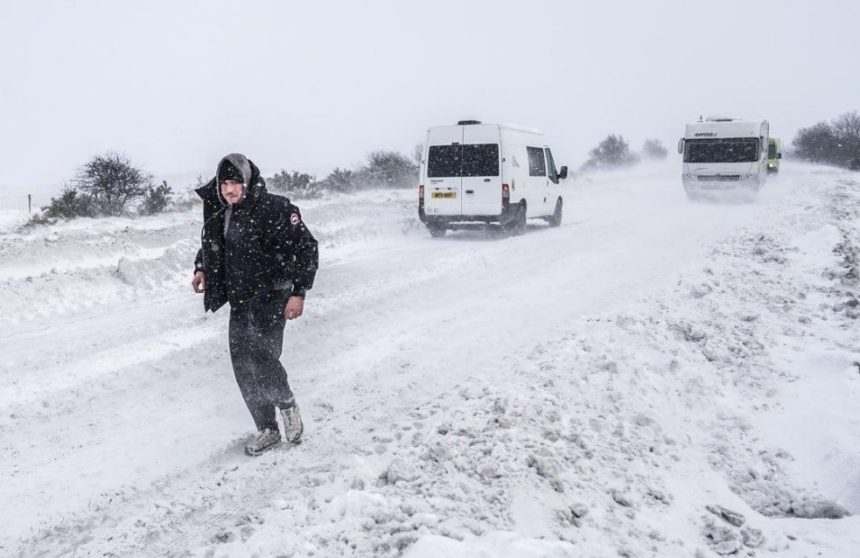
Snow and ice weather warnings remain firmly in place across wide areas of the UK as freezing conditions continue to grip the country.
The prolonged Arctic blast has already led to hundreds of school closures, major travel disruption and the activation of cold weather payments for thousands of households.
The Met Office says conditions will remain challenging over the coming days, with further snowfall expected later this week and warnings likely to stay under review.
What weather warnings are currently affecting the UK?
Yellow weather warnings for snow and ice are in force from Penzance to the Shetland Islands, covering most of England, Wales and Northern Ireland.
More serious amber warnings remain active across central and northern Scotland, where the risk to life and infrastructure is considered higher.
Most yellow alerts are due to expire at 11:00 GMT, but warnings for Scotland will continue into Tuesday night. Temperatures have stayed at or below freezing for several days, allowing ice to build up and snow to settle.
The Met Office expects widespread snowfall of 5–10cm across affected areas, with some higher ground in Scotland seeing totals of up to 15cm.
Yellow warning of snow, ice affecting London & South East England https://t.co/t1d7LJGXII pic.twitter.com/rpbp3YkXpX
— Met Office – SE England (@metofficeSEEng) January 6, 2026
Met Office: “There is a risk of significant travel disruption, power cuts and delays to public services in areas affected by heavy snow.”
Which parts of the UK are being hit hardest?
Scotland is experiencing the most severe conditions, particularly in central and northern regions.
Local authorities in Aberdeenshire, Orkney and Shetland have confirmed that schools will remain closed due to unsafe travel conditions and concerns over staff access.
Northern Ireland has also been badly affected. More than 150 schools are expected to remain closed on Tuesday, with icy roads and heavy snowfall making travel unsafe in many rural areas.
Phillip McCullagh, principal of St Patrick and St Brigid’s College in Claudy, told BBC Radio Ulster: “It’s as bad as I’ve seen it.”
In Wales, school closures have been reported in parts of Carmarthenshire, Neath Port Talbot and Bridgend, while sections of northern and eastern England remain under snow and ice alerts.
How is the weather warning impacting travel and infrastructure?
The ongoing weather warning has caused widespread disruption to transport networks across the UK.
Rail services have been particularly affected in Scotland, where Network Rail warned that “exceptionally deep snow” was limiting the ability of snow ploughs to clear tracks.
Eurostar services were unable to reach the Netherlands on Monday, while LNER advised passengers not to travel between Edinburgh and Aberdeen until at least 14:00 GMT on Tuesday.
Air travel has also been hit. Liverpool John Lennon Airport was forced to temporarily close its runway due to snow and ice before reopening later in the day once conditions improved.
Why have cold-weather payments been triggered?
The sustained period of freezing temperatures has activated the UK government’s Cold Weather Payment scheme across 451 postcodes.
Under the scheme, eligible households automatically receive £25 when local temperatures are recorded or forecast to be 0°C or below for seven consecutive days.
The payments are aimed at helping people on certain benefits cope with rising heating and energy costs during extreme cold spells.
Is more snow expected later this week?
The Met Office has confirmed that further snow is likely on Thursday and Friday, with the potential for fresh weather warnings to be issued.
Snow could fall across England, Northern Ireland and southern Scotland, while southern areas may also face heavy rain and strong winds.
Forecasters warn that the combination of snowmelt and rainfall could increase the risk of flooding in some locations.
What should people do during the ongoing weather warning?
Officials are urging the public to avoid unnecessary travel, particularly in amber warning areas.
Drivers are advised to check road conditions carefully, while households are encouraged to prepare for possible power cuts and to check in on elderly or vulnerable neighbours.